Friday, March 30, 2012

The Hero With A Thousand Faces

Written by Joe the Revelator


Joseph Campbell possesses such a vast knowledge of myth, history, and religion, it's hard to believe this book was written by one man, over the course of one lifetime of study.

Hero with a Thousand Faces is an attempt to put a lens over every heroic tale ever sung for a crowd or chiseled into stone; from Samoan verse to Indian adage, Egyptian gods to Greek legends, Grimm's tales, Aesop's fables, dream collections, the bible, the Qur'an, the teachings of Buddha...A world of myth over the course of thousands of years. These he refines into a few simple rules and formulas.


To speak or not to speak

Before I tried posting about this book, I wanted to fully absorb what I'd read. Hero with a Thousand Faces is a bit daunting in its speech. Campbell's cadence is flowing, old-fashioned, and poetic. While his subjects are broad and make many references to classics in literature, and are composed in lengthy textbook blocks of information. Depending on your reading history, you may have some difficulty chewing through the chapters. But chew you should.

There are also audio books available of Campbell's work. I listened for a few hours after I'd finished Hero, and found I preferred the texts, since it was the notion of his ideas that struck me and not the language he uses. The fast, eloquent speech of the narrator often had me rewinding parts I wanted to hear again, or stopping the tape altogether to think on the author's interpretation of a particular myth. It was good for review, but it may be too high-pace to grasp the material.

Finally, I listened to a few of his classroom lectures which can be found on Youtube or Netflix. These were the easiest to understand, as Campbell was a natural instructor, injecting humor into his stories and always circling the heart of the lesson. But I feel there were much left out, as if his classroom voice wasn't able to hold everything he wanted to say. The book felt more substantial.


A god walks into a bar...

However you decide to peruse Hero with a Thousand faces (I prefer the book) be ready for a rapid-fire course in heroism vs. the human psyche. Or more accurately, why the human mind fixates on a hero and his journey. Why the shaman spins stories for the tribe. Or why dreams so often reflect pieces of mythology.

One would think after hearing so many heroic tales we'd soon grow tired of it. A hero is born. He is prophesized or creates his own prophecy. He is given the Hero's Call. And he takes that first step into the unknown, and from there... Well, this is an oversimplification. But if it's written with slight variations, and adheres to the primary formula Campbell explains, it becomes an instant hit.

During a dinner speech thrown in Campbell's honor, George Lucas once explained that if he hadn't read the book, he'd still be working the kinks out of the first Star Wars script. After reading the hero's journey you may find yourself analyzing every movie, every story you've read, and holding up to this new light. Those that stray from the path often fail to hold the audience, where their hero does something remarkably unheroic.

Wednesday, March 28, 2012

Books I Chose Not to Finish - Part II


The Dresden Files – Turn Coat

The Dresden Files is my guilty pleasure. We all have one. At least mine isn't Twilight *shudder*.

I really only stopped this one because it was that time. This is the eleventh book in a fourteen book series (planned to have twenty installments in the end!), and reading them all straight through is an impossible feat. At some point, you just get tired of the main character. His trenchcoat. His talking skull buddy. His unending snark. But he isn't even the main reason I like the series.

What makes The Dresden Files so endlessly exciting for me are the creative and dangerous antagonists. Of these, though, not all of them are successful at engendering my interest. The last book had the twin threat of the Faerie Courts and Fallen Angels. Imagine the faeries of A Midsummer Night's Dream... The off-putting splendor of Titania, the creepy mischief of Puck. Imagine the eerie magnificence of Queen Mab from old Arthurian legends. These are old characters that are very interesting that you don't often see in fiction. On top of that, putting them in the same book with the corruptible and manipulative Fallen Angels (titled in series as the Knights of the Blackened Denarius), agents of Satan? You have two antagonist groups that are deeply rooted in our culture and religions; learning about them can make the pages fly.

By contrast, the antagonist of Turn Coat (as I determined by reading the first fourth of the book) is a Native-American shapeshifter monster... thingy. It sounded dangerous, but after reading of two previous antagonists which have a significant mythic background, you can color me disappointed. I'll return to it later, like I always do, but The Dresden Files turns me off when its antagonists either are disappointing (werewolves, shapeshifters) or tired (vampires, undead).
.

Galapagos

I believe that this book caught me at the wrong time. Around the time I picked up this novel (my first foray into Kurt Vonnegut, who is a world renowned writer), I was in the mood for an epic, long book with a great attention to detail and setting. Basically, while looking for a Tolkien, I ran into a Vonnegut, which is anything but.

The style of the writing in Galapagos is very sporadic, random, and quirky. It isn't bad, by any means, but it struck me at a time where I really wasn't in the mood for it. Vonnegut is humorous, self-deprecating with his writing, and prone to fantastical and amusing tangents. Is it my style of writing? I don't know. But it sure wasn't at the time.

I think it was supposed to be a murder mystery at the heart of it, but I didn't get very far before I had to try something else. Vonnegut's writing style also wasn't very conducive to me understanding what his overall plot or focus with Galapagos was going to be, even 15-20% into the novel, so pardon my lack of detail as to what the novel is about.
.

Jonathan Strange and Mr Norrell

In my efforts to find an 'epic' that would be detailed, lengthy, and rewarding, I browsed the internet languidly for great 'modern' fantasy books. Of them, I found Jonathan Strange and Mr Norrell to be the most intriguing. Set in Great Britain during the time of the Napoleonic Wars (around 1803-1815), it tells the story of various characters in their efforts to rediscover magic which once (apparently) used to exist. Thus begins a tour of Britain, the ruminations of a bunch of old codgers who write histories of old magic but don't practice it, and a search for the answer of the question: why don't we have magic anymore? In the process, an eccentric magician is discovered (one Mr. Norrell) who decides that he must prove to people that magic exists. But, given that he has been by himself with his books for far too long and thus doesn't really know how to make this happen, he quite mordantly bumbles about playing pranks on the French for the British Parliament, resurrecting dead wives despite the peculiar consequences, and making poorly thought-out deals with faeries.

Now, see, this sounds quite entertaining, and it really is. The writing style has one helplessly echoing the dry wit and tones of a droll British gentleman without even meaning to. But there's something... missing. The overall plot is too vague, too hard to pin down. And the characters aren't relatable, intended instead to be members of a comedy of errors. Consequently, what you get is a series of humorous moments without anything special to keep you around or tie them all together.
.

And this brings me to where I am today. I could keep reading Jonathan Strange and Mr Norrell, but I don't feel like I really want to. Nothing is bringing me back besides the knowledge that I'll likely be amused and temporarily turn my inner voice into an English gentleman. So where to now? I don't know. I just hope that my recent habit of not finishing books will come to an end soon.

Books I Chose Not to Finish - Part I


Funny how close to shameful this feels. I've made it a point of pride for some time that I focus on one book at a time, poring over the pages endlessly until I've finished. I have so many friends who try to read multiple books at once and I've never been a fan of splitting my attention like that. In my experience, it leaves too many books unfinished and prevents one from fully falling into any individual one among the masses.

But, lo and behold, I've been unable to finish a book for what feels like at least two months. Why? I don't know. Yet I want to give each of these books their due. I hope that I will be inspired to go back to a few of them at some point, but there's no guarantee. For now, they'll each have to be content with a mini-review, as I try to assess where they each went wrong for me.
.

The Faded Sun Trilogy

Now this was an interesting find. Recommended by a friend, I read Faded Sun at around the same time I was writing my piece on how alien species are treated in different fictional pieces. Faded Sun was one of those that provided three-dimensional aliens with their own different complexities, personalities, and quirks, refusing to hold to a stereotype while still benefiting from the general guidelines behind one. In a style reminiscent of Dune (lots of sand, immense attention to species and setting detail, complex political machinations), I read the first book and then some of the trilogy before I lost steam.

The problem, for me, was twofold. First off, the pacing of the books was often glacial. The author attempts to achieve a tone that is contemplative, wistful, and slow. She succeeds in this in a way that is remarkable and thought-provoking, but unfortunately for me, she succeeded too well. I got to a point where I was anxious for the plot to move in some substantial way, for the ramifications of characters' actions to reach some crescendo, or for, really, somebody to do something that prevented the book from being an effective way for me to fall asleep. I got to the part where the human and the mri are traveling to a new world, and the author decides to undergo a slow process wherein the human is carefully introduced to small details of the mri culture. So, instead of allowing the reader to pass over the flight sequence in favor of advancing the plot, we are held captive, like the human, to a recurrent Mri Culture 101 class that seems unending.

This would have been more permissible if the alien culture were more interesting. Your mileage may vary on this (for those of you who have read it), but I found the mri culture to be more frustrating than fascinating. Here we have a warrior race that has inexplicably managed to survive despite cultural norms and taboos that seem counterproductive to getting along with other species must less existing at all. I gather that we, as the audience, are supposed to be curious by this fact, which encourages us to learn more about them. But, for me, this made me baffled that they could be so consistently foolish and backwards, lessening my tolerance for cultural lessons.

I plan to come back to this at some point since the aliens known as the regul and one of the other human characters were quite compelling (not to mention the writing style itself), but the incredibly restrained pacing made me want to try something else for some time.
.

Ghost Wars

Ghost Wars is a book that started incredibly strong but then got bogged down very fast. Intended to serve essentially as a detailed history of foreign influence in Afghanistan from 1978 onward, it began with incredible focus. As you read, you get quick back-and-forths between the decisions of the CIA, the off-and-on support of the Pakistanis, and the developments within Afghanistan proper as the Soviets invade in order to retain their influence in the region. There's a lot going on, but the author managed to somehow keep a tight and effective narrative by shining the story spotlight on one individual and event to another.

At least, for a while. Once he introduced the machinations and complexities of Saudi Arabia, Yemen, India, Iraq, so on and so forth, the flow came to a halt. It has been a while since I've actually felt a need to take notes while I read, but I became convinced quite fast that I'd have to if I wanted to keep up. The reader is barraged with an endless cascade of names and is given no indication as to whether these people will be important in the long run of the history or not, leading to an increasingly difficult attempt to keep them all in one's memory banks that is ultimately doomed to failure. Why do I need to care about the particular ideology and nuances of this Saudi Arabian religious organization when the focus is supposed to be on Afghanistan?

I was hooked and then hit a brick wall of details and names that seemed divergent from the overall intention of the book, leading to a loss of interest. Will I return to it? Maybe. But only in hope that the author eventually returns to telling the history in the personal narrative form that was so effective in the beginning.

Go on to Part II

Thursday, March 22, 2012

And Nothing But the Truthiness (Novel 2011)

by DionysusPsyche

In the book written by Lisa Rogak, Stephen Colbert, television personality extraordinaire, reveals his life to us. The popular host of faux news show The Colbert Report and prior anchor on The Daily Show, Colbert's personal life remains largely a mystery to his audience.

The Young Stephen
From the moment America started watching Colbert both on The Daily Show and his spin-off The Colbert Report, people have wondered who the real Stephen is. “My name is Stephen Colbert, but I actually play someone on television named Stephen Colbert, who looks like me and talks like me, but who says things with a straight face [that] he doesn't mean.” When he joined as an anchor, he had his own name, at some point planning to change it over, but never got around to it.

The novel starts before Colbert was born with his parents. His father, James Colbert, made great headway as a doctor in the medical community, and his mother, Lorna dreamed of being a singer and actress. One of Colbert's biggest strengths is his family and hometown in Charlestown, which he references frequently on his show and in the book. “I've got to go home every so often to be recharged by my sun.”

As a young boy growing up, Colbert retreated into a world of fantasy and reading to enhance his current one which was hard. In order to grow as a man, he had to endure loss as a child and come out of it a better person. In high school, he became involved in acting, and that was an excellent use of his talent.
From there, he went on to major in theatre which evolved into his job at Second City, an improvisational comedy company in Chicago where he met Steve Carrell and Amy Sedaris. He eventually landed a spot on The Dana Carvey Show which led to The Daily Show.
The Daily Life
Colbert initially balked at doing news. “I didn't want to...because I hated Good Morning America, and I figured it was going to be the same type of show.” Yet, due to his first child, Colbert accepted the position and realized that he had a knack for news. Back in 1996, the show had just started, was barely heard of, and could get away with a lot. Unfortunately, Craig Kilborn, the host, had a bad relationship with the co-creator and most of the cast. They also mixed funny takes on real news with completely fake news, making weird bedfellows for anyone watching. Jon Stewart, a little known comedian and actor at the time took over for Craig Kilborn in 1998, and the entire show changed much to the applause of the critics and viewers.

Colbert had initially wanted to be a serious actor until he worked for Second City when he met Amy Sedaris, and a similar occurrence happened when he met Jon Stewart. Stewart's focus was on satirical news, and since Colbert had a background in writing his own scripts, he took a liking to the new direction. He began to enjoy television news programs for the first time. Stewart transformed The Daily Show into a “more organic” news source whilst making it comedic at the same time—like a longer version of SNL's Weekend Update.

Stephen and Jon
Colbert best describes his on screen personality in relationship to Stewart as “Jon deconstructs the news; he's ironic and detached, while I falsely construct the news, and I'm ironically attached. In fact, I'm not detached at all; I'm passionate about what I'm talking about. I illustrate the hypocrisy of a news item as a character. So while Jon's just being Jon on the show, conversely, that's me not being me, that's me being that Stephen Colbert guy.” He also said that although his duty in both Daily and Colbert was to make the audience laugh “[he] really wanted to make Jon laugh.”


The Daily Show has had to come up with some legal parameters in order to avoid being sued, which has happened when folks feel they are inaccurately represented. Colbert has been known to make good friends and enemies. His guests tend to fall into polarized groups: loving his show or hating it.
The Character Colbert
They were described as the opposite: Stewart being satirical, serious, and detached, while Colbert is upbeat, intense, and somewhat passive aggressive in his approach. Colbert explains that his background in improv solidified his ability to be on the two news stations where he has to be on his toes during interviews. During different interviews, he has to play with his character. If he's interviewing a scientist or an economic consultant, he has to take more serious approach asking questions that the viewers might ask, but if he's interviewing someone the audience knows more about, he has more freedom to let the character talk.

Colbert sites many influences to his character, the most obvious being Bill O'Reilly. Colbert refers to him as “Papa Bear” on his show and has had O'Reilly on his show and been invited onto O'Reilly's as well. Both instances were less than comfortable. “I was dissapointed that we couldn't actually come to an emotional or argumentative agreement over things. He saw the mirror that I was presenting and he didn't want to play.”

He has been asked to speak at several events, this reviewer's favorite being the one at the White House while President Bush II was in office. Colbert himself will admit that it was a night when he heard crickets among the invitees (politicians and journalists, go figure!), and it was one of the single hardest speech his writers ever had to come up with. Since Colbert's preference for media and “real” news has waned significantly since he started working in the news industry, there were a number of jokes targeted at the media that didn't endear the reporters to him anymore than they already had been.

More Than a Man
Colbert has done a number of charitable events, the most well known being his trip to Iraq to entertain the troops. He reports this to be one of his hardest shows, because the crew had to work out of two locations, different time zones, rigid rules through customs and countries. He even helped raise money for the Olympics during financial crisis in 2008.

He's inspired an ice cream flavor, endorsing a number of organizations and raising money for them, a published writer, a producer, and a family man. “You know what I like about comedy? You can't laugh and be afraid...sometimes you laugh because you're afraid, but when you laugh the fear goes away. That's why I don't ever think I could stop what I'm doing, because I just laugh all day long.”

Conclusion
As someone who enjoys comedic memoirs, I was unsure what to expect going into this book. I've found in the past that when you feel like you know someone as a character, it becomes impossible to extract them from that personality and when you do, your impressions are often shattered. You don't like them or aren't sure what to make of them. While I'm sure Stephen Colbert does this to many people, I genuinely enjoyed this book.

I admit, it might not be for everyone, but there is magic in reading about a comedian's life, and his is no exception. Just when you think that Colbert doesn't do enough, he pushes you. That is true for his character and his personal life. Rogak does an excellent job of portraying his life and essence.

Wednesday, March 21, 2012

3-21-12 Blog Update

Hello gentlemen and ladies!

So, as you may have noticed, I haven't posted on the blog for a little while. I have been confronted with that monstrous beast that is preparation for grad school, specifically writing a hell of a lot of scholarship essays, which has consumed my writing energies and prevented me from keeping up on the blog. I'm not quite done with it all, but I wanted to tell you that this will change.

But perhaps not in a way you might expect. After all, it isn't like grad school will present me with a festival of free time. Instead, I might not easily manage finding time for writing at all, though I remain optimistic. I wanted to write this to explain that I'm going to be trying something new. A personal goal for myself.

Here are my goals for this blog:

  • I want to continue contributing and writing to this blog until my fingers get arthritis.
  • I want to see my writing style and experience change and grow from this.
  • I want to encourage guest writers to write about whatever is most thought provoking for them in all the subjects the blog hits on (see Categories).
  • At some point, I want to possibly migrate this blog to another service/provider/whatever-the-hell-you'd-call-it, because of the limitations of blogspot.

Now I'm going to talk briefly about each of these in turn.

The first two goals are for me alone. Currently, this is going to manifest in me writing less frequent posts that make up for their lack of quantity by focusing on quality. I want to try and make a goal of writing less reviews and instead writing and musing upon aspects of things that I read/see/do/whatever that intrigue me and that I can talk about generally. For example, in my last two posts on the game Mass Effect 2, they haven't been reviews so much as me talking about aspects of the game that made me think about certain aspects of the story or gameplay. By doing so, I believe that I can do some cross-genre/cross-media conversation that will be more thought provoking as well as escape my tendency of the past few months to keep myself to a tight review mentality and regimen. Of course, this is subject to change later as, in this little corner of the Internet, I am God and I can do what I please.

Guest writers. You all are awesome, and I love having your voices and unique interests present themselves on the blog. If you have any friends who would like to try it out, feel free to let me know and I can help set that up. Also, feel free to hit me up with questions on how the blog is doing or if you want to try something new that you aren't sure I'd be cool with. I very much enjoy the special posts you all have made. The recent post of “Three Movies to Avoid” comes to mind, as well as “Grimm vs Once Upon a Time” and posts akin to that that pit one film/TV show/book against another. I'm also reminded of when we compared our “Top Five Movies that Influenced My Life”. These exercises are fun, original, and often hilariously entertaining to read.

Finally, the blog migration. This isn't going to happen anytime soon since I'm just too busy and disinclined to look into it right now, but I dislike a number of things about this blog that could be better. For example, writing comments is kind of a pain in the ass for people new to the blog, and they don't feel readily available. And I really don't like how hard it is to access older posts. Sure, we have a Categories line, but have you ever tried to use it? It simply chronologically displays posts of that category from most to least recent without allowing you to do anything but hit “Older Posts” over and over without any hint of what lies beneath. The Blog Archive, while nice to have, could be more helpful. Things like this prevent the blog from reaching more people and striking out into the Internet.

That said, The Inquisitive Loon definitely *is* popular. Within a few days we'll have reached 150,000 views, which is quite an immense number from where I'm standing. However, it could do even better than that, and I still haven't reached my goal of having complete strangers discuss blog posts among themselves in the comments. At some point, I'm going to make an effort to see how I can make the blog more accessible and displayed to an even greater amount of people. We'll see how it goes, and any advice any of you have to offer on that would definitely be appreciated.

On that note, I was going to do a handful of mini-reviews on things I've done and seen over the past few weeks, but I think I'm actually going to just address those in a few sentences and then save my writing energies for the first of my aforementioned new future posts that will be less review and more musing/opinion. So all I'll say is:

Underworld: Awakening a miserable fusion of fan fiction and script-writing that should be avoided at all costs.

Catherine the Great: Portrait of a Woman is one of the best, enthralling, and readable biographies I've ever read about a powerless girl who grows into a mature and beautiful woman who commands an empire.

Guild Wars is an enjoyable older MMORPG that will appeal particularly to those people who enjoy tactical games and the manipulation of skills akin to collectible card games of old.

University education's price hikes would be far more tolerable if they simply presented them in a lump sum altogether instead of hitting you with endless little charges on technology, tuition deposits, fingerprint scans, and bullshit like that. I speak from direct, recent experience.

And that's all I can think of for now. Inquisitive Loon, signing out!

Tuesday, March 20, 2012

The Booth at the End (TV 2011)

by DionysusPsyche

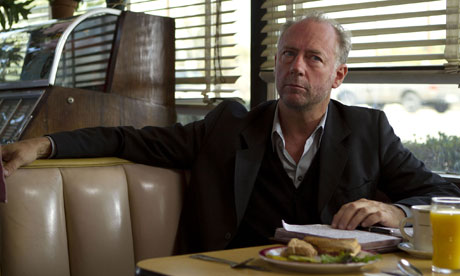
A mysterious man sits at a booth in a diner and sees clients. He looks like any other suit, but his deals are very different than that of your average business man. The clients come of their own will and by referral only. They sit in his booth and ask for something specific, and their requests are often strange or difficult to grant.

The man tells them he will make their desire reality if they do something for him. These things vary on the level of the request. The harder the request will reflect the difficulty of the task. They may ask for a better relationship or to be more attractive. Usually the more elaborate the request, the harder the action will be to achieve it.

Is the man God? Is he the devil? He seems like a neutral representative, and his clientele focuses around eleven characters. He is a passive man; doesn't appear to be pulling for either side. Like the audience watching, he is in it for the story and how it is unfolding. They have to reveal information in order to supply his help to succeed with the task. His clients may find that once they start their assignment, the assessment of how badly they want something changes or that the task itself makes them happy or too unhappy to complete. Others find the tasks difficult and ask for help or hints or loopholes. They must follow certain rules if they intend to succeed.

This sci-fi mini-series was created by Christopher Kubasik and premiered exclusively on Hulu. This non-reality show series does have a real feel to it, and it's mysterious, not overly dramatic, and highly character driven. At times, the man (Xander Berkley), feels more like a therapist than the underling of a deity. The show pulls you in and brings to mind the jingle that says "What Would You Do For a Klondike Bar?" Although instead of a weird, half melted, half frozen dessert, it's how far would you go to get what you wanted? Would you want it once you get it? Is it fate or just a test?

Personally, I enjoyed the series and was relieved by its brevity. It has several different characters and at times if you break from the show, you have to go back a few episodes to remember the exact story and how it unfolds. There have been rumors of a second season, which I would be pleased to see. Recommended for anyone who loves character driven plots, but only has the attention span for 10 episodes.

Friday, March 16, 2012

The Waterborn

Written by Joe the Revelator


The Hills

It's a story as old as time. Boy meets stream-goddess. Boy professes his love for stream-goddess. Boy promises to slay a larger, more powerful river god called the Changeling, who is fed by the steam in an endlessly painful, infinitely unendurable cycle, which has existed long before mankind.

Perkar, a young man whose only female companion is the beautiful goddess, is certainly motivated enough for the task, if only he knew how to slay a god. His family and friends encourage him to settled down with a wife and a cattle pasture of his own, but nothing compares to the love he feels for the stream. When an expedition is organized to meet with another forest god, downstream of his goddess, Perkar is excited to join. His hope is that this "forest lord" may have a weapon to kill the Changeling.


The River

Along the banks of the Changeling and over the waters rests the city of the river people; a folk who worship and praise the river god. Their nobility are said to have the Changeling's magic in their blood, and the ability to use a portion of his power. But if an individual is born with too much of the river, their body begins to deform, and those "Blessed" are brought to the underground palace to dwell for all-time.

This is the secret which princess Hezhi stumbles upon before she reaches puberty, when the signs of the river are most likely to come out. The world seems to be conspiring against the bookish young girl. Rumors of an assassin are abound, and the priests in charge of monitoring the nobility are becoming suspicious of her. Out of desperation she makes a wish to one of the river's fountains. A wish for a hero to rescue her, a hero from faraway lands.


The Equation

I feel many of my recommendations for fantasy novels come off double-edged. I rave about interesting books while simultaneously picking at their faults, or more often, the distracting tendencies of the author. It's hard to find good fantasy, I believe, because anyone in the genre can get lazy when they don't want to explain facts or plot holes, and they fill it in with nonsense. Gregory Keyes may have a lot of myth, magic, and mysticism, but he never uses it to pave over the rough writing.

Something else I've enjoyed is Keyes' attention to supporting characters. I often found myself wondering about the background of Hezhi's tutor, Ghan the curmudgeonly old librarian. Or about Tsem the princess's hulking guardian. Or Ngangata, the self-possessed scout who seems uncommonly wise beside the protagonist Perkar. In almost every instance the author manages to satisfy my curiosity with well-placed dialogue, developing the character with quick, efficient strokes.


The Conclusion

The Waterborn feels every inch like a myth of old. It incorporates the notion of gods existing in every facet of nature, much like the spirits in Native American lore, or the Kami of Japan. Add to this a hero's struggle of Greek proportion with modern prose. By the end you've been given a whole entity within the book, and not just a "to be continued..." chunk of saga about slaying The Dark Master.