Showing posts with label Television. Show all posts

Wednesday, November 14, 2012

Life Unexpected (TV)


by DionysusPsyche

Summary
Lux, a foster child, finds her parents in order to receive emancipation from the state and live on her own. Lux is sixteen years old—the same age her parents were when they conceived her.

To Baze, her father, this comes as a huge shock. He had no idea that Cate, a girl he wasn't even dating, had given birth and given this child up for adoption.

Cate is surprised herself. She was assured by the adoption agency that her daughter's adoption was guaranteed, so it's news to learn that her daughter had heart trouble, needed surgeries, got sick, and was in and out of the hospital. After that, Lux became bitter towards the adoption process, and rightly so.

Much to the surprise of everyone except those who've read the synopsis, the judge grants custody to Cate and Baze temporarily in order to reassess the status of adoption and foster care for Lux.

The first handful of episodes are a massive wave of emotional outbursts and blaming. Cate blames Baze, the high school jock who impregnated her. Baze is enraged that Cate never told him that she kept the baby, and Lux has to deal with two grown ups who are still figuring out their lives and have no idea how to raise a child—let alone a teenager, who is angry, hopeless, and lies constantly. Creepy boyfriend and a rebellious best friend included.


Location
The show is set in Portland, OR, and the footage they show of the city is absolutely, astounding gorgeous. Portland is at home here, and it might be the best show yet that's filmed in Portland. Unlike Grimm which feels the need to constantly remind its viewers where we are, Life Unexpected is more subtle. We see footage, Baze always wears some kind of Oregon Ducks shirt, everybody loves the bong lamp (no, it's used as an actual lamp), and the show is set to an awesome soundtrack. Two of the characters are in radio, a Portland staple of morning shows (Cate and Ryan on set sometimes remind me of 105.1 The Buzz), and Baze runs an independent bar in the heart of downtown. Cate's sister is a therapist who teaches yoga on the side. Short of someone working in a coffee shop, it couldn't get more culturally relevant than that.

Die-hard Portlanders will hate this, but when Lux talks to someone about the staples of living in the city, she says Voo Doo Donuts is "okay." As someone who never understood the hype of that place (homeless people always outside, drunk people always roaming about, you can get married there), it's probably one of my favorite moments in the show. Finally, someone agrees with me, fictional or not!

Lux, the daughter
Her family up until this point has consisted of her best friend since age seven, and her boyfriend. She is frustrated by the hand life has delt her and doesn't know where to turn or whether she can trust her new parents, or anyone for that matter. Instead of talking things out, she yells, hides the truth, and bolts, which is common for someone in her situation whose mode for stress reduction is to do what has always been done to her—leave. Take the easy way out.


Cate, the mom
A morning radio dj, Cate is an overachiever, type A who compensates for early childhood issues. The trist that left her pregnant is the primary one, but as the series goes on, we learn that there are even more pressing thoughts than age that crossed Cate's mind when she gave Lux up for adoption. She strives to be a good mother, despite her shortcomings and throughout the series is unable to forgive herself for giving up Lux.


Baze (Nate Basil), the dad
Owner of a bar, Baze's charisma and laissez-faire attitude are evident in his carefree lifestyle. Yet when his daughter shows up at his door, he, like Cate, is determined to do right by her. Everyone's progress throughout the series is telling, but Baze's is the one that made me most proud. Initially accused by Cate of being “the fun one” (not an untrue statement), Baze has a serious discussion with Lux around the middle of the first season where he tells her that he wants to be her friend, but despite what they would like, he is her father, and he's going to keep trying to be a better one. He tells her what good parents do—that being her dad is more important than being liked. He also fears his past and hopes it doesn't dictate his future in terms of careers and relationships. Over the course of a couple dozen episodes, Baze takes emotional and financial responsibility for both himself, his daughter, and 'fesses up to his shortcomings. He makes good on promises, and he begins to take on a role of a proper caregiver.


Ryan, mom's boyfriend
The last influential role model is Cate's boyfriend and co-host of her morning radio show. It was initially easy to write Ryan off as “the other guy,” “the wannabee dad,” and “that man in Lux's life who isn't Baze.” This is natural, and happens in real life when both kids and biological parents feel threatened. However, Ryan shows more depth once he comes to terms with the new arrangement that consists of Lux's dad suddenly being a part of their daily lives. When Cate and Baze fall short, Ryan is the one who talks to Lux, makes her see the reason, and is a rational adult. He is the first one who has a discussion with Lux about her past that has nothing to do with current issues and problems. Ryan has his own shortcomings which take awhile to show, but he is the solid rock that everyone needs while they're adjusting to this new life.

The ever present history
Every family is dysfunctional, but Baze and Cate's families both prove why Baze and Cate are slow learners in the parenting department and why they haven't attempted it until now. Their relationships with their parents are lacking, complicated, and unsatisfying. Both of them are afraid of commitment to others, and they're not starting with a baby to mold and teach. They're thrown into the chaotic world of hormones, adolescence, and a daughter who is a victim of abuse.

Yet, Cate, Baze, and Ryan find ways to repair the damages, build bridges, and try harder than any of them ever has before.

Lux is beyond troublesome. She makes choices that would drive any normal parent above and beyond the wall of reason. Frequently dramatic and ridiculous, she shuns those close to her, pushes people away, and hides important information. Yet, it's pointed out that Lux is used to parenting herself. When that is taken into account, it shouldn't come as a surprise that she struggles to remain in power instead of letting her parents parent. She is a teenager who has been on her own more or less her whole life, so she needs to be forgiven for being childish. She is one—one that needs help. Sometimes in the show, it is clear that Cate and Baze forget who is in charge, and their fear of losing the child they've reconnected with is hauntingly obvious.


Walking away with more than just entertainment
A topic that comes up regularly is that of adoption. How unadopted kids feel alone, scared, and depressed about the future. When Lux's boyfriend overreacts to a situation, Lux, who's made excuses until that point, tells us of how hard a life Bug has led—what happened to his parents and how he ended up in foster care. Life Unexpected is a story about hope, improving, and moving past failures, but it also realistically explains how difficult it is for children of all ages to be adopted, and how the system set up to help backfires when kids age, get fostered for extra money, or are used in lieu of a baby sitter. They strike out and turn on the system designed to help them, acting out or caving in on themselves to avoid being hurt and constantly bounced from one house to the next.

Another theme is the role children play in people's lives. How they are a huge responsibility, a chunk of time and money. However, I found myself swayed by the overflowing amount of love, patience, and steadfastness that Baze and Cate have for Lux. Lux expects them to throw her away, and they don't.

An ongoing lesson, one that the writers find essential is that the characters are challenged each episode with opportunities to lie or tell the truth. In either situation, it usually doesn't end well. Their lies are not elaborate enough to succeed, and their honesty is not typically communicated by the heart of the issue but retaliated with blame and apologies. If someone gets up to make a speech at a time of anger, it's nearly impossible that they're going to back down.

Character Development and Season Breakdown
All good things take time. Watching broken characters evolve, change, and start bringing out the best in themselves and others gives you a warm, fuzzy feeling inside. The episodes can be formulaic, stuffy, and the fighting is stupid and repetitive. However, it presents authenticity. You side with Lux when Baze and Cate are subpar at their job, and when they're too busy arguing to care for her. You feel for Baze when he struggles to overhaul his lifestyle in order to make room for his daughter. You pine for Cate when Lux blows up on her for being, well, a mom.

First season consisted of the bombardment of the new situation that everyone is adjusting to. The second season is, in part, cleaning up issues from the first season (more aptly, prolonging them) while creating new problems spun out of old ones like a never ending ball of yarn. Some of these are legimate issues: having more kids, defining relationships when they change, knowing your significant other, finding your way in school, fitting in. Yet, I had qualms with the second season.

Criticism for the Second Season
Of my check list of what didn't work, there are many here. Second season takes on a perspective of integrating even more out of this world plot lines to complicate any simplicity and resolution that has come from the first season. The writers become overly concerned with making sure that the show is defined by the title which makes it turn on itself and creates bizarre, unpleasing new moments.

The problem with the relationships from second season between main and secondary characters seems extremely forced, especially for one couple in particular. With the case of Ryan and Cate's new co-worker, this is obvious, but the other ones that grow in second season don't fill the authentic places that the ones in first season did. The contrast could be because the connections in the first season felt grounded. Biological parents to a child, a three year working/dating relationship, roommates. While trying not to spoil it, the connections made in the next season don't feel right. It's not that they're morally wrong, which some very well are, it's as if there is a restless, lackluster feeling between the characters and lack of commitment to the plot. It's uneasy and feels unnatural. Also the previously “resolved” cold cases rear their ugly heads.

When comparing the latter half of the second season with the rest, it just doesn't jive. Out of nowhere Lux has inner demons that bolt from her like some sort of human Pandora's box, except it's hard to find the good in it all. I'll concede that just because Lux gets a new life doesn't mean that her old one is put to rest, but I feel like the writers go out of their way to make her unlikeable, and regress from all the progress made at the end of the former season.

I don't know at what point the show's creators found out it was going to be cancelled, but the second half of the season spends its time farting around and in the last half of the last episode, it's like everything changes. Which makes me wonder if the writers wrote themselves into a corner, or if someone just didn't tell them soon enough that the series was going to be cancelled. So even though I liked the last half of the last season, it wasn't cohesive with the number of problems that were set up in season 2.


My Impressions
To be honest, it took me about four episodes to get into the show. The first two episodes I hated, and there was at least one moment every episode since then that got me all angry or exasperated at someone doing something idiotic or just being a complete wad. What kept me coming back for more is the incredibly emotional, well-intentioned confessions that happen every episode between the characters. This is not to be confused with what I dislike which is the over dramatic displays of anger, distrust, and deceit  I still hate Lux's bawling and screaming, that didn't change much which was frustrating. For me, the show over time became less about Lux's character (even though she is the primary one), and more about the adults perfecting parenthood (it's a work in progress). The show may be soap opera-esque, but it boils down to family, love, and having people there to count on whether times are good or bad. People make mistakes, and the best characters learn from them.

The show is defined by emotion and character development. Hell, the only description of the type of show is "emotional." While in certain episodes characters regress, it shows a normal back and forth process that moves the characters forward and teaches good lessons (especially about the importance of NOT LYING!).

If you can stand a certain amount of temperamental behavior and zealous sentimentality, I recommend this show, especially to parents and future parents. I might even go back and re-watch certain episodes.

Saturday, November 10, 2012

Parks and Recreation

Written by Joe the Revelator


To say something "Grew on me" usually brings to mind a fungus or mold, sinking its hyphae or roots under my skin until I'm forced to pressure-wash the offending parasite, lest I become used to it. Or worse, crave its' presence.

Parks and Recreation, the mockumentary starring Amy Poahler, absolutely grew on me. I stopped watching it after the first few episodes became available on Netflix, writing it off as another inner-office comedy aimed at cubicle prisoners, and those who long for interesting dialogue from their coworkers to keep their minds from rotting. I don't like cubicles. I don't care for the yammering of fellow drones in the workplace. And watching a show about other people at work, makes me feel like I'm at work.

But cooler, less judgmental heads prevailed, and I found myself sitting in front of the warm glow of the television, watching as a small branch of government slowly tore itself apart through the trials of the bureaucratic process. And I laughed.


 The town's past is slowly revealed over the course of several episodes with these horrendous "Historical Paintings". They may be the greatest feature of Parks and Rec.


A picture's worth a thousand smirks.

Parks and Rec takes place in the fictional town of Pawnee Indiana, a rural community plagued by racism, sexism, bigotry, fear bordering on paranoia, and an overwhelming obesity problem. In short, Pawnee represents all the negative aspects of living in a small town, collected into one volatile community. It's the perfect setting for a team of apathetic government workers, and one ultra-optimistic woman who borders on saccharin-sweet; Leslie Knope.


 To balance the unending positive energy of the Knope-machine, the rest of the team consists of Ron Swanson, a libertarian supervisor who keeps a claymore mine on his desk and an antique shotgun facing anyone who walks through his office door. Jerry, the loveable office screw-up, who endures an unreasonable amount of ridicule from his peers. Ann, the "normal" element, who was added to the crew to highlight how odd everyone's behavior is. Tom, Leslie Knope's assistant, who acts like a disgruntled Brooks Brother's salesman and uses the parks department as his personal entrepreneurial kickstart. And April the intern, who makes the show feel like a real documentary by frequently glaring strait into the camera, and exudes the angsty attitude of a high school punk-rocker. Others join the team, and some leave over time, but the chemistry is kept throughout the first few seasons.

The Ron Swanson Pyramid of Greatness, which is introduced to a kid's basketball team to inspire them and give them principles...just before Ron administers mandatory crew cuts, sheering 10-year-olds like sheep.


If you can't beat 'em, Sweet'ems.

Cameos are made by members of the Saturday Night Live cast, as well as many other improvisational comedy groups and Stand-Up comedians. The mockumentary format never changes from season to season, but the jokes seem to compound on themselves, drawing from past episodes for witty punchlines, so I wouldn't recommended jumping into Parks and Rec without watching the episodes in order. I do, however, recommend watching more than one episode in a row. The ongoing political battles and struggles of the parks department segway quite well into one another.

Wednesday, October 31, 2012

Community


By DionysusPsyche

Not a lot of my friends have seen Community. The critics like it enough. Bits of social media conversation have sprung up occasionally, individuals commenting on an episode here and there. One friend claimed it was the “best show on television right now.” I wasn't sure what that meant, because “right now” could mean that nothing else good is on or that something better may be around the corner. From what I gathered, this series got bundled with other shows, but wasn't a “must see.”

When I went to watch it, I was hesitant. While many are fans of Chevy Chase, I am not. I've seen him in movies, caught snippets here and there of the Vacation movies, but over all, he's never really wowed me. I've found people put him in a similar category to that of Bill Murray and Steve Martin, and although this critic finds no fault with enjoying the entertainment your parents do, I tend to fall neutral on the matter (although let it be known that my preferences lie with Murray and Martin, in that order). You shouldn't love or hate something just because everyone else does, nor should you necessarily judge an actor based solely on previous works. So I decided to put my opinion of Chase behind me and get down to watching the show.

The show initially appealed to me, because I've been to community college. I fit there, because I was working, covering my basics, and trying to figure it all out. In this way, the show really gravitates towards that. It has your types: overachiever with issues, jock who couldn't score a regular college, the crazy old man that no one wants to be in a group with, the empty nester, the socially awkward one, and the charismatic/jerk leader. They don't have majors yet. They're all different ages, but they all need to study and a shoulder to lean on.

Expectations vs. Reality
I expected Parks and Recreation or The Office (quirky) meets Glee (heart, emotion) minus the uncomfortable humor, drama, and singing. Not as dry and awkwardly funny as the former two, not as intense as the latter. Yet, it wasn't really any of those things. I watched part of first season, not sure how I felt, then moved on to some of the “best” episodes. The cast is a quilt of misfits led by an ex-lawyer, Jeff Winger (Joel McHale). At the beginning of an episode, the set up is pitched, and then the gang either gets into a fight where they have to amend the breach by the end or they all get mad at one person and that person has to make apologies. Or both.

Half the characters are unlikable outright. She bristles to the touch, he's nails on a chalkboard, etc. The characters that are likeable aren't likeable enough, and no one is extreme enough to be funny in a terrible way or lovable enough to be funny in a wonderful way. They come off as cardboard cut outs waving in front of a screen. None of the cast that I've seen in other roles (Alison Brie, Ken Jeong) break out of their comfort zone. Which means that if you like these actors, perhaps you'll like them when they show up and almost read from the script onscreen. I do love Ken Jeong's character and Donald Glover who plays Troy (especially in the Halloween episode). It feels like the actors aren't acting, just talking (with the exception of Abed, the uncomfortable Indian obsessed with pop culture). Note: I just found "Best of Troy" on Youtube. I think I'm good for all I ever need to see of Community.

The episodes that are funnier than others are either borrowed from other movies or shows, and the funniest scenes do not make up for time lost. While there are other shows that frequently borrow or downright steal from other shows/movies, they make it really funny. Even when borrowing, the show still isn't great. Which is a shame.

Conclusion
This nearly humorless, waste of a time slot show is not something I would recommend to people. Quite possibly, I don't get the humor. The writing style is not meant for me. If you see clips of the show, and you like it, then more power to you! I have seen clips of the show I liked, and there are two scenes that make the time I did spend watching the show almost worth it. Unfortunately, it wasn't enough. If you choose to take a chance on Community, I hope you fair better than I did.

Monday, October 1, 2012

Ringer


By DionysusPsyche

Ringer is a television show that welcomes back a much beloved actress in a new role. Sarah Michelle Gellar plays Sibhon Martin and her twin sister Bridget Kelly. The show intrigued me, the way stories about twins have sparked my interest since Sweet Valley High's Jessica and Elizabeth from their kid days until college. I even read the special books.

This ain't no Sweet Valley (despite the concept of twins and swapping places).This also isn't a fun fest where Mary-Kate and Ashley run around for 90 minutes of shenanigans.

Bridget Kelly has witnessed a murder. Upon being asked to stand trial by the local police (Nestor Carbonell, Lost and The Tick), she realizes that before and after testifying, she'll be vulnerable to an ex-boss and killer on the loose. Despite years estranged, Bridget flies to New York, where her Shibhon (Shiv-on) has forgiven her. Something strange happens, and Bridget takes on Shibhon's identity, and unbenownst to her, Shibhon's messy life.

Why it's Good
Unlike Revenge or Tru Blood (at least season 1), the antics while stretched from reality, are not far fetched. At least some of the characters are lovable in their own way, and their motives (at least most of them) are understandable. Unlike a lot of shows about broken people who make bad decisions, say a few kind/charming words then make worse decisions, Ringer is about overcoming your past. It's also a rubix cube. Characters say or do things that seem to define them, but when the cube turns, more pieces of the puzzle fall into place.

For Bridget, becoming someone new is relatively easy, since that person is a deep part of her the way twins are. However, entering into Shibhon's life requires some finesse and off the cuff lying to save face. Trying to explain things that Bridget's not had full disclosure on is tricky, but the writers and Sarah Michelle Gellar do a good job of balancing the line between realistic and entertaining. Because Bridget is the solo witness in a trial, keeping her identity secret is crucial to her survival.

Both sisters benefit from this transaction of Bridget's portrayal, even if one of them is not present for many of the moments. The real Shibhon, while she may at one point have been sweet and kindhearted, has been extremely secretive and leads something of a double life without her twin wrapped up in the mix. This gives her an opportunity, a door by which to pass through in order to escape some of the walls she's backed herself into.

Repentence
Unlike Revenge where every episode is another attempt to take a stab at a past ruined by the rich and a failing corporation, Ringer provides us with something more. While Bridget's first priority is to become her new life, she is not willing to completely absorb Shibhon's life as is. Bridget has had her share of rough times, and she has done things she's regretted that have irreperably damaged her relationship with her sister. She also views Shibhon's choices as questionable considering the hand she was dealt.

While Bridget made mistakes in the past, many of the ones she made she didn't do out of malice. In part she begins repairing damage that Shibhon has done to her current life while attempting to make amends to her sister by being the better version of herself. Of either of them. However, perhaps there is reason to believe that Shibhon has not been completely out of line.

The show does a good job of keeping the audience on its toes. At times, it's unclear which twin is which, but the real one always gives herself away. There is also a medium sized cast that works each end to make sure that the over all story arc keeps coming back to the same place. While the show does a good job of answering the questions the audience asks itself while watching, it also does a good job of not overwhelming its viewers by creating too many questions.

Negatives/Spoilers
Towards the end of the first season, the entire plot kind of caves in on itself. The drama becomes more of a night time soap opera than ever. Characters become incestuous in unbelievable ways. One character is replaced by an almost identical one, and we're not talking twins. It's hard to tell if any of the characters are telling the truth, if people will die, if those who've disappeared are dead, and who to point fingers of blame at. It could be that the writers found out the show wasn't renewed for a second season.

Don't get me wrong, I was still hooked on watching the show, but the characters peaked, and everyone was just sort of pooling into one awful character. No one ended up being blameless. Also, one of the characters, I really enjoyed, so I watched it 'til the end just for him.

Conclusion
Ringer is superior to many shows on tv—at first. One season, full of turns and tricks provides mystery and entertainment for awhile. Its momentum and creativity start deteriorating halfway through, and although it temporarily sees bursts of interesting moments, the latter half of the season lacks the originality and curiosity the first half provided. I still think it's worth watching, because it's both interesting and provides characters that require more than one look.

Tuesday, September 18, 2012

The Voice: Season 3


By DionysusPsyche

Kick off this year for Season 3 was intense. I don't mean that the stakes felt higher. I mean, I felt like there were more episodes this time than there were last year. Maybe that's because last year was my virgin/honeymoon period with the show. Second season aired right after the Superbowl, which was good because my place, like tons of homes across the U.S., we left our tv on in a post-food/football exhausted stupor. This year, there were 3 episodes, Monday through Wednesday where Round 1 consists of the judges choosing and fighting over singers to have them on their teams.

Reality TV
There's nothing particularly real about any show, except the illusion that its actually happening. There are a set of people that will never watch The Voice because they avoid reality tv. That's all right. Audiences watch the same shows for different reasons or for varying levels of the same reasons. I primarily watch this for the judges and their amusing relationships with each other and their team. Someone else I know mostly views it for the singing, and another loves the drama the best. It's impossible to watch reality television without some shaudenfreude, and appreciation in one form or another for pettiness on the show is what drives this type of programming. It's less about the activity and more about how the action and emotions in it are mixed like a blender.

The Coaches
You probably know, but I'll tell you anyway.

Christina
Stats: Used to be on The Mickey Mouse Club with Brittney Spears and Justin Timberlake and was part of the late 90's pop scene. She still makes albums and cameos in movies.
Preferences for up-and-comers: People who can belt it out, and tends to look for ultimate star power potential.
Dislikes: When talent rivals her own in a different venue. People who can't hit high notes. Tries to be the Paula but doesn't quite pull it off as she's considerably patronizing.
Last year's defining moment: Fighting with Adam. Trying to break Chris Mann out of his classic training to become mainstream.
Known for: Of all the judges, Christina tries the hardest to get team members and because of her notoriety has the easiest time getting picked by them. Extremely competitive. Almost wardrobe malfunctions of the mammory variety. Has weird hats that rival Cee Lo's.

Cee Lo
Stats: Half of the Gnarles Barkley/Danger Mouse group, has his own solo album, and produces other music he views as worthy.
Preferences for up-and-comers: Unique voices that he can help mold and grow (Cee lo picks those who are interesting and require the most guidance).
Dislikes: The status quo and drama
Last year's defining moment: Transforming Juliet Simms, and almost winning the Voice last year.
Known for:
More than any of his peers, Cee lo really tries to find a musical blending of what he can offer and his talent's particular voice. Is probably the most eclectic of the group. Outfits, toupees, and onstage pets that tweet and get the audience amused

Blake
Stats: A Texas born country singer, his first big hit was in 2001 with the song “Austin.” Married to Miranda Lambert.
Preferences for up-and-comers: Spunk. If they sing country or really interesting rock, he tries to nab them. Also hot chicks.
Dislikes: When possible singers pick Adam over him.
Last year's defining moment: When his team member, Jermaine Paul won the title of The Voice for season 2.
Known for: Drinking on stage, awesome one-liners (sometimes a back and forth dual with Adam), and his husky accent. Definitely one of the funnier coaches. Plays off Christina and especially Adam.

Adam
Stats: Part of Maroon 5, and after regrouping and renaming, released their debut album in 2002. Probably the second most famous of the group.
Preferences for up-and-comers: Talented—someone who he could tour with (one of the members from his team last year was on tour with him this past summer)
Dislikes: Singers' inability to optimize their voice and pick songs that work for them.
Last year's defining moment: Picking former Mickey Mouse Club star, Tony Luca, for his team (which angered Christina). Upon her criticism of Luca, Adam talked Luca into singing “Baby One More Time” by Christina's rival Brittney Spears' to show off his talent and to make her even more annoyed.
Known for: Sense of humor and using it to push buttons of the other judges. His ability to articulate what did and didn't work for someone in the song of their choice. His friendship with Blake.

Going once, Going twice...
There are multiple rounds. In the first, the above mentioned pick their teams then coach them. The next involves the chosen ones battling against each other within their teams where their coach decides the winner, and the last one resides on individual performances. The last round involves home viewership voting—even though the futility of the maxed out website gets the best of us.

The first round is by far my favorite, because to me, the judges fighting over contestants like the last piece of meat at the market is almost more competitive than the people who are actually singing. Less so now that they added an element, one that I'll address in a minute.

Everyone has his/her own sob story where they try to gain audience appeal by sympathy. You get “my parent has/has died from cancer,” “I lost (insert family member here) when I was ___,” and “I was ostracized when I was little.” The stories always end with “music got me through,” which is a backwards, lamer version of VH1's “Behind the Music.” While the potential's background story is fun to guess, the stories themselves are boring/repetitive. Then Carson Daly comes in, pretends to act interested, and then they sing with their family backstage.

What's Happening on The Voice: Week 1 In Review
This year, the coaches can steal talent from other teams. I'm not sure if this is going to be done outright or if coaches are going to have to switch them out NFL style. To be honest, I don't really care, I'll enjoy the surprise.

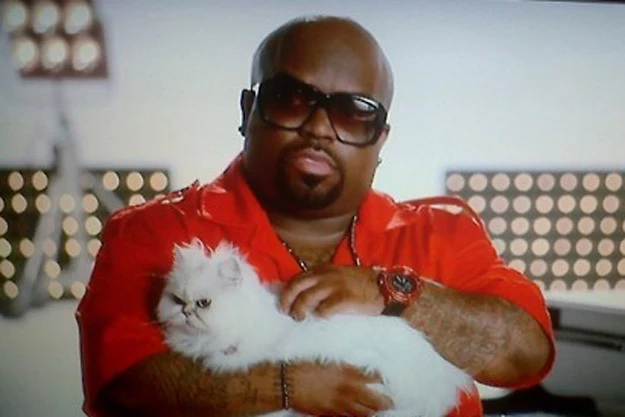
Cee Lo seems a bit low key this year and doesn't appear to be trying as hard to pick up new artists. Perhaps he's under contract and just wants out? Or is bummed out for not having won the first two years? It's also possible he's staying under the radar for now in order to come out on top later (as in steal the talent he lost out on). He's also changed out his Persian cat, Purrfect, for a pink cockatiel. Or else the cat is taking a rest from fame, possibly holing up in Kitty Rehab.

Christina and Adam seem less competitive this season in the first three episodes than they were this time last year when it got down right uncomfortable. While Christina is staying quiet, her breasts are doing all the talking. Who's job is it to shove them back in her super tight tank top?

There are more country music singers in the first few episodes, and Blake has picked up basically all of them. Which seems weirdly suspicious. While Blake does enjoy a good Southern sound, it's almost like there was a commercial slogan with the words “collect them all” (he did pass on one country singer). He can do the most for them though, and they all know this (Miranda Lambert and Jewel were two of his guest coaches last year).

Carson is upbeat, which was my biggest surprise. Last year you could hear the “this is hell, I couldn't care less” in his voice and lack of facial expressions. Occasionally, he jumped in early with “okay, judges, it's time to make a decision.” They have him backstage with the participants family, and on one occasion, he seemed more jazzed about the performances than the family. He either cut a deal or someone gave him some depression medication, because he's just peppier this time around.

Highlights so far
Adam impersonating Blake.
Adam running around the stage to punch Blake in the arm and then go back to his chair.
Blake moonwalking.
Carson with personality.
Blake tries to convince a contestant to be on his team, because they "both wear vests." No good.

Drinking Game
For you at home who watch, this is the part when I reveal an addition to your normal viewing (or maybe just different rules if you already do this). For those who don't watch but would like to, you can do this too. For those who weren't going to watch (and if so, thanks for continuing to read!) but now are intrigued, here are the rules.

Drink Every Time...

Cee Lo's pet of choice appears with him
Christina almost falls out of her clothes
A coach impersonates another coach
One of the contestants cries
This is The Voice!” is announced
A judge chooses Carson (spoiler alert: Carson doesn't sing. If for some reason he does, drink twice)
Blake points to himself
The judges perform together (note: NOT with their team)
Our reporter uses the word “trending”
A coach says they weren't “feeling it”
Adam makes a joke or he and Blake reference their love for each other
Someone says that Blake has been drinking (drink twice if this person is Blake)
Anyone sings an Adele song

Warning! If you're going to play this drinking game, do so at your own risk. No blame should be exacted on the writers of this blog for any alcohol poisoning or repurcussions for an absence at work due to a hangover.

Wednesday, September 12, 2012

Lost - Season 5


Okay, maybe it was just the mood I was in, but Lost Season 5 is fucking depressing. Seriously, the only legitimately awesome part was when Miles and Hurley troop around together and comedically muse about time travel and Star Wars. But even that was tarnished by giving Miles daddy issues. Why did you need a fucking dad, Miles? The best damn characters are the characters who don't appear to have fathers who have just sprung up into the world like immaculately conceived island babies. Did we really need to spread MORE father problems around like the goddamn bubonic plague?

Sawyer and Juliet's Downhill Spiral

Yeah, I just wrote about Sawyer in the last season review. I don't care. @#$% you too, buddy.

Have you ever heard Robin Williams' Live on Broadway? He has this one skit where he describes just how masochistic a sport golf is. In the dulcet tones of an inebriated Scotsman, Robin Williams explains how many obstacles there are, and then points out how the flat green at the end is there just to give you hope. And then you go right back where you fucking started, eighteen damn times, until the entire course is finished. He's describing Lost.

After seasons upon seasons of problems and small triumphs, we finally seem to see Sawyer in the clear. He's gone through hell, but he seems to have found happiness with Juliet in a neighborhood full of people who respect and admire him. Sure, they'll all die after a while, but we'll ignore that. Shush. It isn't important.

What is important is that Sawyer and Juliet, unlike any other damn duo outside of Rose and Bernard, have managed to give a collective 'fuck you' to the show itself. Smoke monster? They don't care. Time travel? Whatever, they are happy in their cabin. We have to go back? They're already there, and in the seventies to boot. They are enjoying life, and all the complications that have beset these two characters since their introduction have faded away into quiet happiness.
.

Then, because the show's writers HATE US, their idyllic life is shattered. Sawyer manfully tries to respond in a way that both preserves his way of life and saves his friends, but inevitably is unable to keep up. It all is reminiscent of Season 3, where Ben tries constantly to adapt and change in order to keep his little kingdom together, but we care more about Sawyer succeeding. Sawyer's cool. Ben's a prick. Anyways, it gets to the point where shit hits the fan, Sawyer and Juliet are captured, then they are put on a submarine heading back to the real world. But they're cool with this. They can live together out in the seventies, get wacky hairstyles, go help found Microsoft, and be happy. But nooooo. More interference from the other Losties and they're back in the game, like it or no. Juliet essentially breaks up with Sawyer, but they're still going, there's still hope. Then Sawyer is unable to stop Juliet from falling in a hole, breaking countless bones, and hitting a nuclear device with a rock until it explodes in her face.

So much for that happy ending.

Anyways, to try and step back and look at this with greater appraisal and less craziness, Season 5 was effective in convincing me that Sawyer and Juliet were capable of change, and change for the better. Sawyer as a leader is great, and it was stunning to see how, without prompting, he seemed to take the moral route of Jack even when Jack himself refused to. It was like they switched places, and this turnabout was remarkable. Juliet didn't change much, but we were able to gain a better understanding of her character and what makes her awesome. Then, naturally, they killed her to piss me off.
.
To offset the tragedy I'm about to dwell on, here's Faraday wearing a tiara.
Sayid, Faraday, and Locke – The Triad of Misery

In a competition as to who goes through the most shit this season, it is genuinely hard to pick. Sayid is such a wreck as to be nearly unrecognizable. Seriously. Gone is the kindly Iraqi guy who is always willing to help out while simultaneously reluctant to become too violent. Instead we have an Arabic James Bond without scruples. I lost count of how many people he randomly killed without warning. At one point he even shoots a kid. Yeah, I know he's supposed to grow up into evil island Machiavelli, but seriously! In flashback-land (or is it flashforward this time around? Who the @#%^ knows?), Ben lets Sayid leave to live his own life after going around assassinating Widmore's peeps. Will he try and atone for what he's done and become a better person like the old Sayid? Hell no. The show won't let him. He's quickly cornered and captured by Ilana and never given the chance. 

But he does manage to kill someone with a dishwasher this season. Gotta admit that was pretty cool.

Poor Daniel Faraday gets it just as bad, but it's even worse with him because Faraday, unlike Sayid, never really does anything bad to provoke us into saying that he might deserve any of it. Sayid kills people. Faraday does everything within his power to help the characters through time travel, and does his utmost to explain it as it happens. But then they give him a love interest. And we can pretty much assume at this goddamn point in time that any newly rising love interest is going to fucking die. Charlotte, while initially a kind-of-annoying Brit, actually turns out almost adorable in the season, making her death even more horrific. When Faraday runs into her in the past when she's a child, the scene is additionally heartbreaking. And, finally, when trying to help the others, he's literally killed by his own mom who basically set him up to die. Now that's cold.

On the bright side, we get another amusing theory behind why Daniel is a bit kooky. Aside from all the electromagnetic radiation of his experiments, we can now point to his mom dicking around a nuclear missile as another possibility.
.
This man needs a teddy.
Finally, we have Locke, who is the poster child for writer abuse. Is there any moment where this guy actually achieves something meaningful? Locke is a sad tale of trying again and again, no matter the odds, to realize dreams, and then getting ground down into paste. Yes, he had to die as the catalyst for the other characters to go back to the island. Did it need to feel so hopeless? In retrospect, we understand that it wasn't Jacob speaking to Locke and telling him he needed to die, it was the Smoke Monster/Man in Black. Thus, not only was his death unnecessary, it was downright savage to have everyone dismiss him as thoroughly and utterly as they did. Yes, Locke has done some crazy and bad things. But is that enough to rip up his emotional core and psyche as thoroughly as they did before throwing him to the wolves? Ugh. It's just a pet peeve of mine because I loved Locke so much at the beginning. His death and the events leading up to it are just awful.

But I will say that I consistently find his scene with Walt as one of the most touching and bittersweet of the series. It's like going through your own flashback of Walt and Locke's friendship at the very beginning, and remembering what Locke was like as a total badass druid-like Obi-Wan of the island.
.

Conclusion

This season was a good one, don't get me wrong. It wouldn't have elicited such a reaction otherwise. Watching the Dharma Initiative and the characters interact in the 70s is damn fun, and all the background on events that took place on the island was pretty sweet. But holy hell! When you stand back and look at it as a whole, this is one depressing season! Now on to the Jacob/Smoke Monster clusterf***.

Wednesday, September 5, 2012

Lost - Season 4


*SPOILERS EVERYWHERE* Don't read this post if you haven't seen Lost before. This is intended as a retrospective review from someone who has seen the show before, and so will not resonate as well or be particularly revealing for someone who hasn't.
.

Sawyer

Sawyer is a character who, while always amusing, is generally predictable. You can always look to him to make up ridiculous nicknames, to show macho bravado, and to flirt incessantly with any woman who looks remotely attractive to him. He's the jerk with the heart of gold, the rogue with a past, the one who refuses to take any dangerous situation seriously. These traits define his character for much of the series, though one can definitely observe a change from think-for-your-selfer to defender of the group, like any good Han Solo.

But what I want to talk about here is how his relationship with Kate seems to change him. From day one, we know that Sawyer has the hots for her, but we're never given much of an impression that he would genuinely change himself in order to get her. Yes, he says that he loves her but, hell, so does everyone else on the island. More seriously, despite what he says in how much he cares for her, you're never really convinced that the two of them hooking up will make him become anything but what he appears to be: a charismatic, happy-go-lucky, independent philanderer.

However, this seems to change subtly in season 4. Presented with the opportunity to finally leave the island, Sawyer tells Kate that he's going to stay. What's more, Sawyer asks Kate to join him, to move in with him, and to make a life on the island together. Given the context, this is tantamount to a marriage proposal. Kate is unable to take the offer seriously, but Sawyer looks as serious as we've ever seen him. When she later spends the night with him halfway through the season, Sawyer is happy as can be, viewing it as her being close to taking up his offer to live together on the island, no matter what others say. But then he discovers that the truth is anything but. In a bittersweet scene, Sawyer tries to reason with Kate about what's bothering her, but fails to reach her (mainly because she's there to spy on Locke's group and has to manufacture an excuse to leave). I found this poignant because, of all people, Sawyer tries to solve a problem just like someone in a marriage or relationship would, by talking about what Kate really wants and how he can factor that into his own point of view.
.

Why the change?

This isn't something I really noticed the first time I watched Lost, but Sawyer here genuinely tries to shape himself into something solid and lasting. Faced with the choice of the island or the real world, Sawyer chooses the island and, in that choice, it's as if he's decided to grow up. Instead of going with the flow of things, rejecting to look out for others, and following his own interests, Sawyer embraces as his own those who chose to stay on the island. And he tries to get the one person he truly loves, Kate, to be a part of this with him.

As for why, I think that Sawyer wised up. From conversations with Ben and others, Sawyer can see that what Kate wants is someone who is good at heart, caring, and selfless (like Jack). This shift in his goals and interests, this maturing, is what he believes Kate will stay for, and so he makes that change his number one objective. It's hard not to appreciate how much this says about the depth of his caring for her. It's frankly adorable, like watching a gruff hairy dog that never listens to you suddenly trot up to a cute dog, lick her, and quietly walk along beside her.

Dog analogies aside, I thought the change in Sawyer's character worthy of note. For a character defined by his independence, it was surprising to see him try to stretch as far as he could to sway Kate to spend the rest of her life with him. It doesn't work out for Kate and Sawyer in the end, but it is the first change we see of what results in him becoming a responsible leader of all the others remaining on the island after the main survivors split off.
.

Desmond Hume

I actually don't plan on writing much about Desmond himself here so much as I want to point out why it is that he's everyone's favorite character. The funniest part is that the reason for this is because the writers failed. They tried to write him a certain way, but screwed up. The result is to ironically make him better than he would have been if he had 'worked as intended'.

Lost is defined by showing us characters who are inherently flawed. Nobody is perfect. The average character of the show is a person who tries to do good but is prevented from easily doing so by a crippling imperfection, usually deriving from a past experience. Here are some examples:
  • Jack – Great, determined, good leader. Doesn't know when to quit, hates leading, and cries a lot.
  • Locke – Capable, caring. Rejects the status quo if it doesn't have something he is driving towards. Needs lessons in anger management.
  • Jin – Entertaining. Resolved to do the right thing. Occasionally forgets that he can be a good husband.
  • Sayid – Great guy. Has trouble not torturing people.
  • Charlie – Cool dude. Drug addict.
  • Claire – Cute with baby. Unspeakably annoying.
  • Hurley – Adorable heart of the group. Technically useless.
  • Vincent – Dog. Never around.
  • Michael – WAAAAAALT!
I could come up with more, but the point is that every character has at least one clearly negative trait that prevents them from being fully admirable.
.
Pictured: Vincent, who tragically never gets his own episode

But what about Desmond? What makes Desmond an exception (and a writing failure) is that the audience is informed that Desmond's weakness is that he is a coward, but he is clearly anything but. There is nothing this guy does that doesn't reek of courage. When Locke flips out because he messed up the hatch, Desmond takes charge and risks his life to save everyone on the island. When Desmond receives visions of Charlie dying, he goes out of his way to stop fate itself from succeeding. When presented with the fact that the love of his life is out in the real world and far away from the island, he does everything within his power to reunite them both while simultaneously saving everyone he can.

Even in moments where we are supposed to view him as a cowardly failure, we see him as anything but. Any scene he has with Charles Widmore is indicative of this; Widmore tells Desmond why he's useless and Desmond stands up to him and refuses to say the same. When Widmore tells Desmond that he isn't worthy of marrying Penny, Desmond completely ignores him. If this is cowardice then how are we supposed to tell when Desmond is being courageous??

This is why I say that the writers failed. Unlike the other characters, whose flaws we can visibly see, we are simply told that Desmond is a coward but not given any actual evidence. It's like George Lucas telling you that Darth Vader is intended to be a super cuddly nice guy and then him putting you in a chair to watch Star Wars for the first time; it just doesn't make sense! Consequently, because Desmond is arguably the only character in the show without a genuine flaw, he becomes everyone's favorite guy, the character you can always root for, with an epic romantic odyssey besides.
.

Conclusion

I have less to say about how the overall story of season 4 progressed because it was relatively short and wasn't objectionable. Well, let me correct that: everything that happened on the island was pretty cool. We see Jack's camp versus Locke's camp, the warring factions of Ben's Others versus Widmore's freighter mercenaries, and we start to see interesting manipulations of the island's supernatural side-effects, such as time travel.

By contrast, everything that happens in flash-forwards was a pain in my ass. Seriously, if it had been less of a chore, I might have skipped these scenes. It isn't necessarily because the events within them are uninteresting, it's because the characters themselves moan endlessly about how we should go back to the island, just like I am. This show is based on weird stuff happening on the island, so why the hell are we off it? Flashbacks are one thing, but to have actual plot occur off-island when the real important stuff is what happens on it made it feel like a depressing waste of time. It also features Jack at his most annoying (beardy alcoholic).

On the bright side, I'm really looking forward to season 5 because, flash-forwards aside, I want to see the progression in Sawyer and Juliet (who was ridiculously hard to write about and pin down, if you couldn't tell). More to come soon!

Sunday, September 2, 2012

Lost - Season 3


Season 3 takes a different tack from the previous two. Instead of being with the main group of survivors on the beach, we are put into a scenario where many of the main characters are captured by the enemy, splitting our attention between the faction of the Others and the “Losties”.

Is this good? Not really. I'm going to make an extremely nerdy reference now:

In Dungeons & Dragons, if you are the 'dungeon-master' in charge of the players, the last thing you want to do is let players go off away from the group. Once this happens, the overall pacing of the adventure slows to a crawl. You have to describe different things to different people, construct entirely separate events and challenges. And, while you do all of this for the splinter group(s), everyone else has to sit back and twiddle their thumbs. This is what turns an hour-long masterpiece into a six hour slog.

The same applies for Lost. This season is where events grind slowly to a halt. We are introduced to two pointless new characters who get killed off in the same episode they get introduced in. Jack shows off his tats. Hurley fixes a van and goes joyriding (admittedly, this was awesome, but had zero relevance to the overall plot). Claire gets an episode... Stuff like this creates drag.

Then the writers miraculously realized that this show won't last forever, and that they needed to take it somewhere. Shit goes downhill, starts to swirl around, and then goes out of control (do not visualize that). And the island is finally opened up to outside intervention. All things considered, this was a pretty good season, no time spent in a stupid hatch, and with genuinely interesting questions being asked and character moments being had.
.

Benjamin Linus

Ben is one of the more remarkable characters in the show. Perhaps the funniest part about him is that his character was written to be killed off within two or three episodes of his introduction but, because the fans loved Michael Emerson's performance so much, they essentially rewrote him into being something close to the main villain for the entire series. Part of me is impressed by the flexibility of the writers in doing this. The other part of me is horrified at all the plans they must have shifted around crazily in an effort to accommodate a character who was never supposed to be around.

But it was a wise decision. Season 3 is where we see Ben at his strongest, leader of his little island fiefdom, every single person on the island either subservient to his wishes or wanting to kill him but not having the power to do so. Rewatching this, it was particularly interesting to watch the extent of Ben's authority and its slow erosion. Things spiral rapidly out of control for Ben and his people during this season, but Ben constantly adapts and shows himself incredibly flexible, utilizing his powers of manipulation as adroitly as he can in an effort to keep control over everyone.

And yet, watching this made me notice just how fragile Ben is as a character. It also illustrated to me how unlikely it was that he would ever find true happiness. We see Ben's youth as one where he was completely powerless. He is constantly held as an unwanted curse by his alcoholic father. He is largely friendless, grown up on a tropical island surrounded by people indifferent to his interests or activities. Ben is near completely bereft of human connection, a situation which the writers set up as a way to justify his willingness to murder and use others as pawns later on.

And so we see Ben dominate the island as some sort of tropical Machiavelli. But it occurred to me that this is the closest to happiness he'll ever be. Ben's comfort derives from control; he constantly seeks to make everything subservient to what he wants. And, to some extent, you can't blame him. His youth left him with no control at all, no goals outside of getting through the day without getting put down by his father. It is only on this isolated island, with people that have next to no choice but to obey him, that he can create his own society that is dependent on what he wants. You also see this in how he treats Locke. He is jealous of Locke's status as a sort of prophet to his people and, once Locke is able to hear something that Ben cannot, this is the last straw for Ben. Ben doesn't want to live in a world again where his opinions no longer matter, where he is just forced to follow in the wake of someone else like he did with his father long ago. So he kills Locke, not because Ben loves to kill, but because he can't stand sharing power. Ben doesn't want to face a world where he is not paramount. It's remarkable how powerfully our childhood can shape our lives, and Ben is a perfect example of how a lack of caring can result in someone doing 'villainous' things in an effort to feel whole and happy in the world.
.

Juliet Burke

Juliet is a really odd character, and one that I found particularly interesting as I rewatched the series this time around. I say this because, for lack of a better comparison, she's like a bizarre mix of Ben and Kate's characters. She has a personality that often is akin to Ben's, and her motivations are comparable to Kate's. Juliet faces life with a mask. It's hard to tell what she's thinking, and we quickly gather that this is a shield from getting hurt or too attached to anyone. Like Ben, she's more than willing to engage in manipulation in order to get what she wants. The only difference is that manipulation defines Ben; with Juliet, we get the feeling that she uses it more because she feels like she has to in order to survive.

As for comparing her to Kate, I found Juliet to be a fish out of water. Like Kate, Juliet is constantly discontent, looking for a home but simultaneously unable to feel like she's home anywhere she goes. Both characters focus on survival before anything else. Then the comparison starts to deviate. Juliet neither identifies with the Others or identifies with the “Losties”. Nobody really accepts her, and her detached personality doesn't help matters any. But you almost get the sense that Juliet's okay with that.

You know, she's actually surprisingly hard to write about. But I wanted to try nonetheless, as I found that her time with Jack as her captive was powerful stuff. I'm still not sure if their bond was a genuine one created by both of them feeling like they were separate from everything else, or if it was a complicated form of Stockholm Syndrome. Juliet's attempts to stage a coup to overthrow Ben also were really cool. Their struggle for authority is an interesting back-and-forth, and her relationship with Ben is complicated and well done. I look forward to watching her character more and trying to get a better sense of what makes her tick.
.

Conclusion

This saddens me, because the quality of Lost really starts to flip-flop drastically from this point on. Things start to get ridiculously convoluted, with flash-forwards, time-travel, and more. I'm also not sure how much I look forward to watching it because I find the parts where they go back to the real world to be relatively uninteresting compared to what happens on the island. But I shall soldier on.

Thursday, August 23, 2012

Lost - Seasons 1 and 2


This is not your conventional review. I say that because I've seen Lost before, all of this is familiar to me. But I haven't seen it knowing what I know now, learning everything that happens in the final season of the show. Lost is much like a mystery; it is full of sudden surprising reveals that cast everything you've seen before into doubt, or into a new light. Some of these are epic. Others are shit. But, for lack of another show to passionately watch many episodes of back-to-back, I thought I'd return to one that I have a very strong affection for, and to see how it was on a return viewing.

This will be rife with spoilers.
.

The Rise and Fall of John Locke

Man, do I feel sorry for this guy. Unfortunately, Locke is a character who was built up into a mystic old man capable of leading everyone to salvation, and then replaced with one who is tired, embittered, and ultimately killed off so that the ultimate big bad could adopt his form like some fucked up body suit. I watched seasons 1 and 2 again wishing I didn't know this. After all, Locke at the beginning is just so awesome and inspirational. He gets Charlie off of his heroin addiction, he helps Jack resolve some of his father issues while simultaneously teaching him lessons on what it takes to be a leader, he motivates Boone to separate himself from the unhealthy relationship he has with his sister, teaching him that being his own man is something desirable and ultimately within his grasp. Locke (at first) has all the promise of an island Obi-Wan Kenobi, the kindly old man who teaches you something crucial about life before vanishing mysteriously into the wilderness.

I miss that Locke. Instead, what I watched (knowing what I know) was a borderline delusional old man seeking some purpose out of life that is ultimately ephemeral for him. Season 1 Locke finds purpose in helping others through their problems, but he then fails to learn that this can be an end in itself. Instead, he begins to fixate on how the island has nominated him for some undefined greater purpose, believing in this so utterly that he starts to forget that he cares for the people around him. As season 2 ends, we find him in the hatch, everything crumbling all around him, endangering everyone on the island, with a terrified expression on his face. “I was wrong,” he says. This moment is indicative of everything he does from here on out.

Locke has always been one of the most interesting characters in the show for me, but I found watching him at his best to be far more bittersweet now that I know what happens to him in the end.
.

Born to Run

As is infamous among anyone who knows me, I've always had a loathing of the character, Kate Austen. It wasn't that she was necessarily annoying to watch (Claire wins the award of most annoying female character), it was that her love triangle with Jack and Sawyer DOMINATES the show. Tvtropes would call this a Romantic Plot Tumor. By this logic, I should hate Jack and Sawyer too, but I don't. The fact remains that, due to Kate's perpetual inability to commit to anything, she acts like a ditzy, scatterbrained moron, flip-flopping wildly between the two men, driving pretty much every other character and the audience to insanity.

This time around, though, I... *sigh*... I kinda liked her.

The thing is that, in paying closer attention to her character and trying especially hard to empathize with her, it finally clicked. Yes, her back-and-forth was still a little aggravating. But I connected more with her psychology. With Jack, it makes sense (from her backstory and personality) that Kate would be attracted to him as a pinnacle of goodness that she strives for but has never been able to fully reach. It made sense that she would want to simultaneously flee from that because of her history of inevitably hurting those good people who get close to her. With Sawyer, it makes sense that she'd be attracted to him as another renegade with experiences similar to her own. And with him, it also made sense that she would be skittish about committing his way. Kate wants to be something more (like Jack) than what she perceives herself to be (equivalent to Sawyer). And so, as we see later on, she only seems to decide on Sawyer when she feels divorced from everything else, or when she's going through a bout of self-loathing.

I don't know how easy that was to follow, but the short of it is that I suddenly found Kate intensely interesting to watch. Her personality is so rife with paradoxes and opposite desires that, if you can see what is going on with her, it becomes easy to empathize with her struggle. People have passions that conflict with reality. Everyone has an aspiration of who they want to be struggling against what they know as truth. In that sense, Kate becomes a mirror of humanity, a reflection of our dichotomy of wants and needs.

Damn, that's heavy stuff.
.
This, while having nothing to do with what I'm talking about, is awesome
Differences in Quality

Other than those characters, the other thing I noticed about seasons 1 and 2 is how many more good episodes are in the former versus the latter. I thought about it for a while and then I figured out what it was. It's all in how the story is shown to us.

In the first season, we are introduced to Lost's now famous method of inserting character-centric flashbacks into every episode. This continues on throughout the entire series, though later on it starts to get silly tricky with flash-forwards, flash-sideways, and all sorts of crazy bullshit. But season 1 & 2 are flashback only. Yet one is better than the other.

What I found was that season 1 did a much better job of tying the flashbacks of the character-of-the-episode into what is happening on the island. Jack gets flashbacks of how his father's dominance and cynicism consumed his childhood; we see him overcome these issues in a cathartic odyssey through the jungle. Sun gets flashbacks of the difficulty of her marriage with Jin; we see her reenact similar problems with him on the island and then ultimately reaffirm their love together at the end.

By contrast, by season 2 we get flashbacks that have, at most, a distant relation to what is happening on the island. For example, with Mr. Eko we get flashbacks of how he became the scary, intense guy he is today, but it doesn't have that strong of a connection with anything that happens on the island. It's like watching another TV show and then being given a biography of one of the characters to read during commercial breaks. It could be interesting, but isn't altogether relevant to what's happening in the show, and so makes it harder to get into the episode as much as you could if it were more concise. It's distracting. As any Lost veteran knows, the best episodes are the ones where the flashbacks and the main plot are seamlessly woven together into something that keeps your attention solidly focused on one point throughout.
.

Conclusion

It's also worth noting that (with season 2) the hatch takes us from the novelty of having the show on a tropical island, and forces us into a small, enclosed location where even the characters are frustrated by how not much happens. It is part of the challenge for them, but it is also a test of patience for the audience themselves.

Rewatching Lost like this has been interesting, and I'll undoubtedly have more thoughts to come as I continue to delve through it (as I get time). More to come later!