Showing posts with label Fiction. Show all posts

Friday, October 26, 2012

The Perks of Being a Wallflower

by DionysusPsyche

Stephen Chboski talks a lot about family. He illustrates their troubles, weaknesses, deep-seated issues although not in a psychoanalytical way. He speaks as the voice of a teenager--an empathetic, young man who tells and understands what others might miss.

Easy reads are out there. Well-written literature overflows from libraries. The author stays true to his character, and he also manages to make even the worst main and secondary characters somewhat lovable.

"Some people have it worse," he writes at the beginning, and it really sets the tone. He's a good, smart kid. The kind you hope you were. The kind you hope you have.

Charlie is incredibly close to two of his friends, although the general feeling is that Charlie is still removed from the present. He does and says things that others don't do and say. His friends love him for who he is, but that doesn't inhibit them from wanting to tune in him ways to make him more understanding of human nature. Yet, Charlie is what he is, and as a narrator, he does a great job, even if we don't feel like we get the full impression of what's going on.

As someone who had a preference and received superior grades in Language Arts and writing, I make notes as I go along. I used to only read books and occasionally take notes, but I began realizing that I had to read all my books twice. This was stressful, so eventually, I just kept notes within the novels (in pencil, calm down, and I owned them). I once loaned a book to a friend, and he said that the best parts were my notes. I think of that whenever I read and write in the margins.

The primary reason I keep notes, is because I like keeping track of quotables. There is a main part of this novel that I had to contrain myself to keep from underlining.

Cons
The book is melancholy, and downright depressing at times. It feels like Charlie is both much older and much younger than is the case, and I, as a reader, couldn't grasp as to why it felt this way until the end. He looks at things in a way I'm not sure high school kids do. this is one of the few times that Charlie feels different. This continued throughout the second half of the novel, though it did significantly improve from the middle portion.

Conclusion
I haven't seen the film, but I think The Perks of Being a Wallflower is a good book. It's interesting, and there are some twists you don't see coming. At times, the main character feels a little like Forrest Gump, but in a good way.

Monday, October 15, 2012

One Day


I've a weird fascination for romance stories and romantic comedies. I say weird because, as a guy, it isn't considered socially acceptable. Guys are supposed to be nonchalant, perpetually tough, and unwilling to show emotion. To do otherwise would be to fail what is expected of us. I see the draw of that image, just as I simultaneously reject it.

I like romances because they delve into the psychology of people at their most vulnerable. We've all felt the feelings before: lust, infatuation, insecurity, a yearning for more. Through romantic stories we are able to view the complicated nature of how we, as humans, embrace companionship or reject it. Is love real or imagined? Is there such a thing as 'the One', or does life hold many different possible partners, none of which are perfect or ideal? Are people really meant to spend their life with just one person? How does idyllic love measure up against the hard reality of seeing your partner once again leave hair all over the soap in the shower?

I was introduced to One Day through the movie. The movie version, to me, was a horrific superficial mess. I can honestly say that it was one of the most depressing and annoying romantic dramas I've ever seen. It featured a girl meeting a guy. The girl is obsessed with the guy; the guy is a flippant, self-absorbed prick. I spent most of the movie with my jaw hitting the floor, unable to understand what she saw in him. Two thirds of the way through, I turned it off. I just couldn't see anything there. I witnessed a selfish man fall to pieces, a doe-eyed woman following him all the while. I hated it. It was shallow. I was given no reason to care about these people, characters who seemed to be going out of their way to implode without reason, longing after each other without rationale.

Something was missing.

A Better Day

Then my girlfriend read it. Lo and behold, the novel seemed to have redeeming value. She shook it cutely in my face, said that I'd love it, said that I should read it. I was resistant, though, for quite a while. I presented my reasons for hating the characters. I explained why it was stupid for Emma to like Dexter at all. I pointed out how, if the movie was that godawful, how could the book do much better? But my girlfriend's responses threw me for a loop. It seemed like there was more depth, more reason, behind the actions of the characters than I had thought. They (*gasp*) had motivations beyond the surface level.

Really, I should have caved earlier. It seems ridiculously obvious. Of course the book would say more about the characters and the events of the story than the movie ever could. I just hated it so much. Perhaps it was Jim Sturgess. I don't know what it is about that actor, but I always get to a point where I really want to slap him, no matter what movie he's starring in. Alternatively, it could have been the cynical nature of the plot and what happens in it. No matter the reason, I tried it. And, while I can't say I loved every minute of it, reading it was infinitely more rewarding than I had expected it to be.
.

Premise

In brief, what makes One Day unique is its choice of how to tell the story. We can already assume that 'one day' these two, Emma and Dexter, will get together. But, instead of proceeding exactly chronologically like we might expect, David Nicholls only shows us where Emma and Dexter are at on the same day every year. The first chapter starts on July 15th, 1988. The next chapter is July 15th, 1989. This continues right up to the end of the novel. Thus every chapter skips an entire year of their lives.

This is both a blessing and a curse. On one hand, this choice allows us to see these two people change over a great deal of time. It allows us to skip over a lot of unimportant details. And it gives us a snapshot of important moments in their lives, allowing us to see their victories, worries, and uncertainties from their early twenties to their forties. On the other hand, there are times where I felt like I had to make a leap of faith. Having a full year happen from one chapter to the next occasionally made it feel like I had missed too much. There are a few times where I was completely floored by how differently one of the characters was acting from one moment to the next. Granted, a lot can obviously happen in a year but, sometimes, it felt like I had no warning that something would occur.

Tortured Souls

But regardless of the premise, what made One Day really engrossing was the characters and what they go through. I feel like it is normal for authors to cultivate characters who are more admirable than the average person, people who we can aspire to become. But, in Dexter and Emma, David Nicholls creates two people that are so flawed, so human, that you pity them. It made me want to strike out and realize my dreams and desires because, for the greater part of the book, these two characters are completely unable to. Even at their happiest, they question whether there should be something better. They think of childhood dreams or the live-life-to-the-fullest philosophy of their college years, look at their present, and find it wanting.

Essentially, this book serves to slam the reader repeatedly with aggravatingly nasty and real existential questions. What happens if you discover that your lifelong passion isn't going to work out? What if the person you're with isn't the one you want? What if you just aren't ready to be a mother or father? What do you do if you continue disappointing your friends or family? What if you are too tempted to do something that you shouldn't? What if who you are is unrecognizable from who you think you should be? The questions go on and on and never relent. What results is a romantic story that is as poignant as it is realistic. It is subject to the caprices and unpredictability of life. And we see the ups and downs of their romance with others and each other, full of heightened passion at one moment and then merely comfortable and content the next.
.

Dexter and Emma

I'm trying to avoid spoilers, but I did want to touch on what makes the characters of Dexter and Emma so interesting to read about.

Dexter is a player. He's self-absorbed, happy-go-lucky, and always at his most charming. Constantly flirtatious, constantly pushing the limits, Dexter is the epitome of the social butterfly. This is a guy who you look at and think, “He must get all the ladies.” He does. He's got a zest for life that everyone wants to be a part of. His sheer confidence is hard not to admire.

However, he is also completely unable to figure out what to do long term. He lives in the moment to such an extent that he's unable to compensate for actual goals. Part of him thinks he shouldn't have to, that such a laissez faire attitude is so encouraged and embraced by society that he should be able to live like that forever. Part of him resents his parents, who believe that Dexter should be able to just decide on a career path and make it happen. Another part of him fears that he just doesn't have what it takes to be as successful in life like everyone else.

Emma, by contrast, models herself on being a productive, intelligent, and active woman in life. She's bookish and well-read. She makes constant references to classic literature and defines herself on her creativity and smarts. She's the woman you look at and think, “She has it all together.” She's capable, funny, self-deprecating, witty, and loving. She has heart and spirit, and the determination to use both, be it in her friendships or in the public sphere.

However, she is also hard on herself to the point of being a mess. Her self-image isn't there, and it's hard for her to think of herself as beautiful. Similarly, though Emma has the vigor for it, she doesn't believe that she is an interesting person. Her standards for herself are so high that she dooms herself to failure. She also lacks the confidence that she needs in order to be more assertive, both professionally and personally. She's shy and, when she fails to live up to where she wants to be, she attacks herself with such fury that she comes off as morose.

Compatible?

One question that I found myself asking continually throughout the novel was whether Emma and Dexter are good for each other. On the surface level, it's like asking if the smart creative quiet girl in the corner is a suitable match for the partyer prom king popular guy. It's a simplification but, just looking at the two, it's hard to pick out what they see in each other.

But, when you delve in further, there's more to it. I found myself thinking of two puzzle pieces. As mentioned just before, Dexter yearns for a solidity and responsibility that he can never seem to reach. Emma craves confidence, the freedom to recognize that she's beautiful, and a desire to be able to let go and have fun. In a sense, they fit together perfectly. Dexter is able to give Emma the release and wild adventure that she wants, just as Emma is able to give Dexter the focus and drive that he needs to succeed. Perhaps it is as simple as that. Opposites attract and, by offering one something that the other doesn't have, they complete each other.

Yet the novel doesn't leave it at that. It is one of the strengths of the book that it offers such depth and analysis of the characters and their relationship; we are never able to walk away and definitively say that, “Yes! Of course they're perfect together!” Though Dexter and Emma seem to complement each other well, they also aggravate the shit out of each other. Dexter lacks the drive to stay on top of current events or act responsibly, which Emma can't stand. On the flip side, Dexter is continually frustrated by Emma's inability to act with spontaneity or impulse. It teases at the quintessential relationship question: is it better to be with someone like you or somebody completely unique from you?
.

Conclusion

It's hard to say that I loved One Day. A good deal of it is goddamn depressing; it hits on the existential life questions with such bluntness and frequency that it's hard not to lash out at it and turn on a Disney movie. I self identify as someone who is passionately optimistic about life, and this book is written by someone who just isn't on that level. Yet that is not to say that it is all a downer. The chemistry and banter between Emma and Dexter is often invigorating and exciting. Similarly, though the ending is bittersweet, it does express hope for the future. Finally, I naturally was very much absorbed in the questions raised about the psychology of people in relationships and how relationships work. The teasing, the touch and go, the expectations and frustrations... This novel is extremely effective at nailing just about every phase of infatuation, love, break-up, and more. It is not the type of book that is about riding off together in the sunset, but it still captures enough sweetness about how we love each other for me to appreciate it for what it is. A story of two people, how their lives become embroiled together, and what happens when they dare to try their hand at loving each other. For that, it is worth the read.

Sunday, September 23, 2012

50 Shades of Grey

by DionysusPsyche

Oh look, a noose from which to hang myself...nope, just a picture

According to Business Insider, this best-seller for 10 weeks in a row is beating all kinds of records. Number of copies sold by week, money dropped to secure film rights, etc. This series, based on Twilight fan fiction by E.L James, has had book stores and grocery stores selling out of the copies. What actually made me want to read it, however, was a review spouting how terrible it was (I'm posting it, but not quite yet). Unsure who to believe, I found the novel cheaper than I could pass up, so I snatched it up and took it home. It didn't take long to figure out who's side more accurately reflected my own. Below, I will try to be as objective as possible, even though it may seem otherwise.

Anastasia Steele is a clutzy, no self-esteem, bozo who has never liked a guy, kissed a guy, or held hands with a guy (I'm speaking off the cuff, and that last part was definitely part Back to the Future line, but no, I'm not exaggerating). That would make her eleven years old in human years (tops unless she's asexual, which she's not), but according to the novel, she's graduating college (still not entirely sure how or why). When her roommate, Kate, takes ill, Ana willingly interviews the mysterious Christian Grey, an intimidating entrepreneur and philanthropist, who is an alumni of their university. After making a horrible first impression, Ana falls into a topsy turvy "relationship" with Chrisian.

I've had my share of fantasy novels, where I've had to suspend my belief (to clarify, a genre combined with sci-fi, not to be confused with erotica which the novel is, sort of, "not until chapter ____!" claimed one fan). I've read bad writing, created bad writing, and attempted to edit bad writing. I've read it, and I've come to the assumption that this novel was never actually edited (I can only assume the editor died of disgust). This one takes the shit disguised as cake cake. The characters are completely unbelievable--ridiculous, cliche to the point of nausea, and dumber than a bag of...anything, really, just take your pick.

Like this, but less sparkly

On the bright side, the novel is a fast read. Easy, because you already know where it's going. Easy, because this book diluted and dressed up on the freaking best seller list as "literature," goes fast when there's nothing but air between you and the pages and the author's brain. Hard, because it hurts to read it. The foreshadowing screams. The main character is a whiny piece of cardboard that you want to get into a BDSM relationship just so someone will smack her around a little (or a car crash, since they're rarely construed as sexual). The only personality that she displays is one of lacking. She's jealous of her beautiful, smart best friend. She can't understand what Christian would ever see in her, and is continually confused by his interest in her (honey, it's called a stalker). She works at a hardware store, but never describes anything related to this--nor could she be construed as helpful. She has two other men who are interested in her (again, I'm not sure why) whose existence she barely acknowledges. One even sounded fantastic, but Ana can't see him as a "literary hero." Based on her powers of observation and inability to even take a hint, she can't know what that means.

Unlike some of the best books I've read that begin with unforgettable sentences, incredible scenes, and strong, vivacious characters, our heroine begins her story by telling us about how much her hair sucks. If you don't believe me, read it. She follows this by telling us how her roommate got sick (basically on purpose) and is more or less forcing her through charm (whaaat?) to do an interview 3 hours away when the main character is not even a writer at the school's newspaper and has finals *foot stomp.* The book is full of these kinds of oversights, despicable displays of "typical girl stuff" which the author should be ashamed of, unnecessary repetition of descriptions, stupidity on every character's part, and chalk full of stereotypes (weak willed submissive woman meets strong and dominant man for vomit-inducing scenes!).

I would struggle to think of why this book is so popular, but the answer is easy. Sex. One of the creepiest things about this is the audience--housewives. In possibly one of the saddest articles I have ever read (not counting deaths and injury by abuse), women called into SiriusXM radio and told them that they loved how sexually confident Grey is and how he "takes care of" Ana. That's one point of view. Another is that he's a controlling, cold man who's attracted to a woman so stupid that she steps out into the street and almost gets hit by a bicyclist in one of the greenest cities ever. However, things she could learn from a small child could fill up the rest of this review, so I'll say this: ladies, if you want to be turned on by a novel, read one that's not degrading.


Conclusion
A screeching reminder that just because something is popular, does not make it good. Sadly (unless you're a fan of Stephanie Meyers), it even made me appreciate Twilight. Why? Well, this author did fan fiction about it first. She has two kids, and she's in her forties so...why is she doing fan fiction? Secondly, the whiny Bella is a teenager. Teenagers make a lot of stupid decisions.

The number of criticisms I could make about 50 Shades is nearly endless, so instead, I'll let this blogger say them instead. Read 50 Shades of Grey at your own curiosity and horror, if you want to lose faith in humanity, are looking to lower brain cells without doing drugs, or if your normal porn is getting too real or is stuck between the mattress and the wall. If you haven't practiced rolling your eyes lately or want some more expensive toilet paper than necessary, this book is definitely for you (or if you end up hating it after you finish it).

Wednesday, September 12, 2012

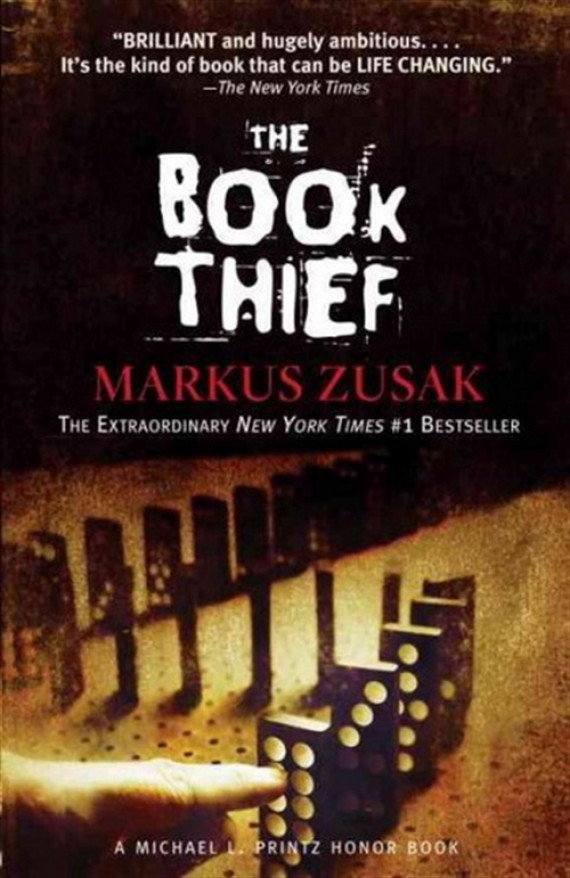
The Book Thief (2005)

by DionysusPsyche

Books, books, books
As an elementary school and junior high student, I read a handful of unforgettable books. They not only gave adolescents across the board literary heroes their age to admire, but transformed and hopefully imprinted the history on the minds who read them. The books were based on actual events and sturdied by strong roots they were tied to (minus the non-fictional account which was also important which I will mention by name shortly).

Every few years though, it felt like we went back to one particular point in history—a horrific and saddening series of years that everyone, most of all teachers of young children, thought were important lessons to learn. After all, ages ten through fourteen can be the sweetest or the cruelest years of all.

A Book About Someone Who Loves Books
The Book Thief revolves around a little girl who is present during the rise of Hitler and the Nazis and what it meant for her and others, like The Diary of Anne Frank or Number the Stars. The book doesn't hit you over the head with facts (although it didn't obscure them either), and you don't need to know much about the war in order to read and enjoy the story. Although it's a good idea to prepare yourself.

The narrator is the most apt and unusual one I've come across so far—it is told by Death. By the time he tells the story, it is many years past the war. Yet, he remembers it accurately—how could he forget? Death is weary, reluctant, and knows no rest. He's collected many, many souls, and he is not a narrator who enjoys his life's work, although he tries to do right by it. Claiming he is always in “the right place at the right time,” Death has, like those he takes with him, been dealt a hand to play. When he first comes across the book thief, otherwise known as Liesel, he is intrigued.

Upon first learning the truth about the narrator, I was hesitant to continue. It's disturbing when the voice of your novel is the ultimate fear, and when the time is 1930's Germany, it is obvious he is going to be an integral part of it. He's not the side character as is the voice in The Great Gatsby or someone you can initially write off like Holden Caulfield in Catcher in the Rye.Yet, I wanted to see where he was going with this, and thankfully I did. There may be solemn and depressing moments, but the happy ones and the optimistism that comes out was one worth reading and waiting for.

A piece of what draws you in is the fact that Death drops hints and not-so-veiled spoilers about what will happen, but the reader doesn't know when and how these things will take place. Hence, each chapter brings a quicker heartbeat and even segments that begin benignly and beautifully carry an air of apprehension, which must have been what it was like living back then.

Characters
Liesel, like the story teller, has seen a rough life. She's adopted just after watching her brother die in her arms. She's scared, sad, and confused. Throughout the novel, as things become worse for Germany and Liesel's family, she, like any young girl, comes into her own. As a child, when things are off, one has the sense that something is wrong, but not how or why. This is how Liesel feels at the beginning, but by the end of the novel, she has a clearer sense of what is right, what is wrong, and what lines can be blurred due to the state of the country.

Fortunately, she has some wonderful people in her life that play significant roles in making her the woman she becomes. Her father, Hans Hubermann, is an upstanding, gentle, and joking painter who plays the accordian. He also teaches Liesel how to read. I loved Hans, and from the moment he's introduced, I knew that he's going to be for Liesel what Atticus Finch is for Scout.

Despite their poor existence, her father rarely has work and her mother does laundry for a select few of the richer folks in town, Hans tries to give Liesel a better life. He soothes her nightmares, he hugs her, he sells his cigarettes (one of his few wordly pleasures) to buy her Christmas presents. Hans is everything a father should be, and he's also one hell of a friend and employee, cheering up those around him, making wise cracks, helping out those less fortunate to create a better world.

Hans' one shortcoming in the book makes him a hero in ours—he is not a follower of the Gestapo nor a member of the Nazi party. Hans is the first person we meet in the book who is a non-conformist, and during that time period, it was not only popular in Germany to be pro-Hitler, but it was dangerous if you weren't. Hans attempts to hide his beliefs and keep his opinions to himself recognizing the problems it could cause for his family. Yet, because he's such an upstanding person, his true colors shine through to those who know him, and it causes rifts.

But my favorite person is Liesel's best friend and neighbor, Rudy Steiner. In many ways, Rudy is a younger, brighter, more boisterous and exuberant version of Liesel's father. Except Rudy is a little crazy. He's obsessed with the athlete Jesse Owens, loves soccer, and adores Liesel. Constant confidantes, Rudy and Liesel are inseparable and always up to something together—Liesel's always looking for a new book, and Rudy's always hungry. He would do anything for her and does do a great deal.

The Best and the Worst of Us
Because it is a novel aimed at youth, many disconcerting, uncomfortable, and awful daily and historical moments are left out. War does involve perishing, and the narrator reminds us that victims are random. The ones left behind often feel responsible and bad for having escaped it. Guilt and abandonment show up frequently in the novel. However, Liesel's opinion of abandonment shifts slightly as the book, and the war, progresses. She learns that people move through our lives, and a reason for leaving, in certain circumstances, is to protect us. Kindness is also something Liesel gains through bravery of doing the right thing. Of course, she already has some kindness in her, but she borrows some from the friends and family she makes along the way.

Conclusion

Zusak superbly paints his words, and he uses them so well, that The Book Thief may become one of my permanent favorites. I found memorable quotations everywhere without trying, and his characters only improved further along. His writing is comparable to a meal you've been looking forward to, one that will be better, tastier, and something appreciated. First, you'll start to salivate at the idea, then you smell the meal. You take the first bite, and eat voraciously, until you remember that this dinner (or lunch or breakfast) is a priveledge, and then you slow down. Soon, you're full. You sit back and digest, but after a bit, you keep trying to eat again even though it hurts. Even when I put it down, The Book Thief was never far from my mind.

It is a classic to add to the collection of interesting and amazing literature that is essential for not only its timepiece in history, but for the heart. I wouldn't recommend it for very young children, and at times, I found the emotional waters heavy to navigate, even as an adult, or maybe moreso because of adulthood.

However, I think that the audience from that suggestion is wide enough to include anyone who enjoys a whole hearted story of herocism and a reminder that despite all the evil and fear in the world, there are wonderful humans with good intentions.

Sunday, August 26, 2012

Sea of Ghosts

 Written by Joe the Revelator


I've reviewed novels by Alan Campbell in the past, and my feelings about his work are usually mixed. It's stimulating, imaginative, deeply emotional, and borderline insane. Paradise lost meets the industrial age. The flaws displayed by his characters strike personal nerves, and the violence is visceral and bloody.

On the same token I've said a few disparaging things about his sequels. The Deepgate saga seems to follow a crooked, meandering path that often breaks from the main characters to follow other, stranger viewpoints. That said, and having had more time to reflect on his later work, there's nothing in Campbell's collected material that I regret reading. His strange visions of hell on earth, and of noxious forests and glass trains still pop into my head from time to time.

Sea of Ghosts is a beast of a slightly different stripe. It's closer to a traditional "Fantasy" with magic and treasure, bizarre powers and elves (not called elves, nor do they have pointy ears. But they are a mystical, tall, waspish race with light hair) Dragons play a part in the story too, as do ghost-ships and mermen, which are more like oceanic zombies.


The Sea is a Harsh Mistress, with an STI

The story starts out with promises of trove. And let me be clear that although the word trove (as in treasure-trove) is thrown about, Sea of Ghosts is NOT a pirate-themed book. Trove is a term used for magical items imbued with powers drawn from the cosmos, or from a yawning void in the cosmos, as one of the characters tried to explain late in the book. Trove is money and power, and it is found at the bottom of the poisonous seas.

A dunk in the ocean without washing off the brine will result in a tight, infected patch of gray skin. A full-body dousing will turn you into a gray-scaled monstrosity known as the Drowned; wandering the sea bottom, breathing the brine. Which leaves the dangers of trove-finding and dragon-slaying to men experienced with the sea's fickle nature. Think Dune's deserts, except wet, and slowly rising to consume what remains of the land.


Granger, an ex-military officer turned prison warden, lucks into the best trove finding tool in the empire; his own estranged daughter. With her uncanny ability to see treasure lying on the seabed from the bow of a boat, the two of them are able to haul in more curious brass artifacts and glowing gems than anyone living on the island. Which, of course, begins to attract unwanted attention to the young girl who Granger is just getting to know.

But you don't mess with a Gravedigger. And Granger's past as a naval lieutenant and a hunter of Unmer (magical not-elves) has given him a 'very particular set of skills' as another enraged father once said. The inevitable kidnapping of his daughter sets Granger, aka Unstoppable Force, into action- blowing through virulent waters, haunted ships, fortresses, even cosmic roadblocks. It's hard to make men this driven seem believable, but Campbell does it.


Don't drink the water

I haven't read a novel that so completely captured my attention in a long while. Campbell throws illuminating descriptions and intriguing ideas out like live wires for the reader to grab onto, and doesn't stop to dwell on his own neat notions, like so many other genre writers. A few things are reminiscent of other fantasy works (I swear to god he was playing Skyrim while writing this, or channeling 'Dwemer' ruins) but any similarities are easily forgivable. Most fantasy overlaps itself until it becomes a giant tapestry of the collective human subconscious anyway.

Tuesday, August 21, 2012

A Dance with Dragons


Yep, I finally got around to finishing A Dance with Dragons. And, to my astonishment, it was actually pretty damn good! It helped that it was preceded by the Game of Thrones equivalent of a pile of poo (I'm sorry A Feast for Crows, but you just weren't that interesting). But, more seriously, I think that its quality was about comparable to A Clash of Kings in terms of cool stuff that happened and characterization that occurred.

Now, I'm definitely going to talk about this, but I wanted to point out that I'm going to do two things with this review. First off, I am going to review it by viewpoint character. Every character that gets a chapter will get some commentary from me about if he/she was interesting and how they went. The other thing is that I'm going to avoid major spoilers. I will share what I think of as “minor” spoilers (such as where the characters are and their general goals in the book), but events of crazy awesome will be at most hinted at, no more.

Without further ado, I present A Dance with Dragons!
.

Jon Snow

You're goddamn right, Jon's back, and he's more epic than ever. When we last saw Jon, he had near single-handedly taken the shittiest rangers in all the lands to beat back a Wildling army worthy of Mordor, long enough for one Stannis Baratheon to show up with all of his knights to lay the smackdown. Now in ADWD, we find Jon as Lord Commander of the Night's Watch, balancing carefully on a path between supporting Stannis' claim to the throne and preparing the Wall for the invasion of the Others.

Jon's chapters are freaking awesome. Through his station at the Wall, we see how difficult leadership can be and, by god, Jon is going to stick to his principles no matter what. He has always been an admirable guy like that, and that aspect of his character bleeds through especially strongly in ADWD. Watching him try to recruit the Wildlings to his side while placating the Night's Watch veterans while trying to retain Stannis' help while doing his best to stay out of the gargantuan war happening to the south of him while preparing to repel this fictional universe's equivalent of a Nazgul army... This is one shitty situation. Ancient Night's Watch fortresses are prepared, factions are approached for help, a lot of people tell Jon he knows nothing, and WHOA HOLD ON. Stuff actually happens in this book?? Thank you, George R.R. Martin!
.

Tyrion Lannister

Oh wait, this is the Feast for Crows shit that I remember. Yes, unfortunately the worst part of ADWD is that it somehow manages to make Tyrion Lannister chapters uninteresting. The sad part is that he starts out so well. Tyrion has just killed his father and escaped onto a ship heading to Daenerys is on. After a great deal of drinking and whoring, Tyrion decides that h should go find Dany and serve as an impish Machiavellian advisor, kicking her in the pants to go conquer Westeros with his help. Holy. Shit. Epic, right?

Then we get a truly grueling amount of chapters where Tyrion apparently decides to take the longest route possible to Dany. Seriously. This is a spoiler, but he never even really gets there. We meet some thoroughly uninteresting characters, a few that are really important, and then suffer through him learning how to entertain people with his dwarfishness. It's not all bad; he does start manipulating people like badass old Tyrion near the end. But most of it is one interminable trek after another where nothing of real note seems to happen. That and an enormous number of people giving him dwarf noogies (though this is awesome; it is apparently a tradition on this continent to rub a dwarf's head for good luck, and it happens a LOT).
.

Davos Seaworth

I've always been a huge fan of the Onion Knight. There's something about his character that is just really cool. He's like everyone's favorite uncle, if uncles were regularly faced with starvation and death. Davos never lets up, and his personality is so solid that you're able to see a lot of what happens in the series through how relaxing his chapters can feel.

Anyways, Davos is given a mission from Stannis. He is tasked to approach White Harbor, the wealthiest city and vassal of House Stark, as a diplomat and envoy in order to convince them to swear fealty to Stannis and ally together against the factions who betrayed Robb Stark (Lannisters, Freys, Boltons) and killed most of the Stark household. He is presented with a political situation so bizarre as to seem Shakespearean in the theatricality of it. Needless to say, it is awesome, and the results have a huge impact in what happens in ADWD. Yes! Things happen AGAIN! Oh, I love you so, George R.R. Martin!
.
Hawt
Daenerys Targaryen

Goddamnit! Yes, dear readers, it was a trap and, despite the sheer marvelousness of Dany in the previous few books, George R.R. Martin manages to make her a pain in the ass in this one. Now, let me clarify, it isn't that things don't happen in Dany's chapters that makes her irritating. It is the fact that the things that happen with her don't seem to really matter in the larger conflict, and the fact that she starts acting against her character.

We find Dany managing the city of Meereen and doing her best to be a benevolent queen. She rejects the slave trade, manages alliances with nearby cities, hires mercenaries, etc etc. But because it involves nations and factions that we don't know and who don't appear to have any relevance to anything happening on Westeros, I just lost interest after a while. It doesn't help that Dany starts to compromise and give in to pressure. That's right, the character most famous for being the uncompromising determinator starts to go back to being a scared little girl. Then she chooses to sleep with a thoroughly unlikable character, marry another, and generally be kind of stupid.

But it ends with her in a much better place than she was before, so there is hope that she'll do something useful when Tyrion shows up in the next book.
.
This pretty much sums up the weirdness of the average Bran chapter
Bran Stark

Bran Stark is one of those characters who I hated for a long time. From the moment he was crippled, I replaced the name “Bran” with “That-Interminable-Whiner-Cripple-Kid”. He just wouldn't shut up. And the references to his purported powers were so cryptic that I just couldn't care less.

Needless to say, this changes in a huge way in ADWD. I wanted more Bran chapters. A lot more. We encounter Bran where we left off, with him passing the Wall and going deep into the land of the Others, searching for the Children of the Forest. All I can say without spoiling more is that he finds the Others. And he finds the Children of the Forest. And a lot of awesome and weird shit happens that indicates that Bran might have the most important viewpoint of them all.
.

Arya Stark

I have to admit that I don't have much to say about Arya. While she was on Westeros, she was one of the coolest characters of them all. But in Braavos (a city in the middle of nowhere on the-continent-we-don't-care-about), Arya continues her assassin training surrounded by characters who aren't interesting who we don't give a second fiddle about. If you like this growth in her character, then you'll love her chapters in ADWD. But because I've read far too many books about training characters to become assassins, and because I have no connection to what is happening around her, I really don't care. I skimmed all of her chapters.
.

Asha Greyjoy

Our first new viewpoint character, Asha is the first and only Greyjoy we've met who is actually likable. She's a badass girl who grew up into a sexy, independent woman, all within the most grotesquely masculine culture since the Vikings. And she owns it. In ADWD, we find her within the occupied castle of Deepwood Motte (a Stark vassal located near the western shore by the Greyjoys). She gets the second hottest sex scene of the series. She weighs her chances, what with a hostile uncle now in charge back at home, takes her men, and decides what she wants to do.

She then joins up with another group and serves as a viewpoint character for the movements of one of the more important characters in the series. But I can't tell you who without spoiling things. Regardless, Asha has a lot go on with her point of view, and I found her a thoroughly enjoyable character to read about.
.

Quentyn Martell

Another new viewpoint character, Quentyn Martell is less interesting. An uncharismatic heir of House Martell, he is sent by his father to marry Daenerys. Unlike Tyrion, Quentyn actually makes it to Dany and presents her with an offer; if she will marry Quentyn, Dorne will give Dany the military that she needs in order to take Westeros. In exchange, Quentyn becomes king and Dorne the paramount House of the realm.

Dany's answer is for you to figure out when you read the book. As for Quentyn's character, I kind of liked him. I say it like that because he doesn't really have much to him. He isn't handsome, clever, or skilled in combat. What he is is dogged. He sticks to his guns. And his men listen to his orders, even though you can tell that they might not necessarily impress them too much. Quentyn isn't the most interesting character we've ever seen in the Game of Thrones series, but I found him fairly interesting on the whole.
.

Theon Greyjoy

Yes, Theon Greyjoy isn't dead. Some may groan at this revelation, but I thought it was pretty cool. The thing is that, even though Theon has always been rather annoying in his own way, he has changed. He is held captive by House Bolton (which is apparently the House for all of the creepy assholes of the realm). He has been thoroughly tortured and abused. He doesn't even identify himself as being a Greyjoy for a long time.

But he starts to become a better person. And this makes Theon perhaps the most deeply characterized person in the series, turning from arrogant douchebag into defeated trash into something more. On top of that, Theon manages to serve as a viewpoint character into the machinations of the Boltons, the Freys, and a bunch of other Houses besides. This made him one of the most interesting characters to read about and, on top of his characterization, made me genuinely hope that he turns out okay in the end.
.

Barristan Selmy

Barristan the Bold gets his own viewpoint chapters but, unlike aforementioned others, Barristan's kinda suck. For whatever reason, Barristan shifts from the wise old Gandalf-like father figure for Dany to that-one-old-guy who stands in the corner and never says anything. Even when Dany makes poor decisions, he never says a word unless prompted and, even then, he doesn't say much beyond, “Make queenly decisions so I can keep standing prettily.”

He does end up taking some initiative in the end but... Frankly, he spends most of it whining to himself about how “true knights only do things that are pure and righteous”. Which kind of drains some of the awesomeness out of the asskicking he delivers. For someone who seemed more than willing to provide his thoughts and act independently before he was made head of the 'Queensguard', Barristan the Bold seemed to turn rather timid.
.

Everyone Else

Victarion Greyjoy pulls a less interesting Tyrion. Spends most of the book traveling to Dany. Doesn't get there by the end.

Cersei Lannister has a small handful of rather interesting chapters where her back is against the wall and we actually, finally, see her overly prideful facade crack, revealing a character who we can actually care about who isn't a power-crazed harpy bitch.

Melisandre gets a chapter which is really cool. And everything that happens with her is really interesting new information. But she only gets a chapter, so her importance is fleeting.

Jaime Lannister gets a chapter where he dashes off with the only person he'd predictably dash off with.

Areo Hotah (the blandest character in the series whose only purpose is to give us eyes into what's happening in Dorne) shows us that Dorne is secretly planning some really epic and crazy shit.

And then, finally, a new character named Griff turns out to be someone who will shake up the world of Game of Thrones in an enormous way. Then he begins an invasion. Really cool stuff.
.

Conclusion

Altogether, I really enjoyed A Dance with Dragons and recommend it to those who enjoyed the series before A Feast for Crows. Yeah, Dany and Tyrion's chapters are a bit disappointing, but so much happens elsewhere that it didn't bug me that much. When/if other people read it, I'm looking forward to hearing some other thoughts out there!


Monday, August 20, 2012

Sherlock

Written by Joe the Revelator


Ever since reading The Adventures of Sherlock Holmes by Arther Conan Doyle, I've had an affinity for British sleuths from Baker street- crusaders with an eye for detail and a magnifying lens in their waistcoat pocket. After watching Robert Downey Jr. nail the role of Sherlock Holmes with a twist of humor and a slice of hyper-vigilance and aspergers, I thought; who could possibly do better?

Enter Benedict Cumberbatch. (War horse,  Atonement) Young-looking for a Sherlock, modern, and plays the classic detective a bit on the fussy side. But with the success of the show riding on the strength of his portrayal, I say he nailed it. His need to be validated, to show he's always 'right' takes precedence over all else, even going so far as to risk poisoning himself to prove it. Downey's character was fastidious. The new Sherlock is downright anal.

Cumberbatch's Sherlock is accompanied by Martin Freeman (Hitchhiker's Guide to the Galaxy) as Dr. Watson. He's a friendly, personable, salt-of-the-earth type. A battlefield medic just come back from the war. He's introduced to Sherlock through a mutual acquaintance when John expresses his need to find a roommate, and it's love (for sleuthing) at first sight.


Digital Detective

As it has always been in any adaptation of Sherlock, the diaries of the detective's conquests are kept by the good doctor. But to add a modern twist to Watson's storytelling, the trail of cases are kept on a blog that steadily attracts more clients and crime investigations. Sherlock's methodology has also gotten a kick in the cummerbund by the modern boot. He uses cellphones and text messaging, crime labs and microscopes, laptops and card readers. Instead of coming off like a cheap CSI knockoff, this digital era Sherlock manages to enhance his repertoire in ways that would make his horse-and-carriage predecessors jealous.

To say the hour-and-a-half episodes are humorous might be an understatement. Dry wit is plentiful in the most British of ways. And a tip of the hat is made to both written works about Sherlock Holmes and movies. One of Watson's blog entries is titled "A Study in Pink", which is a reference to the original Study in Scarlett. Hounds of Baskerville are actually H.O.U.N.D.S, a fictional elite unit of soldiers. And Holmes' sexuality is brought into question more than once, as it has remained questionable in almost all adaptations. Sherlock Holmes: A Game of Shadows was one long gay joke.


Long Format

My only complaint about Sherlock might be the length of the episodes. As I mentioned, each episode is around 90 minutes, which makes it difficult for someone with a busy schedule to enjoy it all in one sitting. At least compared to most 50-60 minute serials that have cropped up.

Also be prepared for lulls and long moments of deep contemplation. The clues and deductions may be fast paced, but the action is not. Doyle's Sherlock hardly ever got into any scrapes at all. It feels to me that modern adaptations of the character go around picking fights, just to show he can locate someone's liver with his knuckles.

Friday, August 10, 2012

The Witch of Blackbird Pond

by Dionysuspsyche
Synopsis and History
This classic young adult novel by Elizabeth George Speare was one of my favorites growing up. Upon finding it at a great price, I got it, and reread it. Since I'm no longer technically in the YA category, this book took on a whole new light that I didn't fully appreciate as a child.

Kit Tyler, the grand daughter of a wealthy Englishman, leaves her home in Barbados after his passing to live with her last living relatives in Connecticut. The year to date is April 1687, and life in Puritan New England is quite unlike the life Kit has been used to living. With her life turned upside down, Kit does the best to make herself a part of the Wood family. Despite her best efforts, Kit just doesn't manage to fit in. Her cousin, Mercy is a kind and patient teacher. Her cousin Judith is vivacious, beautiful, and easily jealous. Both are excellent with the house and yard work. Kit is not devout enough for her Uncle Matthew with his short temper and dislike of change. She's not as obedient as her Aunt Rachel would prefer. She even is a disappointment to William and John, two men in town who both seem interested romantically in her.

Her frustrations wane when she meets Hannah Tupper, an old woman the town calls a witch. Kit gets to know Hannah and finds in her a mentor with whom she loves to spend time. The "witch" even helps Kit resolve anger with others, even if Hannah does not personally agree with them on all fronts. Her purpose is served as a guide and counselor, whereby she is the proverbial Yoda to a Jedi of sorts. In return, Kit helps the old woman when she needs it the most.

An important aspect of the book to note is basic background history. As of the 1600's, Columbus had discovered America, but the Declaration of Independence had yet to be signed for almost another hundred years. The country was in constant anxiety over whether the King would revoke his freedom to America. Many places in the United States had slaves, although it wasn't in abundance until the 1800's. The Salem Witch Trials were about to happen in 1692, but were yet to transpire.

Motifs: "If they only understood"
It is frequently stressed that people misjudge others without knowing them or trying to understand things from their point of view. This not only happens to Kit when she feels that others disapprove of her (she can swim, wears glamorous clothing, and is rebellious), but it even happens to her in terms of the way she views the townspeople--especially her Uncle Matthew. As Kit is brought to light on why her family has the traditions they do, why the Puritans seek independence from England, and why her uncle is seemingly cold and unforgiving, Kit's understanding and respect for those around her grows. This is not to say that Kit changes her mind about everything, but she is brought to a better understanding of the way things are.
I can't help it. Uncle Matthew always looks like this to me. Maybe because he built the wood house they live in with his own bare hands.
Spiritual Showdowns
Religion is also a frequent topic of the book. There is much bickering and prejudice between various religions and loyalty (at one point so heavily so that one of the characters becomes very ill and is not brought a doctor due to the doctor's allegiance). There is also the question of whether religion requires the use of politics and whether one should completely follow the works and ideology of his/her predecessors (in the most common instance, the pastor and doctor in training) or if they should combine both what is known with what one believes to be right future path for oneself.

The author stresses that holding beliefs too tightly can become problematic in relating to other individuals or groups so much so that it causes bigotry, isolation, and wild accusations/stereotypes. The other extreme where one is so loose in one's beliefs and so willing to accept what one is fed can lead to frustration, confusion, and unhappiness. Neither extremes are good.

From my observation, the book does not take a stance on what particular religion, if any, is preferable. What the author does do is show that religion has two sides: dark and light. Kit learns from all the people in her life what religion can mean in terms of love, values, and regimen. At the end of the book, Kit sets aside one of her dresses that she would like to give to her cousin. She tried to do it at the beginning of the novel as well, but this time, she thinks, "he would know now that she offered the gifts with love instead of pride" (p. 217).

Home
Throughout the book, Kit is constantly grappling to fit into the puzzle of home and comfort. Even when her place in the household becomes more secure and serene, she longs for what she once had and what she views as her future. For one, Kit never gets over the weather, the lack of color from birds and flowers, and a feeling of content. There are a few people and places that Kit feels truly at ease, and by the end of the book, she finally realizes where she truly belongs.

Conclusion
I don't tend to enjoy fictional novels based on historical facts. Fortunately, this is a loosely enough based story that the background does not interfere or impede upon the story or history itself. I adore this book. It has a lot of philosophy, romance, and fun to it. You can definitely tell that the main character, Kit, is a teenager, but there's rarely a character in the book that is not in his or her own way interesting. The way the characters stick together and save each other is beyond amazing. I recommend this to anyone ready for a light read with a lot of sentimentality (it's a quick read, and the characters form in one's heart easily).

Monday, July 23, 2012

Luther

Written by Joe the Revelator


Cop shows and police dramas have never been a big interest of mine.  CSI, CSI Miami, NCSI, ASDF-CSI, Miami Heat...It's a game for people who like to guess who the killer is, why the killer went on a spree, and what evidence will turn up to convict them. The same vindication can be had from reading Encyclopedia Brown novels, or if Jeopardy had a killers and victims episode, and the audience could guess at the categories without feeling dumb when Alex Trebec hits them with "Who Is: Ed Gein?"

Luther is all the crime drama and the police politics interplay without the feeling that you're being brought for a squad-car ride along, or that you're a lab tech fumbling through last year's cutting edge crime analysis tools. Luther, played by Idris Elba the captain in Promytheus, is a cop-on-the-edge, spiraling out of control after catching one too many kidnappers.

His first real breaking point and the opening scene is of a child predator hanging from a catwalk in a warehouse like the Joker, waiting for the good-guy detective to haul him to safety. Without knowing the inspector's background it's still evident he's struggling with the notion of upholding the law when he has the opportunity to remove an infected limb of society by simply not lending a hand. Dirty cop? That's the whole magnificent package, from seasons one to two.


Offices are made to be broken.

The foes Luther faces are as stunningly strange as the rivals in a Sherlock Holmes novel. Alice, played by  Ruth Wilson, is a sociopath extreme. Her flop of a case is one of many recent failures Luther is faced with, which somehow earns him a companion, albeit a very disturbing one. And the challenges get stranger, between men he's known and worked with turning the guns on him, to a severe case of Role Playing, which a pair of 'Gamers' roll dice to see which weapons and methods they'll use to slaughter groups of innocents.

I honestly don't know why Luther works at the police station at all. Any real stumbling block in the case, any argument with his wife, results in a broken window or a smashed keyboard. Watch the series on Fast-Forward and you could make a drinking game out of the show. Every time he breaks something take a drink. If he does something ludicrously self-destructive (playing Russian roulette, dousing himself with gasoline, running into gunfire) take a shot.


That's what the killer said.

If my judgement of Luther so far sounds overboard, that's because it is. It's amazing they've kept up the tension this long. Any real cop would have been suspended, killed, or just plain retired after making so many back alley deals. The third season should have Luther sitting in a doctor's office complaining of high blood pressure and a ulcer. Watching this show could give you both. But like me, you might love every minute of it. Despite having the drama in the red for every minute of every episode, Luther manages to come off smart and compelling. You may feel you need a hot bath and an antidepressant, but it's worth giving it a spin.

Sunday, July 1, 2012

Dark Visions by L.J. Smith


by DionysusPsyche

Extraordinary people live among us, but you may not know it. You may just call them witches or freaks or losers. But they can read your mind. Or predict your future. Kaitlyn Fairchild lives in such a world—one where her gift of seeing the future is more of a curse. It manifests itself in her art, an itching she gets in her hands to draw. Yet, what she draws troubles her and others in her small town. She's an outcast left to a lonely existence. One where she has no friends, and her fellow students are afraid of her. All from a talent she can't control.

One day an outsider comes to her based on some nationwide testing she's done. A private company wants her for their research project. Then Kait discovers a life that she's always envied, and one that puts her in danger.

In this three part series by L.J. Smith, five teenagers are chosen by researchers for the Zetes Institute. They each have different gifts, but together, they are an unstoppable force. They are told it is to better hone their powers, because they are special. But what is the motive behind the head of the institute?

Contradictary Emotions
The book talks a lot about this topic. From the very first paragraph Kaitlyn, who is listening to other people plan a party, is torn—between disgust and desire. She wants to go to the party, but she hates the girls who are planning it for shutting her out. Not inviting her in. Not accepting her as one of them.

Throughout the novel, although Kaitlyn is increasingly accepted by her friends, she still seeks out acceptance. It could be because Kaitlyn wants to help people, or it could be that she worries about what will happen if she doesn't help.

Everyone has conflicting opinions and feelings about the people they meet. Teenagers more than most. Kait is drawn towards two characters in particular in the book, both for clear reasons. The first is the most positive, giving boy that Kait has ever had the pleasure of meeting. The second boy is described frequently as troubled and handsome. Kait aspires to be like Robb—the salt of the earth, the best of the best. Yet, Gabriel is the one she wants to save more than anyone—more than any of their friends. To most, he's just a screwed up boy with a broken and terrible past. Kait sees potential in Gabriel, and while everyone else is afraid of him, Kait sets out to help him. To rectify his soul. She sees good in him when no one else does and believes he's meant for something better.

Light and Dark/Fire and Ice
The colors described are very vivid, and all the kids are described like elements. Kait is fire with aquamarine eyes. Rob is always spoken of as full of light in a few ways. He's physically blonde with golden eyes, often naïve, and has an energy that flows into others that causes bright properties and feelings. Anna's last name is Whiteraven, describing her goodness, heritage, and connection with all living things. Gabriel Wolfe is dark, with dark actions and brooding moods. Lewis Chao is the only one who doesn't seem to match any of these.

Kait and Gabriel moreso than any of the others exhibit signs of fire and ice. Gabriel goes back and forth between angry outbursts and icy silence. Kait is strong, like fire, but also prone to occasional outbursts (wildfire?). Gabriel is especially torn between good and evil. Kait wants them all together, and she wants to bring out the best in Gabriel. One of her goals throughout the books seems to be to prove to him that you don't have to be perfect to be good.

When there is a harbinger of evil in the air, the group feels suddenly cold. They suddenly start getting cold for no reason, and then something weird happens. There are also warm feelings that are associated with tenderness, romance, and passion.
Sir Ian McKellan, sorry, I picture you as the villain...who is melting their brains!
Control: Good vs. Evil
Supernatural story telling is always about a struggle for control. There's always a villian who's trying to usurp the world's resources and use them for evil. Taking the innocent and turning them into monsters. An excellent example of this is Gabriel who seems to go back and forth between the two, between being a good guy and a bad boy.

Not unlike X-Men First Class, one of the challenges is learning to master talents. Wielding someone who's labeled an outcast and turning them into a threat or a powerhouse of either extreme. It is also up to each individual in the novel to decide whether or not they want to be good or bad.

There is also the aspect of mastering your talents and taking charge of your life. Regardless of intention, all the characters in this novel strive to take control of their life. Rob and Anna always do the best thing possible, Kait and Rob are the leaders, although Rob struggles with controlling the good in others more than Kait does.

Dance, Magic, Dance”
Emotional intelligence
Because they have extraordinary talents, the crew end up linked telepathically. This gives each character in the pentagon (not to be confused with a pentagram which is a pagan symbol) the ability to connect mentally with one another even if people who are not linked to them are physically present (the ordinary equivalent of passing messages during school). They learn how to block thoughts from coming in or out and how to direct messages at each other without the rest of the group knowing. This causes a heightened awareness that teens may not necessarily experience due to hormones and their brains being only mostly formed (not done forming until they're 25). Additionally, they bury feelings they don't even know they have to avoid being “heard” by other members of the group. Some members even alienate themselves from the group to avoid overloading themselves, because with distance comes freedom and stress relief.

They also become good at reading each other's feelings, and their own. By the end, the group seems to have mastered themselves in more than just their talents and are beginning to know what they want out of life or how to make the world a better place. The two main characters grow over the course of the three part story, and are better able to read others' intentions as evil or good.

Sexual Energy and Healing
Since this is primarily aimed at teenage girls, the author has to be careful regarding views upon physical encounters while continuing to appeal to a younger age set. The answer, of course, is psychic vampires. Vampires that are not your average blood sucking type, but the kind that are mentally energetic and can drain their victims of life.

It also gives certain individuals the power to heal each other spiritually. One way is through holding one another while kissing, another is touching an area (i.e., a knee or elbow) that is in pain. Yet, when the transfer of energy occurs, so does emotional attachment. Power draining can take a life, but giving energy to another is an incredibly bonding and dangerous action. It's beneficial to both parties, but also is causes side effects of varying extents.

Mythology and Religious Tradition and Folklore
The novel contains lots of history on legend and story telling. Anna, the Native American girl, is extremely tied to her past and her culture. The others are very well versed on the magical tendencies of other cultures. The book draws on these to add strength and pride in tradition and also a respect that comes with it. At the same time, the message that breaking tradition to make way for better things is stated. There's an emphasis on being neither passive nor aggressive but using resources to enforce good and destroy evil.

Below are the characters I picture in my mind when I read the book to go along with the description. Don't let the pictures fool you into thinking some amazing (or disappointing) movie is being made.

Anna Kendrick
Kaitlyn Fairchild
Spirited, beautiful, and intelligent, Kait discredits her power as it is initially uncontrollable. Through her mentors and friends, she is better able to hone her power and to use it to benefit the group. Unlike most of the group, Kait isn't afraid to go against expectation if it means bettering her friends and the people they meet along the way. She also grows as a woman as she discovers love and learns what it really means to love another.
Natalie Kelley
Anna Whiteraven
While she's a picture perfect sidekick, she doesn't overshadow Kait by any means. At times I felt frustrated, because she and Lewis weren't as well developed as some of the other characters, but Anna in and of herself is shy, sweet, and calming. She can't truly be the heroine like Kait; her traits that are better for supporting and nurturing. The force to be reckoned with and the mysterious sneaky side of Kait aren't things that would come naturally to Anna, although she does change over time to become bolder.

Ian Somerhalder
Prince Zuko from the animated tv series Avatar: The Last Airbender
Gabriel Wolfe
His very name is a contradiction. I actually did think of Prince Zuko's voice every time Gabriel speaks since his character is so conflicted and full of anger. Gabriel brings to mind the angel or Saint Gabriel who was the patron saint of messages (since Gabriel is a telepath, this works). The surname is also helpful for making one realize his/her spiritual destiny. His last name conjures fairy tales. A sheep in wolves' clothing or whether or not he is to be trusted. Of course, wolves also have a foreboding reputation that precede them, not unlike this one, and cannot be caged. Like Prince Zuko, Gabriel is also a contradiction, a boy with a dark past torn between good and evil.

Damian McGinty. Yes, I know he's from Glee. No, I don't know why I pictured him.
Rob Kessler
He has the ability to heal which is both convenient, extremely beneficial, and a main attraction for the ladies. He's morally just with a wholesome and optimistic outlook. He believes in a common good, would never do anything to hurt another, and he's very trusting. In many ways, he's the opposite of Gabriel—they're light and dark as the book says.

I never really connected with Rob's character after the first book. In some part, that's intential, but Rob didn't have the situation or circumstances to grow like the rest of them or wasn't able to due to his complete belief in what is "right." His friendship with Kait changes significantly over the three stories, but it's necessary. They do something to “tidy up” his character at one point that I disliked.
Wang Lee Hom
Lewis Chao
In a lot of ways, I felt like Lewis was just “there.” He's telekinetic, but I could count on half a hand, if that, the number of times he uses his powers. I'm not sure if there just wasn't an outlet for him, but I would've liked to see him more involved in the story—most of his character is laid out in the first half of the first book. He's described on several occasions as being “uplifting,” but his situational negativity seemed to surprise the others, while I was practically yelling at the book that Lewis wasn't mentally prepared for these things and that he was pessimistic given the situation.

Conclusion
I was pleasantly surprised by this find. It's not my usual genre of entertainment, but it was enjoyable nonetheless. I'm not normally interested in stories about vampires, psychic or otherwise, but the supernatural intrigues me.