Tuesday, May 17, 2011

The Girl with the Dragon Tattoo


The first book of the outrageously popular Millennium trilogy by Stieg Larsson, The Girl with the Dragon Tattoo proved up to the task of overcoming my automatic bias against "popular books". For as long as I can remember, I've always shied away from reading books that have ever been in the center of the public's eye. The Da Vinci Code, Hunger Games, Middlesex, The Kite Runner... These are examples of books that I've avoided like the plague, all out of the assumption that the general public is terrible at judging what a good book is. Elitist, I know. I can't help it. It comes from a long history of reading.

Anyways, this is why it was a rare event for me to even consider The Girl with the Dragon Tattoo, much less read the damn thing. And, despite my reluctance and foot-dragging, I did enjoy the book immensely. It blends mystery, thriller, and crime novel together seamlessly into an interesting and rare setting: that of Swedish big business, journalism, and well-to-do family organizations.

Unraveling the Swedish Countryside

The first thing that immediately becomes clear is that this book was written quite well. This is especially remarkable when you consider the fact that it had to get translated from Swedish to English first, and yet still manages to retain an addictive power. Stieg Larsson discovers that perfect balance between feeding the reader details while keeping the events simple and well-paced. If you had told me before reading this that I would be excited to learn about Swedish business practices and obscure family history, I would have laughed in your face. But, somehow, the author manages to adroitly pull this off.

Another aspect of The Girl with the Dragon Tattoo that caught my fancy were the two main characters, Salander and Blomkvist. These two individuals are as different as can be; Salander is a very young woman who is perhaps most easily described as a very intense, smart, determined, goth hacker with issues; Blomkvist is a man in his forties who is an insatiably curious, kind, journalist/ladies man whose reputation is soiled from the very beginning of the novel. These two end up working together to uncover one of the darkest family secrets I've ever seen in a story, and they do it through an exciting mix of journalistic deductive skills and cold, logical analysis that keeps you incredibly interested as each fact passes before your eyes.

The Mother of All Mysteries... Or is it?

My main complaint is, after I thought about it, maybe a little unfair. In essence, I found it irritating that, unless I'm mistaken, it is completely impossible to try and figure out for yourself how the story is going to end. In my experience, the ideal mystery is one where you have the opportunity to look at the facts yourself, have the chance to solve it with your own reasoning, and become incredibly shocked when the conclusion turns out to be right before your eyes; you just failed to see it. Usually this is accomplished by a clever placing of hints or reveals throughout the story that individually have no bearing but altogether paint the picture entire. To my eyes, The Girl with the Dragon Tattoo failed to do this. I don't see how anyone could have deduced the truth to this mystery; the conclusion was definitely surprising but, as I thought about it, I don't think that there is any possibility that someone could have successfully trailed the hints or facts that led to it. The reveals were tied to what Blomkvist and Salander told the audience; instead of an active thinker, I became a passive listener. I could not look to hints or details in the description or setting; instead, I became railroaded into the chain of discovery revealed by the dynamic duo.

But I think that this complaint may be unfair. After all, I'm sure there are readers out there who don't really care about having the opportunity to deduce a mystery for themselves. Although I find that to be a rather strange concept... Isn't that the point of a mystery? Anyways I digress.

Conclusion

Overall, I did very much enjoy The Girl with the Dragon Tattoo. The details of the Vanger family, the intricacies of the characters, and the pace that quickens from beginning to end makes this one hell of a mystery. I wish that I had had more opportunity to think for myself as to how it could have ended, but this nonetheless did not hold me back from enjoying the story.

One final oddity I wanted to point out is that the author appears obsessed with sex, but in the most peculiar way. I really don't care whether there is sex in a novel or not, but the way that Stieg Larsson approached it made me raise an eyebrow. In The Girl with the Dragon Tattoo, sex is everywhere. Characters sleep together seemingly just because they can and it never has much, if any, impact within the story. Weirdest of all, the author is so matter of fact about it, and very rarely goes into detail as to what occurs during the act itself. It is as if his editor told him to, "Put more sex in your book!" and Larsson decided to flip him off by putting it everywhere but doing nothing with it. I found this highly unusual, but ended up more amused by it than irritated.

In the end, The Girl with the Dragon Tattoo is well worth reading but, despite its near-universal acclaim, is not without its flaws. I suppose I can hop on the bandwagon of recommending it to others. Just this once...

Monday, May 16, 2011

Bridesmaids

by DionysusPsyche
After watching this movie, I realized that bridal movies, like any subgenre, evolve with the times. In Father of the Bride (1950, 1991), we see a father come to grips with the realization that his daughter has become an adult through the sheer torture of having to go through wedding planning. My Best Friends Wedding is from the point of view of the best friend/ex girlfriend who realizes too little too late that she is in love with her best friend and wild hijinks ensue to put a stop to his impending nuptials. And The Wedding Singer is about the 1980's wedding industry's workers and their love lives which don't always add up (see my other review).

Four Weddings and a Funeral, My Big, Fat Greek Wedding, Muriel's Wedding, and My Best Friend's Wedding

That being said, the 90's are over, and the last ten years have brought us Wedding Crashers, The Hangover, Bride Wars, and 27 Dresses to name a few. The new generation has decided to take a different spin on the story, and more often than not it involves facing the ugly truth. The last two movies (27 Dresses and Bride Wars) have focused more intimately on the bridal industry. Moreover, what it does to the women who are--and aren't--getting married. Like 27 Dresses, Bridesmaids is about a woman who struggles with being the Maid of Honor at her friend's wedding. It also resembles Bride Wars, because once again we have two best friends whose friendship is tested by the trials of matrimony.

Annie (Kristin Wiig) isn't there. Her roommates are incompetent and annoying, taste in men is devastating, and her recent career hit the skids so she has a job she currently loathes. Yet, she does have her best friend Lillian (Maya Rudolph), who, although she has a pretty good life, is not above hanging out with her childhood best friend. Then Lillian gets engaged sending up a big, red flag to Annie that her life is so far from where she would like it to be, and the girl didn't need reminding.

Guess who's getting married!?

Annie is our anti-heroine. It's another refreshing reminder to women of any age that everyone has a time (for some that lasts too long) where your life is under a rotting "construction in progress" sign, and you just have to keep working on it. She has to put up with female competition and jealousy while suffering the job of maid of honor (throughout the film she is perpetually, embarrassingly broke) when she would presumably rather be home in her sweats eating ice cream. The married bridesmaids in the film divulge information that reveals their marriages to all have problems of their own and acknowledge that even marriage isn't without its faults.

Kristin Wiig and Annie Mumolo collaborated on this film with Judd Apatow as its director. It is not without its awkward, embarrassing, and crass scenes, but Judd Apatow does a fair job of directing, and the writers sale through the rough patches of script by creating a bridesmaid smorgasbord from which to choose. Even if Annie isn't someone you can relate to, we all have that friend, and if you don't, there are the other bridesmaids. The group scenes are the best. Have to admit though, there was a certain Hangover-esque ambiance to the plane scene.
My biggest criticism is when Annie's fiery, ball of hatred towards one of the other bridesmaids comes to a breaking point, her breakdown is disappointing. Nothing about that part seemed plausible or funny, and since I felt like the audience could suspend its belief for funny, since it granted neither, the arch fell flat. More than once, Annie screws herself out of her own happiness and the overall well-being of her best friend getting married, but the last time it's just horrifying. The last half hour does provide a good jumping off point for Annie to get herself in gear and start picking up her life.

Even though the ending is a cookie cutter, there is character development and a few curve balls. I was endeared by Annie's relationship with her mother, and it was neither overdone nor under attended. When Kristin Wiig cries alone on the couch watching a movie her mother rented, I felt like we were all right there with her. I am predisposed since I have also cried while watching Castaway.

I won't be buying Bridesmaids, but for anyone who enjoys wedding movies, it is worth adding to your list.

Friday, May 13, 2011

Sucker Punch

Written by Joe the Revelator


Dragons and goblins, knights, zeppelins, steam-powered Nazi zombies, oversized robot samurai, futuristic fighting androids, schoolgirls with swords and strippers with guns... Sound like the premise of a comic book? Zack Snyder, director of Watchmen and 300, takes the idea of hot chicks in a mental asylum and uses it like a platform from which he can launch any wacky fanboy adventure he damn well pleases. And he does.
The movie begins with Babydoll (Emily Browning), a girl who looks so young in her ultra-short sailor skirt I feel like I should card her, and the death of her mother. The graveside sermon and immediate after-funeral rape attempt by her bulging stepfather are accompanied by a softer version of the Eurhythmics’ Sweet Dreams. And if you’ve seen the trailer for Sucker Punch, you know exactly what the plot is going to be.
Babydoll turns out to be too feisty for the drunken step-rapist, nearly clawing his eye out, so he locks her up and proceeds to the younger sister’s bedroom. Babydoll goes out a window to intercept him, finds a gun, an altercation ensues... I won’t spoil it for you but the resulting scene is bad enough to send Babydoll to the asylum with severe hallucinations and you, the viewer, to a nerd-gasm for the remainder of the film.

Dance for me like your mother used to.
During her time at the ‘Women’s Asylum for T&A’, Babydoll re-imagines her captivity as a parallel existence, in which she and the other wardmates are working a brothel, dancing for the club owner. With names like Rocket, Sweat Pea, Blondie, and Amber, I might have come to the same conclusion. And although shy at first, she soon learns that performing stripteases has the benefit of kick-starting her into yet another layer of reality, one where her and her friends engage in the most imaginative battles ever torn from comicbook pages. The tools they glean from each encounter bring them closer to freedom, and away from the lobotomy doctor (high-roller) who arrives for Babydoll in just five days.
Everything is stylized and drastic, even the bloated pig-faced butcher working the kitchens, or the rotund asylum guard with his gold lighter (Why are all the fat people evil?). The artistry of the movie is absolutely fantastic, swaying from melancholy and drab to thunderous fight scenes picked out of WWI era technology. Elements of Steampunk and Japanese Manga are heavy and pasted together like a collage, with a fine clearcoat of expensive editing and CGI.
But amidst all the glamour, the fire, and the shiny objects, the plot gets lost, or at least intentionally set aside. The end scene sums everything up, leaving the viewer to turn off their brain and enjoy the show, but after a while it all blurs together. The karate-kicking girls seem invulnerable during the fight sequences. And their enemies, whether it be cyborgs or secondhand Orcs from the LODR trilogy, die when they’re sneezed on. It’s like watching a reel of anime fight sequences strung together on a loop, with breaks in between for the girls to cry on each other’s shoulders.

When the clip runs dry...
I would recommend fans of comics and action movies to watch this film, but I personally won’t be buying it. 300 and Watchmen sit on my shelf like trophies, but Sucker Punch just doesn’t have the same punch. It’s got the torque and the aesthetic appeal of a Formula One racer up on blocks. The beginning of the movie has heart, and sets the stage so well, while the rest is a colorful, repetitive lapdance.
(Big Spoiler!)
One final mention- the end was a bit of a letdown. The most loathsome antagonist of the story, Babydoll’s stepfather, is left as a sidenote; a hint that he may be incriminated over the scandal of Babydoll’s lobotomy. She gains the strength and insight to stand up for herself and make the most valiant sacrifice of the movie, which also deprives the story of some much needed closure. I would have preferred to see the stepfather executed Rasputin style.

Sunday, May 8, 2011

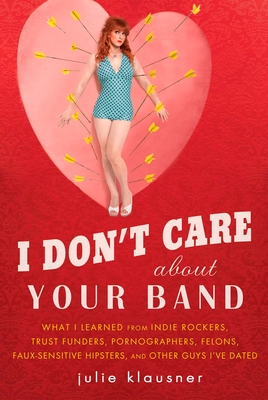
I Don't Care About Your Band

by DionysusPsyche

I Don't Care About Your Band: What I Learned From Indie Rockers, Trust Funders, Pornographers, Felons, Faux Sensitive Hipsters, and Other Guys I've Dated is pretty self-explanatory. Julie Klausner takes us on a ride through her life from her childhood dreams of stardom to her adulthood and dating history. While many women might disguise, cover up, and embellish how cool their attitude towards guys was from a young age, Klausner does not pretend to be shy, reticent, and a follower of “the boys have cooties” club. She wants to inform us almost as much as she wants to entertain us. Her sexuality, experiences, and emotional thought process are all for us to laugh and amuse ourselves with. Except for the occasional chagrin at her situations, our laughter is with her not at her.
Julie Klausner is a comedienne and writer for SNL's TV Funhouse and VH1's Best Week Ever. Purusing my local bookstore's comedy section, I knew nothing about her. For all I knew when I picked up her book, she could have been some bum on the street they dressed up for the picture. Upon glancing at the title, I laughed and said, “Yeah, I've felt that way about a guy before.”
It goes without saying, but I'll say it. This book will not teach you anything that will win you a spot on Jeopardy, unless the entire episode is dedicated to what you should or shouldn't learn from someone's love life. Since Rock 'n Roll Jeopardy is as close as it comes, if you're someone who reads books for information and educational purposes (and not merely to guffaw and delight in the schaudenfreud of someone else's love life), then it's probably not for you.
Klausner makes mistakes, and they don't get better as the story continues, they just get more interesting (until the end when Klausner seems to mentally sharpen to her experiences). Sitting through her childhood, I felt like if she threw out the earlier portions of story hour, I could enjoy the rest a little better. It didn't keep me from the full journey, but I wouldn't say it made me enjoy it more. It does make you wonder, based on her childhood and early reactions to boys, what will come of her teenage and college years. Did I say wonder? I meant dread.
It has become an annoying habit of all comediens to include an elementary or junior high “coming of age” chapter. The good news is that the previous chapter talks about Miss Piggy, and the chapter following the “coming of age” describes her gay best friend. Klausner also has an interesting way of writing about extremely personal situations with an almost out of body hilarity. Compared to some of the more outlandish, foul descriptions and language I've heard other comediens use, I was relieved by her wording and take. Reading something that intimate rarely made me shrink in horror but chuckle. She had more long distance online boyfriends than I cared to hear about, but it was fascinating to read about someone who kept meeting people over the internet despite the onesidedness she describes—probably in retrospect. At the beginning of each chapter, I consistently shook my head all the while smiling and said, sometimes aloud, “this can't be good!” I also could have added, and sometimes did, “in bed!”
Despite the clever phrase that a smart person learns from his mistakes and a genius learns from someone else's, this isn't always a lesson that is true for the world of dating. There is no greater proof than Klausner herself. At one point or another, everyone who is young doubts the wisdom of their elders or lacks information necessary that is withheld from one generation to the next concerning matters with the “birds and the bees.” I'm not talking Masters & Johnson's “How to” guide, I am speaking of more simple matters like, “If you have to get drunk to have sex with someone you find unattractive in mind, body, and spirit then you should refrain from drinking with this person, and never have intercourse with them.”
It took a while for Klausner's sense of humor to grow on me. She has some truly memorable lines and unique situations. When she starts describing her ex-boyfriends as “crazy,” “ugly,” or “judgemental” instead of rolling my eyes, I would widen them and get giddy and nervous all at once. At the beginning of it all, I found her annoying and chaotic, like a personality tornado. Fortunately, she becomes more collected and experienced as time goes on. Although I doubted her taste in men, when she called someone a very distinctive adjective, I grew excited for the chapter to unfold.
This book does show important life lessons, but Klausner does not always point them out as such. She makes mistakes that she learns from, and she makes mistakes that she most certainly doesn't learn from. She starts out picking boys like kids pick flowers—just grabbing the ones that are nearby and hoping they look nice in a vase. It is identifiable for those of us who are older and/or wiser. As the book progresses, her attempts at relationships, albeit often horrific and strange, are sought after with genuine desire to be loved and appreciated. To make things better, as her dates become less monstrous and more human, she actually becomes funnier.
While it is pitiful on more than one occasion, there is a certain relief that it didn't happen to you or it's worse than you at your worst. It is also comical to watch her fall into relationship after relationship all the while having a smidge of an idea of how to conduct herself and even less sense of how her counterpart should conduct himself. After Klausner walks away from the most damaging/destructive relationships she learns lessons about love and herself. She grows from her experiences, which is as rewarding for you as it is for her. The result is an enjoyable and amusing read.

By the end, Klausner become decidedly more mature and conscious of the little details in picking a mate which made the earlier more painful parts bearable. She holds no extreme feelings of anger or regret towards any of her exes, and that peaceful attitude was a much needed attribute of the book. More importantly, she learns to love and respect herself which is the message she passes on to the reader. Taking her past in stride and laughing about it at the same time. Her retelling of the past is not at all critical of others, so one can draw their own conclusions. Unlike books like “He's Just Not Into You” or “The Rules,” Klausner knows that everyone goes about love their own way at their own pace. It is what you make it. In conclusion, even though Julie Klausner's love life is messy, it's a fun mess.

Wednesday, May 4, 2011

The Age of Reagan: The Conservative Counterrevolution - 1980-1989


The Age of Reagan: The Conservative Counterrevolution is the second volume of the two part biography of President Reagan by Stephen Hayward. In it, we see Ronald Reagan as president from 1980-1989, his mistakes, failures, successes and victories.
.

Finally, We See the Man

One of my main criticisms of the first volume of The Age of Reagan was the fact that Reagan himself rarely showed up in his own biography; instead, the book focused on the presidencies and time period before Reagan, from 1964-1980. Happily, this volume focuses on nothing but Reagan, and in it I was able to get a great sense of who Reagan was as an individual, what made him tick, and what inspired him to make his policies while America's leader.

I am convinced that, personality wise, Ronald Reagan was one of the best presidents we've ever had. Stephen Hayward takes us on a compelling journey through Reagan's presidency, focusing particularly on Reagan's own personal philosophy and stalwart belief in the goodness of the United States and what it stands for. For Reagan believed utterly that the United States was a grand country capable of doing anything it set its mind to. All of his heart aligned itself behind the inherent love of liberty and freedom that every man and woman possesses. And, in a step that many presidents have failed to make, Reagan made absolutely sure that everyone knew this. There is a reason that Reagan was dubbed The Great Communicator; in just about every speech he gave, you could feel powerfully his faith in America as special, able to meet any difficulty or crisis that it ran into to.

What made this quality so powerful, and the reason why Reagan is so loved today, is that this unbridled optimism came when it was needed most. For America's previous three presidents (Carter, Ford, Nixon) were ones who gave America plenty of reason to doubt itself, its system of government, and its ability to defeat the Soviet Union. Carter spoke of America as being in a "malaise" and destined to become a lesser power, Ford failed to make much of an impact on the people, and Nixon's Watergate scandal brought with it a populace with far less faith in the goodness of America and its bureaucracy. In the early 1980s, the Soviet Union appeared to be at its strongest. The U.S. military and economy appeared weak from Vietnam and oncoming recession respectively. It is in this backdrop that Reagan stepped in and restored people's faith and optimism in the future, when all looked at its bleakest.
.

The President

As mentioned in my review of the previous volume, Stephen Hayward has a strong bias toward Reagan that occasionally obscures the truth and tells the history from one perspective. By Hayward's measure, Reagan was unsurpassed in domestic and foreign policy, the greatest president we've ever had. However, I did not come to this conclusion. The fact of the matter is that, domestically, Hayward is unable to hide the fact that Reagan was stymied at near every turn. Going into office with the goal of shrinking the government, the size of government grew nonetheless. Reagan's economic policy of instituting supply-side economics (the belief that tax cuts for the wealthy = wealth for everyone) achieved short-term victory then a quick overturning. Although I'm sure there is one out there, having just finished the book I can't think of a single domestic policy that Reagan managed to implement successfully.

On a foreign policy level, Reagan was much more successful, effectively making the Soviet Union repeatedly freak out. One of my favorite stories was of Reagan's command to have every submarine in the U.S. navy stealthily navigate near Russian ships so that they could ping their radar all at the same time (scaring Russia shitless and illustrating to them the technological advantage had by the United States at sea). Another was of Reagan's order to have one of his secretaries collect every Soviet joke he could get his hands on so that Reagan could turn around and use them on the Russian leaders when he met them at summits. Funny moments aside, Reagan's greatest achievement in foreign policy was in showing America's strength to the Soviets instead of embracing his predecessors' philosophy (of compromising and standing down in the naïve hope that the Soviets would reciprocate). On top of this, Reagan's idea of SDI (the Strategic Defense Initiative, more popularly known as Star Wars, that would have been an anti-missile shield) served to scare the Soviets more than anything, contributing greatly to their willingness to grudgingly back down where previously they would have held their ground in diplomatic initiatives.
.

Conclusion

In the end I really enjoyed reading this book, though it sure was a long haul. Reagan was definitely one of the more interesting presidents to read about; his indefatigable optimism and willingness to communicate as clearly to the American people as he could made him a very effective and loved president. Stephen Hayward makes the narrative exciting and easy to follow; his only downfall was his painful bias. Some examples include: Hayward's belief that the president should be able to break the law whenever he deems it necessary (argued in order to excuse Reagan from any criticism associated with the Iran-Contra scandal), the minimal time spent on the Chernobyl incident (maybe 2 pages of ~650) despite Hayward's own admission that Chernobyl was a significant reason in the Soviet Union's decline (he did not spend much time on this because he is transparently pro-nuclear energy), and Hayward's assumption that reading the Constitution literally (aka: conservative originalism) is the only valid way to institute justice in the American legal system (see my review of The Nine for an explanation of why this is kind of silly) without even addressing or countering alternative points of view.

Thus, while I did very much enjoy this book, I would point out to any potential future reader that you need to take what Hayward says with a grain of salt. He covers the Reagan presidency with remarkable detail, but does so from the perspective that you are a staunch Republican, often choosing not to address other points of view. But, nonetheless, I would recommend The Age of Reagan: The Conservative Counterrevolution. Reagan was truly one of the more inspiring presidents that America has had, and he was a key factor in the Soviet Union's downfall. Just be prepared to raise an eyebrow and look up some of the things Hayward goes on about from time to time.

Saturday, April 30, 2011

Confessions of a Superhero

Written by Joe the Revelator


In one of the strangest niches our society has created lies a sect of panhandlers who dress as their favorite superhero, stroll the Hollywood strip, and take pictures with tourists. Marilyn Monroe pretends to smooch with a pedestrian. Spiderman hops up on trash cans to shoot invisible web at people. And on the bad days, Elmo and Mr. Incredible get cuffed and jailed for getting pushy and breaking the rules.

They’re all waiting for their shot at the big screen. They have talent agents and coaches, they go out for casting calls. And when they’re not getting hassled by the cops for aggressive begging, they’re performing on the street, striking heroic poses.

Matt Ogen’s documentary follows four heroes who have seen better days. At a glance they look like Hulk, Batman, Superman, and Wonder Woman. But up close you can see where the spray-painted yellow bat symbol didn’t dry properly, or where Hulk’s mask is slit up the back, or how Superman’s narrow shoulders are slight under his cape. The costumes are all homemade and the actors wearing them are technically unemployed, working for ‘tips’, if the people flocking to them for a photo op are generous enough to pay out five bucks.


Look! Up in the sky! It’s a...

The camera doesn’t stay on the street though. It follows them and captures a slice of their life, their history and relationships. Ever wonder what kind of woman would date a man who wears a cape 16 hours a day? We’re given a good look at their homes, grit and all, and their secret identities might just make you cringe.

There’s something infinitely surreal about watching Batman, still hidden by his leather cowl, explaining to a psychologist that he has anger issues. He even pauses a moment to wipe away the tears which have collected under his mask. Or to listen to Superman lament about the worst day of his life, which surprisingly wasn’t during his battle with speed addiction, but the day Christopher Reeve died. In fact the only hero whose life is on an upswing is Hulk, who has improved his condition from homeless to living in a small apartment without furniture.

Superman, who seems to be the focus of the film, claims to want to star in movies. But this is contradicted somewhat by his odd leadership of the street performers and commitment to the lifestyle. He lectures the new Ghostrider about morals and takes steps to calm Batman’s outbursts toward the public. His apartment is cluttered and stacked with Superman memorabilia. He even makes a trek to Metropolis Indiana for the annual Christopher Reeve day, to compete in a superhero look-alike contest he doesn’t even place in. The other heroes openly admit Superman is the “crazy” one of the group, possibly believing himself to be the man of steel.


After the cape stops fluttering:

By the end of the documentary I couldn’t decide which emotion the director was trying to evoke; sympathy, pity, or humor. Maybe all of the above. I laughed like a madman watching Batman get put in the back of a squad car (which he subsequently kicked out the back window) for picking fights over a port-o-potty urinal. Wonder Woman’s history felt the saddest, the classic failed actress who packed her bags after high school and came to Hollywood on a dollar. And Hulk’s optimism was so natural and sedate it was infectious.

Would I recommend Confessions of a Superhero? When I see these people the only sure word that comes to mind is Byproduct, of stardom, of media, and of economy. Having said that, I would heartily recommend this documentary. And be prepared to feel weirded-out for the next few days.

Friday, April 29, 2011

How I Met Your Mother

By DionysusPsyche
How I Met Your Mother is a sitcom that takes place in New York. Bob Saget is the perfect voice over for Future Ted, and the series is about him telling the entire story to his kids (the reason for which is revealed in one of the episodes).

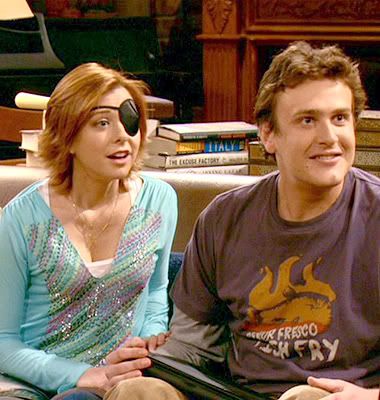
At the beginning of the series, Ted's best friend Marshall (Jason Segel) proposes to his long time girlfriend Lilly (Alyson Hannigan). Ted (Josh Radnor) realizes that it's time he found the person he was meant to be with and settle down. His friend Barney (Neil Patrick Harris), the ultimate player, has other plans for Ted. He believes that Ted is too young to get married, and instead wants Ted to be his wingman while they go off on adventures of dating—or in Barney's case, elaborately hooking up with and then bailing on—girls. Then Ted meets Robin (Cobie Smulders), the girl of his dreams, who doesn't want anything serious.
Throughout the series, Ted struggles with relationships. Whether it's with long distance, waiting for the slutty pumpkin, or battling his feelings for Robin, Ted longs for the real thing and meets a lot women who just aren't it. He's romantic, a little too honest, and very sincere. He also has to adjust his relationship with Marshall as Marshall and Lilly go from dating to a married couple. Ted's friends teach him how to be a better version of himself, and these things he shares with his kids.
Robin plays the love interest and friend who is determined to conquer her career over everything else. She has dogs and loves guns. Despite her confident nature, serious relationships terrify her, and she doesn't care for children. She plays Barney's wingman in one episode. She works with a myriad of frustrating co-anchors, schedules, and job relocation. Occasionally, Robin longs for her homeland, Canada. A lot of the funniest episodes have to do with Robin's essence and weaknesses which is also true for Barney.

Barney proclaims himself to be Ted's best friend—even though Marshall is. He always wants people to “suit up!” and creates catch phrases that often only appeal to him. He constantly quotes The Bro Code and tries his best to live by it—although no one else does. His antics and schemes to lour girls into his bed are wild, hilarious, and extensive. He makes lists, he has goals, and he sets the stage, all in the name of getting laid. Sometimes, he's even generous to try to get Ted laid, which Ted resists most of the time. He is not above changing costumes multiple times in order to hit on the same girl, telling ladies he's shipping out, building a time machine, etc. As the seasons go on, Barney's acrobatics get a little old, but fortunately the writers dive into his childhood, his first real girlfriend, and what makes Barney tick. Even Marshall and Lilly are wow'd by his efforts and ideas once and awhile, and deep down, Barney is influenced by their solid relationship with each other.
Marshall and Lilly are the ultimate duo in every way, even when they dress up for Halloween together. They occasionally act like parents to the rest of the gang, but they are also the paradigm couple that Ted envies. They compliment each other, and he wants that. Marshall and Lilly are not without their faults, and they come up against the same issues that every couple deals with—moving in together, getting married, cold feet, whether they've been together too long, and if they've had enough of a chance to experience the world. They also debate on how to raise their kids, buy a house, and spend time wondering if they're ready for kids. Without a doubt, they are the heart of the show. Lilly is sweet and positive. Marshall's quirks make him one of the best characters, and his constant support for Lilly is one of his many endearing qualities.
Like Friends, the cast of How I Met Your Mother is an ensemble cast, even though Ted is supposed to be the main character. He often takes a backseat to his friends' stories telling how their experiences not only shaped them but shaped him as well. There are lessons to be learned: when and when not to lose your virginity, how to get a girl, the lament of long distance relationships, getting back together with your ex, and more. Frequently, Future Ted omits information from his kids. At one point, when his neighbors are having loud sex, he refers to it as “playing the bagpipes,” and there are actual bagpipes that play. The holiday episodes are pretty great. How Lilly Stole Christmas is hilarious, and The Slutty Pumpkin might be my favorite Halloween episode of any sitcom or show.
The first season is defined by Ted's determined quest which features his desire to date Robin while grappling with being her friend. Lilly and Marshall have their own difficulties, including whether it's time for them to get married. Season two Ted is dating someone, but things get in the way, like his parents. We also learn how he and Marshall became best friends. Barney tries to become a better friend to Marshall. There's a wedding. The season's most memorable episode reveals an unexpected secret about Robin. By third season, Ted is sick of looking for The One and decides to play things Barney's way. Marshall helps him realize that maybe he's not the man he needs to be when he meets The One. Future Ted reveals information about his future wife. Barney, on the other hand, starts developing actual feelings for a woman and Lilly helps him cope with it.
Ultimately, there is the mystery of how Ted meets his future wife and mother of his children. On his mission we get to meet all the girls and crazy situations Ted finds himself in before he finds The One. The show is about the journey, and the fun had along the way.