Tuesday, September 21, 2010

The Untouchables


Saturday night comes around and the endless browsing of Netflix's movies doesn't bring to the eye any standouts. Finally, everyone decides on an unknown quantity: The Untouchables. Sean Connery, Robert DeNiro, and gangsters? It ought to be good...
.

Brothers in Arms

The time is the Prohibition of the 1920s and 30s. Al Capone is king; the mayor of Chicago in his pocket and exceedingly rich from selling illegal liquor for cheap. Instantly, this had me interested. Before this, I don't think I had ever seen a period piece movie focused on the Prohibition era.

Kevin Costner is the main lead, an agent of the Bureau of Prohibition. This role brings him all sorts of ridicule and disapproval. For Prohibition was brought about by a minority of Puritanical men in the upper echelons of power, and the common man found the law against alcohol to be beyond infuriating. While I am not personally a fan of Kevin Costner, he pulls it off with aplomb, making us convinced by his efforts. We sympathize with him as he tries to take on those who would buy or sell illegal liquor in a society that does not truly care about his mission. And we feel for him as he does his best to ignore the challenges before him and the judging people who surround him. But what makes the movie enjoyable, though, isn't just this character and his personal crusade. Instead, it is him and whom he manages to bring with him on this journey. The movie is entirely driven by the characters who populate it, and they are the reason to watch the movie.

As the movie progresses, Kevin Costner brings together a squad that will unseat Capone from power and make him accountable to the law. They are dubbed the Untouchables: men who believe that they are beyond the powerful reach of Capone. And they turn out to be one of the quirkiest cop teams I have ever seen. Sean Connery is a prominent member, playing an incorruptible, near-retired policeman who acts as if he has nothing to lose. He alone makes this movie worth watching as he challenges the entire system, doing it skilfully and with great charisma. Under Sean Connery's expert and badass tutelage, Kevin Costner gathers a team of oddball characters that eventually get involved in some of the most amusing hijinks one would ever expect from a gangster-type movie.
.

Narmtastic

Perhaps it was just my impression, but at times the movie seemed to excel at creating situations that came off as unintentionally hilarious. A major contributing factor is some of the characters. Robert DeNiro plays one of the most over-the-top and despicable, yet funny, villains I've ever seen. In every scene he is in, it is hard to take your eyes off him as you don't quite know what he is going to do next. One could say the same thing of Sean Connery. Both characters do things that are both jaw-dropping yet strangely believable, and it helps keep the movie both entertaining and epic.

What brings the movie considerable appeal is the sheer amount of narm within it. What is narm, you ask? Narm is when an actor, character, or any individual tries to take something seriously, yet ends up eliciting laughter in the viewer instead of solemn nods. This movie is narm-tastic; it oozes the stuff. Whether it be the hilarious charge of the Canadian brigade, the eyebrow-raising antics of how Capone treats his minions, or the fact that a random baby somehow manages to derail the entire movie at one point; this movie turns out to be surprisingly charming on many levels.

Special attention must be paid to that baby. In one of the most memorable scenes I have ever seen, a nameless baby in a carriage manages to halt the entire plot of the movie for at least five minutes. I don't know what the director was thinking. I don't know what the screenwriter was smoking. In fact, filmed any other way, that baby would have been far less funny. And I don't think they were trying to be funny. But I'm glad that they did it, because that scene will be burned into my memory for all time now. In a good way. I wish I could be less vague, but I don't want to ruin it for you. Go see it for yourself.
.

Conclusion

Yet, despite all my highlighting of the hilarity contained within, I would like to point out that this is also a serious movie. It involves gangsters, these gangsters have guns, and they do use them. There are some deaths, but seem rather tame compared to other gangster movies I've seen, and this is a good thing. The movie does an excellent job at portraying the time period, the costumes and sets look dead accurate, and quite a few scenes are gripping on a number of levels. Being funny is hardly The Untouchables' only positive quality.

Needless to say, I'm very sad that Sean Connery has quit acting. This is definitely one of the best roles he has ever portrayed, and he is entirely believable and completely awesome. In fact, he actually received an Academy Award for the role: Best Supporting Actor. As mentioned before, many of the other characters also have a flair to them which makes them each interesting. The accountant of the team has many great moments, as does the sharpshooter. Robert DeNiro hams it up marvelously and Kevin Costner is believable, if not quite as intriguing as the others.

Negatively, the movie did have a number of scenes that seemed like they should have been removed entirely or had little importance to the overall plot. Kevin Costner's relationship with his wife and child is one example. I could not see how their existence contributed to the movie; it seemed to lose steam whenever they showed up. Also, as amusing and interesting as it was, it doesn't quite match other gangster movies out there. The Godfather is king and, in all, I think I enjoyed the more recent Public Enemies better. But The Untouchables is certainly worth seeing if this review appealed to you, and I heartily recommend it.

8/10

Friday, September 17, 2010

Strategic Depth in Sins of a Solar Space Empire


From time to time, I've played a computer game known as Sins of a Solar Empire. Not as well known as others, it is a game set in the deep of space, allowing the player to take control of one of three galactic empires in a quest for dominance of the void. It is not original in its choice of setting and gameplay, but it is an innovator in one respect: bringing unmatched strategic depth to the world of real-time strategy games.
.

A Universe to Conquer

Sins of a Solar Empire is a game that involves testing one's skill; not as a spacecraft pilot, not as a marine invading a world, but as a supreme commander-in-chief of a vast, sprawling, and constantly expanding military and economic powerhouse. When confronted with the task of sending fleets into battle, you are the one who decides where they go, what their unit composition is, and how they will use their varied abilities in battle. You decide when they will retreat, when they will feint, and when they will flank the enemy in battle. At the same time, you make the economic decisions of an entire race, balancing the desire for a vibrant economy with the likely need for defensive and offensive forces. Finally, you also decide whether to try and expand one's culture to subvert the enemy from within; carefully coaxing a powerful and appealing culture into being can cause entire worlds to switch sides and join your nation.

Yet, to those familiar with real-time strategy games, these are hardly original tools of gameplay. So what makes Sins of a Solar Empire so impressive?
.

Options Enough to Paralyze or Enable

Recently, I've been reading a biography of Dwight Eisenhower, the supreme commander of the Allies in Europe during World War II. In it, the author describes the massive amount of build-up and detail that went into the famous D-Day landings. The book takes the reader through a journey both elaborate and gripping. It describes the Allies' need to consider the possibilities of enemy mines, tanks, submarines, aircraft; the need to plan for weather, the need to disable enemy transportation, disrupt railways, split hundreds of thousands of troops into manageable landing groups, and the need to mislead the enemy into thinking that the Allies would land somewhere else. In short, hundreds of things were planned for, countless contingencies accounted for, and innumerable logistical preparations dealt with in order to pull off such a massive undertaking successfully.

Sins of a Solar Empire both allows and often requires such depth in planning if one wants to truly succeed against tricky AI's and even craftier players. Take an example.

In Sins, planets are separated by hyperspace jump routes, creating specific areas of a gravity well where you can expect the enemy (or your own ships) to come from. Thus, if one of your planets borders an enemy, you can create defenses enough to severely cripple any invading force that comes your way. In my game, I took my massive fleet, a fleet powerful and large enough to destroy most of the enemies in the game's universe, and, without thinking, attacked an empire which I had previously ignored up to this point in the game. I did not plan. I did not consider the possibility of failure. I simply assumed that the size of my fleet and its power would be more than enough to crush this new target. Boy, was I wrong.

Upon arrival, my fleet took heavy damage from an unexpected source. My enemy had prepared. Mines were densely laid at my arrival point, destroying dozens of my fighter craft and ripping away the shields of my larger capital ships. Immediately, an enemy starbase positioned nearby (think the Death Star) opened fire on my most powerful ship, destroying it in short order. Enemy strike craft (snub fighters) surged from the planet in my direction. In seconds, my entire fleet had been cut in half and shot to pieces; my capital ship from the start of the game shredded into bits before I even had time to react.
.

Think Out Your Actions or Perish

Quickly, I commanded all sources of industry to build new ships and send them to my planet bordering the hellacious trap. Yet by the time my new force was created, I had lost this planet to a cruel (and totally deserved) enemy counterattack, along with an asteroid belt nearby. By the time I was ready, my new force was positioned at my last redoubt in the system, a lonely desert planet with only one entrance, one exit.

Slowly and cautiously, I pushed from this one planet and recovered my lost possessions; finally returning to the planet bordering the place where I had been defeated so thoroughly and embarrassingly. And I wondered how to break this nut that stood in my way.

This is where the strategic depth of Sins began to stand out. With careful planning, I prepared a small force of scouts able to detect and dispatch mines. I prepared ships that could create starbases of their own. I divided my forces into groups. One group would act as aircraft carriers, skirting the far borders of the gravity well and sending its bombers in to take out the enemy's hangars. One group would be comprised of flak frigates, ships able to fire from every aperture in order to neutralize the enemy's first waves of fighters. Another group would be the heavy cruisers, whose main job would be to take on themselves the punishment of remaining mines and to try and take the bulk of enemy fire from their starbase. Yet another group was my capital ships and a cadre of ships able to bombard the planet. The final group was tasked with supporting my own starbase-creating units in setting up strongpoints able to shelter craft from being overwhelmed and to solidify my advance.

In short, I prepared extensively, as no other real-time strategy game has allowed me to do so; planning for every contingency and pulling off an operation so detailed and multi-faceted that it boggles my mind that I was able to pull it off.
.

Conclusion

I ended up suffering significant losses, but took the planet and destroyed all of the enemy's defenses. My planning was so careful that I was even able to repel the enemy's main fleet showing up halfway through the battle; the enemy's last ditch effort to exterminate my attack force.

For those of you with strategic leanings or the desire to play a game that requires careful planning and thought, I can thus recommend Sins of a Solar Empire with flying colors. The game's strategic possibilities are endless, and in this post I barely even mentioned the strategies involved in managing one's economy, advancing one's culture, and the nuances of marking a fine balance between expenditures on technology, military, culture, economy, and exploration. Sins of a Solar Empire allows this, as few other games have before, and should be recognized and enjoyed for it.

The Uncharted Series Part 2


Uncharted 2: Among Thieves is where the series is saved as a whole, and it is on that game in particular that I will mostly focus on within this post.
.

Deconstruction of the Action Hero

It is in Uncharted 2 where my interest in the main character really began to take off and drive me to finish the game. At first appearance, Nathan Drake is the stereotypical action hero. He is handsome, skilled in combat and common sense, lucky with the ladies, always the center of attention. Along with his crusty old man of a sidekick, the player takes Drake on an epic adventure involving car chases, romantic trysts, and the defeat of the bad guy. But this description misses the most interesting thing about him, and the aspect of his character that makes the game different from the norm.

Nathan Drake is actually a normal guy. He is faced with the chaos of a big-budget action movie but, instead of reacting with suave confidence, Drake has barely any idea what is going on. Drake often feels over his head and seems one step away from panicking completely. After overcoming absurdly dangerous situations, Drake notes shakily how insane it is that he keeps managing to survive at all.

This is a major facet of his personality. Essentially, Drake is the average joe stuck in an action movie, when all he wants to do is get to his archaeogical goal with no fuss or confrontation at all. He is often very hesitant to get involved to begin with. And this creates realistic consequences in the game. When double-crossed and on the run from the police, he actually gets captured instead of getting away like you would expect. Instead of his companions being dominated by his personality, his companions often seem like the one calling the shots. This creates sympathy for him, but he is also competent enough to avoid complete pity by the player.

Drake is you, and Drake is me. He has no superpowers, he is only moderately athletic, and is often faced with situations beyond his power to prevent and beyond his ability to control. Drake is the everyman, and yet he also proves that even a normal person can affect major events in their own way. Thus it is that Drake is one of the more interesting characters of any action film or game, and a compelling reason to play the game and to experience his story.
.

Experiences with Among Thieves

Uncharted 2 is better than its original game in just about every circumstance (although the aforementioned mythic failure still exists). The gameplay is exponentially more fluid, more attention is paid to the rationality of the game's geography and combat sequences, and the game as a whole feels more epic. Unlike the endless rainforests and ruins of the first game, Uncharted 2 takes Drake across the globe; the player gets to visit and experience the jungle of Borneo, the Himalayan mountains, a war-torn Tibetan city, and the magnificence of Shambhala. The characters are more interesting and of a far greater variety. Villains are given more depth and relationships among the group are more complicated and true to life.

It is still difficult to understand why Drake and his friends go looking for treasures such as this and why we should care about the quest for Shambhala, though. But this is overshadowed by the strength of the game and appeal of the characters.

The new multiplayer also bears good mention, as it has consumed many hours of mine. The fluidity of the gameplay and stunning variety of visuals and setpieces lend themselves well to epic duels and fights for survival. Holding out against a steadily increasing onslaught of enemies in an old, mountainous Tibetan monastery is an impressive experience, particularly when one gets to do so online with one's friends. Similarly, competing against others to capture treasure and hold chokepoints against another team of foes is great fun in the midst of a jungle full of ruins and an icy mountain pass. The unlockable perks and items provide additional incentive and are thankfully not necessary at all toward holding one's own against established veterans (unlike other games I could mention).
.
The actors when not rendered
Conclusion

The Uncharted series so far is a mixed bag, but one that has grown substantially better with time. I still do not understand why the first game (Drake's Fortune) is considered among the PS3's best, as it was a chore to play and an endless process of wading toward the next cutscene through an endless sea of mercenaries and contrived scenery/jumping puzzles. I'm glad that they had the opportunity to polish that experience, though, and bring us to a far more appealing sequel.

Uncharted 2: Among Thieves, however, is a classic. I haven't quite even completed the game, but I can say that definitively. The characters are memorable, the action intense, the gameplay fluid and varied. The multiplayer has provided endless fun, and will continue to do so after I'm done with the main campaign.

My only hope is that Uncharted 3 will go more into depth with regard to why we should care about the end goal. I felt that, in both games, the archaeogical goals should be far more compelling. As someone interested in history I thought I would be automatically interested, but it failed to make me care that much until the second half of the game. If the third iteration is able to do this better and hold onto the accomplishments of the second, we might have ourselves a contender for best action-adventure game ever created. And wouldn't that be marvelous?

9/10

Thursday, September 16, 2010

The Uncharted Series


For a couple weeks now I've been playing two video games: Uncharted: Drake's Fortune and Uncharted 2: Among Thieves. Both games have strengths to them, and they also have weaknesses that were not addressed in the change from original to sequel. I want to look at these topics with the goal of assessing the negative aspects first, then the positive.
.

The Mythic Failure

The story of both games seems reminiscent of Indiana Jones. Like the famed archaeologist, Nathan Drake (the main character) finds himself seeking historical artifacts and treasures beyond imagining. The first game involves the search for the lost treasure of El Dorado; the second, the mythical city of Shambhala. We accompany Drake as he encounters dangerous complications, romantic possibilities, and intense action setpieces. The problem with both games, though, is that I'm making this sound far better than it really is.

Both games fail at making the plot matter. When I hear that Sir Francis Drake stumbled upon the city of gold, I fail to be impressed. When I hear that Marco Polo's trail can be followed to Shambhala, I wonder why I should care. Because the games fail at something that the Indiana Jones trilogy did marvelously. They fail to establish mythic importance.

In Raiders of the Lost Ark, we see a number of scenes that cement the Ark's importance in the minds of the viewer. We see Harrison Ford's eyes light up, we hear about its history, what makes it unique, and the supernatural hints and events that surround it. The same applies for the Holy Grail in The Last Crusade. We get the sense that these artifacts are larger than life, that they have seen generations of men rise and fall, and that searching for them is the chance of a lifetime; creating an epic journey that would define one's self. This, along with many other reasons, is why the Indiana Jones movies are so well-regarded.

By contrast, the Uncharted games mention Marco Polo and Sir Francis Drake as if merely stating their names is enough to engender interest and drive the plot. El Dorado and Shambhala sound like interesting places to look out, but don't sound anywhere near as legendary as they should. Nathan Drake sounds excited about these prospects, but his rationale is unclear, and he seems distracted from this goal most of the time. Often it seems that he and his companions are mostly interested in the money they could get from the find, not exactly a gripping motivator.

For a game rendered so cleverly to seem as if one is participating within an interactive movie, the plot seems taken for granted. The historical adventures lack resonance, and attempts to make the goals epic and mythic fall flat, making it difficult to stay interested in anything other than the characters and admittedly awesome action scenes.

--Edit-- This turned out to only apply to the first half of Uncharted 2. The second half was much better about making the story, the end goal, and Shambhala feel as if it truly matters. It instead has a slow start leading up to this increased attention.
.

Experiences with Drake's Fortune

The first game was, blunt as it is to say, an exercise in patience and a constant fight with frustration. The story and characters were largely interesting, but the way the gameplay is approached creates an increasingly annoying grind. Most of the problem lays with the lackluster approach toward gameplay and story segregation.

Basically, what that means is that the story and the gameplay seem altogether different and unattached. This could be seen from the start. As you guide Drake through a temple that has been untouched for hundreds of years, one is jarred out of immersion by the suspiciously convenient placing of explosive gunpowder barrels; each one immaculately placed in a position that blows up something important, allowing one to progress further in the game. It raises questions that distract from the game. Why on earth would Sir Francis Drake have left these barrels of gunpowder behind in such places, as if he could somehow predict precisely how the temple would decay with time so that barrels could be blown up in the future to clear overgrowth or fallen ruins? It seems horribly contrived.

The jumping puzzles throughout the game similarly had no thought put into how this appears to the player. At one point, Drake must ascend the side of a fortress to see what happened to his companion. Naturally, there are bricks protruding out of the sheer wall, vines grown in perfectly aligned positions for climbing or swinging; all of this leading to an open window maybe 300 feet above one's starting position. If one ever doesn't know what to do next in this game, needless to say, it will probably involve some impressively nonsensical jumping puzzle from one area to the next, despite all odds that rock formations, trees, and boxes would ever be aligned in such a helpful manner.

This also shows up in the action sequences. Basically, every part of the gameplay seems designed to ignore and distract from the story. In a number of temples and ruins abandoned for hundreds if not thousands of years, one somehow encounters hordes of mercenaries coming from god-knows-where in order to give the player something to fight. Again, this makes no goddamn sense, but is there nonetheless. After a cutscene, you can guarantee fighting endless mercenaries for half an hour or more, freezing the plot entirely until you defeat them all and move on.

I won't even go into the difficulty of the game because it nearly compelled me to throw my controller out the window in an apoplectic rage.
.

Drake's Fortune: Conclusion

Now, you ask yourself, perhaps this is nitpicking. Perhaps I'm looking at the presentation too seriously. But the thing that made this stand out was my inclination to take Uncharted: Drake's Fortune seriously. The game has excellent cinematic leanings within its cutscenes, the chararacters are vivid and realistic, and it has a realistic feel to it with a dash of romantic adventure. Thus, I figured that they would create it as if it was an interactive movie, and looked at it as if it was such.

Consequently, I was given reason after reason to pray for another cutscene around the corner. Endless waves of enemies gets old fast. Nathan Drake himself complains constantly about the infinite mercenaries. The lack of importance given to Sir Francis Drake and El Dorado killed my interest in the overall plot. And, finally, the contrived nature of the game's geography made me lose immersion repeatedly. The only saving grace were the characters, of which I wished there were more of, and more time spent on them.

6/10

Wednesday, September 15, 2010

Lord of the Rings: Literature and Film Part 2


The other two changes are harder to spot by the viewer given their total absence from the films.
.

The Scouring of the Shire

In the books, Frodo and Sam destroy the Ring, are rescued by the eagles, and return to Rivendell. After a number of farewells, the hobbits leave on their own to go back to the Shire, to breathe the fresh air of home again. The reader prepares himself for the cathartic ending, prepared to view the idyllic hills of Hobbiton once more.

But it quickly seems as if something is wrong. When the hobbits stop in Bree to rest and see how Barliman Butterbur is doing, they hear of the presence of Southern thugs in the region. Not all is at peace. That rest that they were all looking forward to will have to wait. They leave Bree and push on to the Shire.

To the horror of the reader, we see Hobbiton burnt and ruined. The grass of the hills burnt to a cinder. The cheerful, happy cries of children replaced by emptiness. Once boisterous hobbits are bent in drudging toil, working endlessly in factories belching smoke. If ever there was an allegory for terrible industrialisation, this is it.

As it turns out, Saruman, after being exiled and released from Isengard, decided to be a dick and ruin the homeland of the main characters. While this is an unmistakably dark event to be confronted with after the victory over Sauron, it is in perfect alignment with Saruman's character. Saruman is always portrayed in the books as the supporter of science, technology, and industrialisation over all other factors, often to the doom of himeself and those involved.

But this event is conspicuously missing in the movies...
.

Why the Absence?

Amusingly, there are two events in the movie which foreshadow the Scouring of the Shire, despite its inevitable absence from the story. In the Fellowship of the Ring, Frodo sees within Galadriel's mirror the enslavement of the hobbits and the ruinous future of the Shire. In the Two Towers (extended edition), Merry and Pippin raid Saruman's larder and find barrels of pipeleaf from the Shire. In the books, the reason Saruman has the pipeleaf is directly linked to his domination and ruination of the Shire. In the movies, this is merely a plot hole.

In the end, it seems evident that Peter Jackson and the screenwriters did not want such a disturbing event near the end of the trilogy, particularly after the arduous and intense trek up into Mount Doom, the severing of Frodo's finger, and the death of Gollum. This seems fair, as the razing of the Shire, one of the most beautiful and comforting places ever seen in cinema, would be immensely discomforting, and would leave the ending with a sour note.
.
This picture is beyond words.
Tom Bombadil

When travelling to the village of Bree from the Shire, the four hobbits (Frodo, Sam, Merry, and Pippin) encounter in the Old Forest a mysterious character. Saving them twice from harm, Tom Bombadil, a peculiar and whimsical man, takes them to his home to give them some measure of safety and solace before they go onward in their journey. He is unique in his very strangeness. He does not appear to truly fit into the world of Middle Earth. Tom speaks in musical rhyme and without care, confident in himself and his place in the world. Twice he saves the hobbits from dangerous harm, from a giant tree and ancient buried evils. Both times he does it with barely any effort at all.

Tom Bombadil is intentionally written as an enigma, a character whose power and purpose in the world is unknown. The One Ring holds no power over him, and is the only character in the trilogy to put it on without turning invisible, instead laughing at it and then consequently finding it unimportant. This is an effective jaw-dropper for the reader. The greatest threat in the book is rendered irrelevant and without power by some random old guy in the woods... It is clear that he is an entity of immense importance.

But, in fact, after this encounter, he ceases to hold any real importance within the trilogy. The Council of Elrond considers having him care over the Ring, given his unknown power and his immunity to it. But then they decide that this would not do, as he would attach no importance to it and would likely misplace the thing. For Tom Bombadil does not think or act like others do; his is a personality and character that is wholly unique and wholly unreadable.
.

Why the Absence?

In essence, Tom Bombadil's presence is replaced in the movies by Gandalf's imprisonment and escape from Saruman, events not detailed in the books, only mentioned and hinted at. The rationale involves keeping the story at a fairly good pace; Gandalf's interactions and battle with Saruman are understandably more dramatic and active than an encounter with the musical rhymes of a mystical old man in a forest. Peter Jackson points out that Tom Bombadil doesn't actually do much to advance the story, and thus he was bypassed in the interest of "not making the movies too long".

This is a fair judgment. While Tom Bombadil is a very interesting character with myriad possibilities, his creation by Tolkien was an act of world-building; a character who helps bring detail to the world but does not actually move the plot in any form. Consequently, for a movie that turned out to be an already lengthy 3+ hours long, his absence helps save the viewer from another half hour without using the restroom.

But to those intrigued by Tom Bombadil, he is one of the most interesting mysteries of Tolkien's universe, and has been regarded as God, an angel, or the incarnation of Mother Nature herself.
.

Conclusion

Of these differences that I noticed, only Faramir's change in character seemed to have a negative effect on the trilogy as a whole. Taken in all, the films are fantastic and with almost no faults. But so are the books, and it is interesting to note differences between the two and why they occurred. For those who haven't read the books, I highly recommend them, and you will encounter a Middle Earth with more detail than you can imagine. And for those who haven't seen the movies (the two of you out there), they are, for the most part, Tolkien's vision brought to life.

And watch those special features! They are enjoyable and thought-provoking on their own!

Tuesday, September 14, 2010

Lord of the Rings: Literature and Film


I watched the Lord of the Rings recently. I have seen it many times and think it is altogether excellent. But I also noticed a number of things that I had not the first time. I thought on this for a while, and then realized why. About a year ago, I reread Tolkien's trilogy. Relatively fresh in my memory, I was able to notice a number of major deviations from book to film, and so wanted to write about it in order to point them out to those who may not know of their existence.
.

Faramir: Prince of Ithilien

The character of Faramir is significantly changed from book to movie. In the books, Faramir is essentially the leader of Gondor; his father is often too busy with his ongoing mental duel with Sauron to pay much attention to the movements on the ground. The Faramir of Tolkien is intelligent, wise, and, above all, noble. He fights off the encroaching attacks of Mordor time after time, but does not seek war or glory. Thus it is that Boromir, his brother, takes his place in the spotlight and becomes the grand hero of Gondor.

But while Boromir is flashy, prideful, and direct, Faramir is altogether different. Where Boromir blows the loud, proud Horn of Gondor and charges into battle, Faramir only commits to battle when there is tangible gain, and he does not enjoy the fray as Boromir does. In short, Faramir is the ultimate leader; a man who knows his duty but does not revel in it; a man who loves literature and music, not warcraft and glory.

Consequently, it is for these reasons that Tolkien chose Faramir as being the character most like himself. Faramir only fights because he has to in order to save his people. "Here was one with an air of high nobility such as Aragorn at times revealed, less high perhaps, yet also less incalculable and remote: one of the Kings of Men born into a later time, but touched with the wisdom and sadness of the Elder Race." Faramir is the only man to be described as such, and also holds the honor as being the only man able to behold the One Ring and resist it with little effort. Such is his purity of heart, nobility of kings, and confidence in the goodness of his cause. When he encounters Frodo, Sam, and Gollum, he lets them go without fuss. Faramir instantly realizes the immense importance in the quest to destroy the Ring, and refuses to hinder that journey, even over the complaints of his own men, and the inevitable dismay of his father.
.

Faramir: Tormented Captain of Gondor

By contrast, the Faramir of Peter Jackson's movie trilogy is substantially changed. Gone is the purity of purpose. Gone are the similarities to Tolkien. Instead, Faramir is altered to a man perpetually in doubt of himself, and perpetually crippled by his constant desire to prove himself to an uncaring father. The Denethor and Faramir of Tolkien's writing have their issues, but in no way was the Faramir of Tolkien so dominated in action by his father's wishes. In the film, Faramir is tempted by the Ring as Boromir was, to the point of bringing it, Frodo, and Sam all the way to Osgiliath, with the end goal of giving his father "a mighty gift." In essence, Faramir stops the Ring Bearer in his tracks in order to benefit himself, in the hopes that the delivery of the Ring will finally earn Faramir his father's love.

And this deviation in character does not end in the Two Towers. While Faramir eventually comes to his senses and lets Frodo go, in Return of the King, he goes to report to Denethor. Denethor (in his own character change in becoming almost villain-like) tells him to take Osgiliath back, and to not come back unless he succeeds, no matter the odds. In essence, Denethor tells Faramir to take back a ruined fortress seething with orcs and Nazgul with only a handful of men. And, of course, being the weak-kneed sissy that he is (in the movie), he does it, commands over a massacre, and is devastatingly wounded in the process.

The tragic part of all this is that this change in character effectively make the entire nation of Gondor seem weak and corruptible, failing to engender the empathy of the viewer. In the book, Faramir shows us that Gondor is not without its heroes. Denethor and Bormir fell to the corruptive influences of the enemy, but Faramir stood above them, illustrating to us that Gondor was a place that we did not want to fall. But in the movie, the mere change in his character cripples our ability to empathize with Gondor, as all we see of them are men without hope and without willpower. And, consequently, we don't feel as involved in the Siege of Minas Tirith, whereas the Battle for Helm's Deep made us care for the defenders every step of the way.
.

Why the Change?

In the Two Towers, the main climax for most of the characters was the Battle for Helm's Deep and the Ents' attack on Isengard. By contrast, Frodo and Sam were left without a climax of their own. For some reason, they did not want to use Shelob's Lair, so they were left with nothing for the poor hobbits to do. So they fabricated a climax of their own.

Believing that Faramir's "sea-green incorruptible" nature in the book would not translate well to film, Faramir's character was put within the target reticle. Peter Jackson argued that for Faramir to be immune to the influence of the Ring would undermine the movie, pointing out that every other character up to that point had undergone temptation when near it. So they changed Faramir substantially in order to be weaker and more open to corruption, so as to provide Frodo and Sam an emotional climax.

Sadly, as I mentioned earlier, I think this decision had poor ramifications for the trilogy as a whole. Without a strong character for Gondor, the nation as a whole felt like a population of depressed, corruptible, weak bunch of doomsayers. Boromir falls to corruption. Denethor goes totally crazy. Faramir nearly commits suicide. The Siege for Gondor thus feels more hopeless than it should have, with soldier after soldier of Gondor falling seemingly without a fight. It is really too bad that they had to change Faramir. By himself, he was my favorite character and, as the movie rolled on, I found myself missing him, and wanting to return to Tolkien's vision.


On to Part 2

Monday, September 13, 2010

The Deal of a Lifetime: Part 2

Written by the Financial Loon

Getting America Back to Work
All of the growth and flow of money made little difference to the quarter of the population out of the loop. Roosevelt’s second challenge, after stabilizing the economy, was to get the droves of unemployed doing something productive. A wave of construction projects washed across America, providing work to those who needed it. Small farmers were organized into collectives and taught that flooding the market with crops actually made them less money. Businesses were forced to keep wages stable, boosting up those who were still employed, and providing new openings for those who were not. Strict labor laws developed what we would recognize as a modern work week. Older workers were nudged out of the labor market to make room for the younger generation. Social Security soon provided retirees with an income beyond their laboring years.
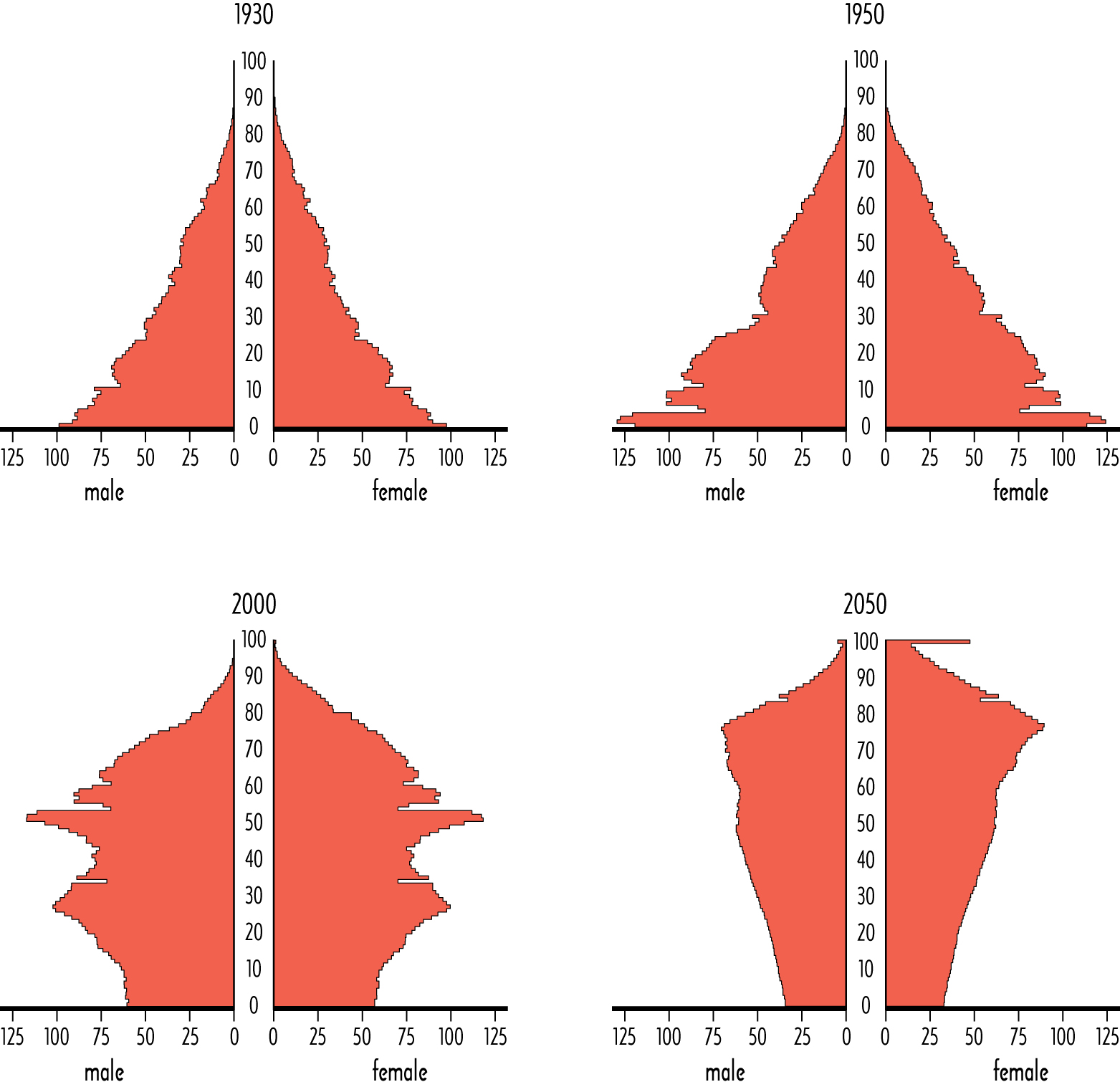
This last point is the one I wish to discuss. During the first half of the 20th century the United States still possessed vast tracts of untapped land, immense natural resource reserves, and had room for a continual influx of immigrants and rapidly growing population. The Social Security system was established with all of these aspects counted into its equations. Most importantly it relies on having many young workers providing for few old retirees. It sets up a requirement of unlimited growth.
Above is a representation of overall population by age. Age is represented in the center; the length of the bars stands for how many people of that age. We are looking at overall trends, so exact population values are not important to this example. You can see the baby boom generation appear in the 1950s, and see the Echo Boomers, Generation Y, establish themselves in the workforce in the 2000s. Notice how the population pyramid has changed shape. Modern medicine has extended lives, and the overall modern environment has reduced population growth rates. Keep following these trends into the future and the survivability of Social Security comes into question. Now consider this quote:
"We put those payroll contributions there so as to give the contributors a legal, moral, and political right to collect their pensions and unemployment benefits. With those taxes in there, no damn politician can ever scrap my social security program." -Franklin Delano Roosevelt
Absent an ever expanding working population, through immigration or offspring, Social Security must be reworked. Benefits will have to be reduced, and age requirements must be increased. Nevertheless, as Roosevelt keenly stated, no politician will ever advocate such drastic changes and have any hope of ever being elected again.
The American Dream
Owning one’s own home has long been seen as a large step toward achieving the American Dream. Outright ownership allows you to be free of a landlord and live mostly as you wish. The sense of freedom that comes with homeownership is undeniable. The New Deal saw the creation of generous loan programs developed to help families purchase their own home. More homeowners led to more property tax collected by the federal and state governments. It was seen as a win-win situation.
The dark side of the new arrangement saw what was once a family’s greatest asset become their greatest liability. Historically loans on single family homes required close to a 50% down payment, the remainder being paid over a term of 3 to 5 years. The stiff financial requirement saw that only about 45% of Americans were homeowners.
Enter the FHA, created in 1934 the Federal Housing Administration substantially eased the monetary demands of homeownership. Upfront costs were greatly reduced and loan terms stretched to their now familiar 30 years. The program saw vastly expanded activity and further reduced costs to buyers after the end of WWII. Its effects to date have increased the homeownership rate to just shy of 70%.
Making homes affordable has inexorably tied Americans to their mortgages. Affordable housing nudged us over the slippery slope of living beyond our means. Needing transportation to jobs in the city, Americans purchased automobiles in record numbers. They also filled their new houses with an ever growing supply of appliances and gadgets. The practice of “Keeping up with the Joneses” was driven to all new heights. More and more frequently purchases of status symbols were done so on credit. Empty space in Americans’ homes became a debt engine of incomparable magnitude.
Where are We Now?
We have stayed on our course of growth and expansion, but are testing the limits of our current technology to keep up with the rates. Gold and silver have been abandoned as backings for our currency. Instead our money is backed by loans taken out by the government from Federal Reserve Banks (more on this interesting arrangement later). Within twenty years we will face a sea change of policy relating to retirement. If we continue to wait until the problem confronts us it will be too late to address it. The recent shock to the housing market has shown us the dark side of living with so much debt. Our recovery this time around will be markedly slower than in the past.
My advice is as follows. Strive to keep debt down to clearly manageable levels if not eliminating it entirely. It can be a powerful tool when used for worthy causes such as education, recovering from an emergency, and business expansion. However, be wary of its long term consequences when liberally used for other purposes. If you don’t want to be doing what you are now for the rest of your life, then prepare yourself financially for when you change direction. Expand your financial literacy; learn about the relationships between money, risk, and time.