Showing posts with label Nonfiction. Show all posts

Wednesday, August 29, 2012

Hypertheticals: 50 Questions for Insane Conversations

by DionysusPsyche

A DIFFERENT KIND OF REVIEW
Let's do something different. Normally on IL, there are book, film, television, and video game reviews. They're enjoyable, and some of them may pique your interest more than others, some not at all. Perhaps this is your first time to the 'Loon, and you have no frame of reference (but I'm sure you've read a review or at least been given a recommendation).

No one has reviewed a game that isn't a video game on here before, and I'm pretty much quoting word for word what the creator of the blog told me when I mentioned I wanted to review this. There is good reason for it. You can explain Apples to Apples or Risk or (please no one do this) Monopoly, but it's difficult (especially when explaining Apples to Apples) with a game to persuade someone why they would or wouldn't enjoy it. With most games you only have some idea of how it's played, what with it being an interactive experience. It's highly subjective, and although one could argue that for one of the other mediums as well, one can more easily assess if they like the other entities reviewed here. You can say, "Well, since I generally dislike movies, chances are I won't watch this" or narrow it down based on genre, actors, script, and finally the blogger's own individual take on it. A game doesn't capture that type of assimilation as easily.

HOWEVER...
It's not your typical card game. It's not a drinking game, it doesn't involve dice, and there are no winners or losers technically speaking (I'll elaborate on this later). You don't bump anyone off a board, in fact, there is no board. You're not bartering for resources, and you don't have to have a dealer if you don't want to (although it's most fun if everyone gets to choose a question). There's no set time, so you can play while waiting for a friend to arrive, a whole afternoon, or over Skype with your pen pal.

The creator of the game is author and pop culture essayist, Chuck Klosterman. The birth of this game was described in Klosterman's second work of non-fiction entitled Sex, Drugs, and Cocoa Puffs. In it, Klosterman introduces only some of the questions by labelling them, "the 23 questions I ask everybody I meet in order to decide if I can really love them."

Because I have read all of Chuck Klosterman's books except for one, I naturally squealed when I saw that he'd extended the questions into a card game online, because I'd been debating how to get people to play this with me while awkwardly reading out of two books. I knew most of what was coming, but I was excited nonetheless. I had no idea what he would say about them. Below is an excerpt according to Klosterman defining the game:

"I refuse to make small talk...I don't care what the situation is or what the protocol is supposed to be: I see no value in asking someone a friendly, non-adversarial question if neither party cares what the answer is. Instead, I prefer to ask questions where the solution is irrelevant--I pose hypothetical questions where how one answers the query matters far more than the literal conclusion. There is no "right" answer..."


Sometimes the details leading up to the question take the whole card, sometimes they're shorter. Occasionally you get options, sometimes you get a "yes/no, but WHY" question. In order for you to better understand what types of questions are included, I will provide one card.

EXAMPLE:
The Honesty Room
Someone builds a paranormal "Honesty Room." Within the walls of this room, it is impossible for anyone to tell lies (or to avoid answering whatever questions they are asked). This same inventor also creates a memory loss drug that is released into the air inside the Honesty Room as an airborne mist; what this means is that people who enter the Honesty Room will not remember what they said, what questions they were asked, or even that they were ever there.  The only antidote to the memory loss drug is a pill, and you have this pill. So--in essence--you have access to a room where every guest who enters will tell you the absolute truth (about anything) and then immediately forget what they were asked and what they said. But you will retain everything you learn. You are inside the Honesty Room with your parents. What do you ask them?
For a completely different question...or a physical representation for the variables you get

RESULTS
Since we're not in the Honesty Room right now (and I did NOT have a memory loss/retaining pill for these questions), I won't breech confidentiality to what was said between friends, especially as pertains to the above question (plus, you don't know them, so it'd be far more interesting to ask your own friends). What I will say is that people's answers vary greatly from question to question. No one answers the question the same way for necessarily the same reason--although sometimes it's extremely close. Like Klosterman says, "why" is a huge factor. The individual players can be as different as night and day so the responses may come quickly and easily or can take more time (granted, it probably depends on who you're playing with, how comfortable they are with each other, and whether or not anyone has been imbibing). Some people have very straight forward answers, and some are like me and answer a question with a question. Usually the interrogations are so well detailed that they don't require further questions in order to answer them (but sometimes they do, and those can add even more dendrites onto any given feedback. Sort of a "Choose Your Own Adventure" branch).

You may be completely shocked by some of the answers you received--hopefully, in a good way. Additionally, it was fun to leaf through the cards (each has a title like Honesty Room), and imagine what solution those around you would come back with. I had one of my party pegged pretty well, but for the other two, I got contrasting answers that I didn't expect.

I found myself going back to these questions over the next few days and turning them over in my mind. For some questions, I found that the more I thought about it, the more I changed my mind on what I said. It didn't help that some of the questions bring up matters of justice (although not in any particular political sort of way that I saw) where one may feel guilty and justify. There was an in depth discussion that ensued between me and one member of my party where I felt the need to defend my answer by providing my facts and fears based around said response.

CONCLUSION
I didn't read all of the questions, because I plan on playing this game again in the future, hopefully with an even larger group of friends. These questions are not for everyone, but over all I and my group (at different levels) enjoyed the game and would play it in the future. If not, I really need to find that honesty pill...

Thursday, May 17, 2012

Talking to Girls About Duran Duran

by DionysusPsyche

Rob Sheffield's first book Love is a Mixed Tape reels you in with his superhero type love for one woman and their adventures falling for each other and road tripping around the Appalachian mountains in search of epic, almost-famous bands. In his second book, Rob takes us year by year in his life and the songwriters and lyricists who meant the most to him throughout the 80's, starting and ending with Duran Duran. For those of you who are too young or not savvy on music from that era, Duran Duran sing "Hungry Like the Wolf" and "Rio" to name a few.

The great thing about Sheffield as an essayist is that while he's a rock critic at heart (and always has been), he's adept at capturing his viewer's attention and weaving each artist's work to his own personal life. For those that love the 80's, but aren't as familiarized with the works of Morrissey, The Smiths, and the Psychedelic Furs, Sheffield also incorporates his beloved main stream pop like Madonna, Bonnie Tyler ("Total Eclipse of the Heart," "I Need a Hero"), Prince, and Hall and Oates. And of course, no book would be complete without an ode, however brief, to John Hughes and what he did for teenage cinema to someone who was a teenager in the 80's--how it continues to define teenagers throughout the decades and how Judd Nelson's fist pump is every kid who's ever scored a kiss with that special someone.

Sheffield delves into his relationship with girls and how he went from full on hermit and exasperated with love to learning what love was all about through the music."I had pretty strict ideas about how I thought the world should be, and my plan for getting a girlfriend was to make the world rearrange itself...Madonna kept reminding me over, over and over, how full of shit I was."

He talks a lot about his family in his second book, and since he's the only son, he naturally compares his musical differences to that of his sisters. One of Sheffield's strengths is relativity and accessibility."Rhythym was girl code, which is why I was obsessed with the claps, but I never got it right. Handclaps were the difference between boy music and girl music...the real action was going on down below, where only girls could hear it."

Of the Beatles, he writes about how they were a teen sensation. All girls at the time were crazy about them, and yet the men of the band were serial monogamists. "It is both weird and impossible not to notice that all four Beatles had absurdly long-lived marriages, seconds marriages in most of their cases--did any other rock band spawn such notoriously doting husbands?"
I like the Sheffield books, and although I recommend both of them, there are nuances that would attract readers to one over the other. In Love is a Mixed Tape, Sheffield talks about the idea of big love and how real it is and it overcomes you beyond anything you'd believe--even the saddest parts. Talking to Girls About Duran Duran focuses more on the intricacies of growing up as a teenager and dissecting pop music as a language to understand "what boys want" or "all she wants to do." I prefer the former, but I love them as separate entities. I encourage anyone who's up for a light and quick read to check out both books at your library or local bookstore.

Wednesday, May 16, 2012

The Red Queen

Written by Joe the Revelator


 Before reading The Red Queen I must admit that my knowledge of sexual genetics was fairly limited. I knew the basics of X's and Y's. I knew that creatures who spawn sexually do so for purposes of trading defenses against parasites. And I thought I knew a few things about the "Driving-Y" and the potential degeneration of the male chromosome, which has been hyped on science sites lately. But after reading Matt Ridley's book, my thoughts on sex have become vastly more complicated.

In the book Through the Looking Glass, Alice is in a race with the Red Queen, running alongside chess pieces. The environment around them rushes past, constantly changing, and Alice must run as fast as she can just to keep pace with it, and faster still if she wants to get anywhere. This is, as Matt Ridley proposes, the essence of evolution. That nothing evolves to win the race. Evolutionary progress is made merely to keep up with changing bacteria, parasites, and the environment around us. And in the case of sexual competition, to keep up with each other.


Sex. AKA; the birds and the birds

Ever wanted to know why peacocks strut to attract peahens during a "lek" even though they contribute nothing to the pairing aside from genetic material? No? Well you're going to find out. In agonizing detail. How about the mating rituals of the swallow? Or the polygamy of voles? The manogamy of gibbons? The mating dance of the grouse?

On the back of The Red Queen there is a brief and tantalizing description of the interesting facts Ridley unlocks in this book; touting the secrets of why women are likely to cheat on their husbands, and why men propose marriage. It fails to mention that every ray of enlightenment is accompanied by several chapters of bizarre animal behavior and digression. It seems that Ridley's global conclusions are drawn from other people's research, so much so that the last twenty pages are crammed with notes crediting the author's sources. Much of the book feels like he's stringing together a necklace of pearls from the important articles and papers he's read.

Another caveat about Ridley's writing is its potential to be insensitive to the reader. He states very early on that his book is strictly about evolutionary science, and the chapters therein will be like kryptonite to fundamental creationists. He later makes backhanded apologies to the gay community, to gender-feminists, and to Freudian psychologists, while simultaneously tearing them down with pointed research and logical argument. All but creationists need not fear these chapters, as they are brief and somewhat painless.

Author Matt Ridley


My parasite brings all the boys to the yard

Those seeking a glimpse into human nature vs. learned behavior, stick with it. The final third of the book delivers on its promises, and Ridley swiftly drags old arguments about the laws of attraction onto the chopping block; why incest exists, why tyrants build harems, why the church practically outlawed sex, why men seek youthful mates and women seek mates with status- these he dispenses with the sharp cleaver of reason.

But the last third of the book can be hard to get to. If it weren't for the fascinating biological examples Ridley picks to illustrate his points, I would have put the book down after the first few chapters. I urge future readers not to delve into Red Queen thinking they're about to unlock the mysteries of attraction, but instead are in for a broad look at the mating practices of all sexual creatures. And although the subject of sex is the primary topic of discussion, the act of sex itself is hardly brought up. There is nothing vulgar about this book, just as there's nothing vulgar about watching lions on the Discovery channel.

Wednesday, March 28, 2012

Books I Chose Not to Finish - Part II


The Dresden Files – Turn Coat

The Dresden Files is my guilty pleasure. We all have one. At least mine isn't Twilight *shudder*.

I really only stopped this one because it was that time. This is the eleventh book in a fourteen book series (planned to have twenty installments in the end!), and reading them all straight through is an impossible feat. At some point, you just get tired of the main character. His trenchcoat. His talking skull buddy. His unending snark. But he isn't even the main reason I like the series.

What makes The Dresden Files so endlessly exciting for me are the creative and dangerous antagonists. Of these, though, not all of them are successful at engendering my interest. The last book had the twin threat of the Faerie Courts and Fallen Angels. Imagine the faeries of A Midsummer Night's Dream... The off-putting splendor of Titania, the creepy mischief of Puck. Imagine the eerie magnificence of Queen Mab from old Arthurian legends. These are old characters that are very interesting that you don't often see in fiction. On top of that, putting them in the same book with the corruptible and manipulative Fallen Angels (titled in series as the Knights of the Blackened Denarius), agents of Satan? You have two antagonist groups that are deeply rooted in our culture and religions; learning about them can make the pages fly.

By contrast, the antagonist of Turn Coat (as I determined by reading the first fourth of the book) is a Native-American shapeshifter monster... thingy. It sounded dangerous, but after reading of two previous antagonists which have a significant mythic background, you can color me disappointed. I'll return to it later, like I always do, but The Dresden Files turns me off when its antagonists either are disappointing (werewolves, shapeshifters) or tired (vampires, undead).
.

Galapagos

I believe that this book caught me at the wrong time. Around the time I picked up this novel (my first foray into Kurt Vonnegut, who is a world renowned writer), I was in the mood for an epic, long book with a great attention to detail and setting. Basically, while looking for a Tolkien, I ran into a Vonnegut, which is anything but.

The style of the writing in Galapagos is very sporadic, random, and quirky. It isn't bad, by any means, but it struck me at a time where I really wasn't in the mood for it. Vonnegut is humorous, self-deprecating with his writing, and prone to fantastical and amusing tangents. Is it my style of writing? I don't know. But it sure wasn't at the time.

I think it was supposed to be a murder mystery at the heart of it, but I didn't get very far before I had to try something else. Vonnegut's writing style also wasn't very conducive to me understanding what his overall plot or focus with Galapagos was going to be, even 15-20% into the novel, so pardon my lack of detail as to what the novel is about.
.

Jonathan Strange and Mr Norrell

In my efforts to find an 'epic' that would be detailed, lengthy, and rewarding, I browsed the internet languidly for great 'modern' fantasy books. Of them, I found Jonathan Strange and Mr Norrell to be the most intriguing. Set in Great Britain during the time of the Napoleonic Wars (around 1803-1815), it tells the story of various characters in their efforts to rediscover magic which once (apparently) used to exist. Thus begins a tour of Britain, the ruminations of a bunch of old codgers who write histories of old magic but don't practice it, and a search for the answer of the question: why don't we have magic anymore? In the process, an eccentric magician is discovered (one Mr. Norrell) who decides that he must prove to people that magic exists. But, given that he has been by himself with his books for far too long and thus doesn't really know how to make this happen, he quite mordantly bumbles about playing pranks on the French for the British Parliament, resurrecting dead wives despite the peculiar consequences, and making poorly thought-out deals with faeries.

Now, see, this sounds quite entertaining, and it really is. The writing style has one helplessly echoing the dry wit and tones of a droll British gentleman without even meaning to. But there's something... missing. The overall plot is too vague, too hard to pin down. And the characters aren't relatable, intended instead to be members of a comedy of errors. Consequently, what you get is a series of humorous moments without anything special to keep you around or tie them all together.
.

And this brings me to where I am today. I could keep reading Jonathan Strange and Mr Norrell, but I don't feel like I really want to. Nothing is bringing me back besides the knowledge that I'll likely be amused and temporarily turn my inner voice into an English gentleman. So where to now? I don't know. I just hope that my recent habit of not finishing books will come to an end soon.

Books I Chose Not to Finish - Part I


Funny how close to shameful this feels. I've made it a point of pride for some time that I focus on one book at a time, poring over the pages endlessly until I've finished. I have so many friends who try to read multiple books at once and I've never been a fan of splitting my attention like that. In my experience, it leaves too many books unfinished and prevents one from fully falling into any individual one among the masses.

But, lo and behold, I've been unable to finish a book for what feels like at least two months. Why? I don't know. Yet I want to give each of these books their due. I hope that I will be inspired to go back to a few of them at some point, but there's no guarantee. For now, they'll each have to be content with a mini-review, as I try to assess where they each went wrong for me.
.

The Faded Sun Trilogy

Now this was an interesting find. Recommended by a friend, I read Faded Sun at around the same time I was writing my piece on how alien species are treated in different fictional pieces. Faded Sun was one of those that provided three-dimensional aliens with their own different complexities, personalities, and quirks, refusing to hold to a stereotype while still benefiting from the general guidelines behind one. In a style reminiscent of Dune (lots of sand, immense attention to species and setting detail, complex political machinations), I read the first book and then some of the trilogy before I lost steam.

The problem, for me, was twofold. First off, the pacing of the books was often glacial. The author attempts to achieve a tone that is contemplative, wistful, and slow. She succeeds in this in a way that is remarkable and thought-provoking, but unfortunately for me, she succeeded too well. I got to a point where I was anxious for the plot to move in some substantial way, for the ramifications of characters' actions to reach some crescendo, or for, really, somebody to do something that prevented the book from being an effective way for me to fall asleep. I got to the part where the human and the mri are traveling to a new world, and the author decides to undergo a slow process wherein the human is carefully introduced to small details of the mri culture. So, instead of allowing the reader to pass over the flight sequence in favor of advancing the plot, we are held captive, like the human, to a recurrent Mri Culture 101 class that seems unending.

This would have been more permissible if the alien culture were more interesting. Your mileage may vary on this (for those of you who have read it), but I found the mri culture to be more frustrating than fascinating. Here we have a warrior race that has inexplicably managed to survive despite cultural norms and taboos that seem counterproductive to getting along with other species must less existing at all. I gather that we, as the audience, are supposed to be curious by this fact, which encourages us to learn more about them. But, for me, this made me baffled that they could be so consistently foolish and backwards, lessening my tolerance for cultural lessons.

I plan to come back to this at some point since the aliens known as the regul and one of the other human characters were quite compelling (not to mention the writing style itself), but the incredibly restrained pacing made me want to try something else for some time.
.

Ghost Wars

Ghost Wars is a book that started incredibly strong but then got bogged down very fast. Intended to serve essentially as a detailed history of foreign influence in Afghanistan from 1978 onward, it began with incredible focus. As you read, you get quick back-and-forths between the decisions of the CIA, the off-and-on support of the Pakistanis, and the developments within Afghanistan proper as the Soviets invade in order to retain their influence in the region. There's a lot going on, but the author managed to somehow keep a tight and effective narrative by shining the story spotlight on one individual and event to another.

At least, for a while. Once he introduced the machinations and complexities of Saudi Arabia, Yemen, India, Iraq, so on and so forth, the flow came to a halt. It has been a while since I've actually felt a need to take notes while I read, but I became convinced quite fast that I'd have to if I wanted to keep up. The reader is barraged with an endless cascade of names and is given no indication as to whether these people will be important in the long run of the history or not, leading to an increasingly difficult attempt to keep them all in one's memory banks that is ultimately doomed to failure. Why do I need to care about the particular ideology and nuances of this Saudi Arabian religious organization when the focus is supposed to be on Afghanistan?

I was hooked and then hit a brick wall of details and names that seemed divergent from the overall intention of the book, leading to a loss of interest. Will I return to it? Maybe. But only in hope that the author eventually returns to telling the history in the personal narrative form that was so effective in the beginning.

Go on to Part II

Thursday, March 22, 2012

And Nothing But the Truthiness (Novel 2011)

by DionysusPsyche

In the book written by Lisa Rogak, Stephen Colbert, television personality extraordinaire, reveals his life to us. The popular host of faux news show The Colbert Report and prior anchor on The Daily Show, Colbert's personal life remains largely a mystery to his audience.

The Young Stephen
From the moment America started watching Colbert both on The Daily Show and his spin-off The Colbert Report, people have wondered who the real Stephen is. “My name is Stephen Colbert, but I actually play someone on television named Stephen Colbert, who looks like me and talks like me, but who says things with a straight face [that] he doesn't mean.” When he joined as an anchor, he had his own name, at some point planning to change it over, but never got around to it.

The novel starts before Colbert was born with his parents. His father, James Colbert, made great headway as a doctor in the medical community, and his mother, Lorna dreamed of being a singer and actress. One of Colbert's biggest strengths is his family and hometown in Charlestown, which he references frequently on his show and in the book. “I've got to go home every so often to be recharged by my sun.”

As a young boy growing up, Colbert retreated into a world of fantasy and reading to enhance his current one which was hard. In order to grow as a man, he had to endure loss as a child and come out of it a better person. In high school, he became involved in acting, and that was an excellent use of his talent.
From there, he went on to major in theatre which evolved into his job at Second City, an improvisational comedy company in Chicago where he met Steve Carrell and Amy Sedaris. He eventually landed a spot on The Dana Carvey Show which led to The Daily Show.
The Daily Life
Colbert initially balked at doing news. “I didn't want to...because I hated Good Morning America, and I figured it was going to be the same type of show.” Yet, due to his first child, Colbert accepted the position and realized that he had a knack for news. Back in 1996, the show had just started, was barely heard of, and could get away with a lot. Unfortunately, Craig Kilborn, the host, had a bad relationship with the co-creator and most of the cast. They also mixed funny takes on real news with completely fake news, making weird bedfellows for anyone watching. Jon Stewart, a little known comedian and actor at the time took over for Craig Kilborn in 1998, and the entire show changed much to the applause of the critics and viewers.

Colbert had initially wanted to be a serious actor until he worked for Second City when he met Amy Sedaris, and a similar occurrence happened when he met Jon Stewart. Stewart's focus was on satirical news, and since Colbert had a background in writing his own scripts, he took a liking to the new direction. He began to enjoy television news programs for the first time. Stewart transformed The Daily Show into a “more organic” news source whilst making it comedic at the same time—like a longer version of SNL's Weekend Update.

Stephen and Jon
Colbert best describes his on screen personality in relationship to Stewart as “Jon deconstructs the news; he's ironic and detached, while I falsely construct the news, and I'm ironically attached. In fact, I'm not detached at all; I'm passionate about what I'm talking about. I illustrate the hypocrisy of a news item as a character. So while Jon's just being Jon on the show, conversely, that's me not being me, that's me being that Stephen Colbert guy.” He also said that although his duty in both Daily and Colbert was to make the audience laugh “[he] really wanted to make Jon laugh.”


The Daily Show has had to come up with some legal parameters in order to avoid being sued, which has happened when folks feel they are inaccurately represented. Colbert has been known to make good friends and enemies. His guests tend to fall into polarized groups: loving his show or hating it.
The Character Colbert
They were described as the opposite: Stewart being satirical, serious, and detached, while Colbert is upbeat, intense, and somewhat passive aggressive in his approach. Colbert explains that his background in improv solidified his ability to be on the two news stations where he has to be on his toes during interviews. During different interviews, he has to play with his character. If he's interviewing a scientist or an economic consultant, he has to take more serious approach asking questions that the viewers might ask, but if he's interviewing someone the audience knows more about, he has more freedom to let the character talk.

Colbert sites many influences to his character, the most obvious being Bill O'Reilly. Colbert refers to him as “Papa Bear” on his show and has had O'Reilly on his show and been invited onto O'Reilly's as well. Both instances were less than comfortable. “I was dissapointed that we couldn't actually come to an emotional or argumentative agreement over things. He saw the mirror that I was presenting and he didn't want to play.”

He has been asked to speak at several events, this reviewer's favorite being the one at the White House while President Bush II was in office. Colbert himself will admit that it was a night when he heard crickets among the invitees (politicians and journalists, go figure!), and it was one of the single hardest speech his writers ever had to come up with. Since Colbert's preference for media and “real” news has waned significantly since he started working in the news industry, there were a number of jokes targeted at the media that didn't endear the reporters to him anymore than they already had been.

More Than a Man
Colbert has done a number of charitable events, the most well known being his trip to Iraq to entertain the troops. He reports this to be one of his hardest shows, because the crew had to work out of two locations, different time zones, rigid rules through customs and countries. He even helped raise money for the Olympics during financial crisis in 2008.

He's inspired an ice cream flavor, endorsing a number of organizations and raising money for them, a published writer, a producer, and a family man. “You know what I like about comedy? You can't laugh and be afraid...sometimes you laugh because you're afraid, but when you laugh the fear goes away. That's why I don't ever think I could stop what I'm doing, because I just laugh all day long.”

Conclusion
As someone who enjoys comedic memoirs, I was unsure what to expect going into this book. I've found in the past that when you feel like you know someone as a character, it becomes impossible to extract them from that personality and when you do, your impressions are often shattered. You don't like them or aren't sure what to make of them. While I'm sure Stephen Colbert does this to many people, I genuinely enjoyed this book.

I admit, it might not be for everyone, but there is magic in reading about a comedian's life, and his is no exception. Just when you think that Colbert doesn't do enough, he pushes you. That is true for his character and his personal life. Rogak does an excellent job of portraying his life and essence.

Tuesday, January 24, 2012

You Better Not Cry (2010)

by DionysusPsyche

I wanted this review ready to go for Christmas, but you'll just have to add this to your book list for 2012. You Better Not Cry is Burroughs' sixth book and fifth work of non-fiction; a series of Christmas stories throughout his life. Be forewarned though, these stories do not start, “ 'Twas the night before Christmas,” nor do the chapters end with a cup of hot cocoa and dreams of sugar plum fairies dancing through your head.

Reading his essays of Christmas Past is more like reading from Scrooge's diary, and finding out that as a small boy, Scrooge had a twisted, unhappy home with a pill-popping mom and an alcoholic dad. Except Scrooge is mean and exacting, while Burroughs is amusing, eccentric, and particular. Whether it's reading about his confusion between Jesus and Santa Claus, his fear of becoming homeless, or manipulating his parents, Burroughs uses his background in advertising to not only appeal to his audience with his words, but to give his readers immediate gratification. Each of his essays are unwrapped like a nice present under the tree.

I enjoyed his books, but then I've also breezed through Magical Thinking and Dry. This was shorter than his other literature, although also provides less background which initially helped me aclimate to Burroughs' style of writing. He's like fellow essayist David Sedaris, if David Sedaris was biting and used to be an alcoholic. He's an ex-advertising executive (a Mad Man, if you like that show), an athiest, and gay. However, Burroughs is darker than Sedaris. Funnier over all, but also a pinch of Chuck Palanuik's uncomfortable reality behind what he writes. He starts with the most horrifying story (in my opinion) and ends on the happiest note as if to say that he lived happily ever after...at last.


Conclusion
I recommend this for anyone who loves Burroughs' other work, Sedaris's work (I like 1 ½ books he's written), the show Mad Men, or a love/hate relationship with Christmas. Ease with sexual orientation and uncomfortable situations is best as well (I'm not talking The Office or Curb Your Enthusiasm discomfort, we're talking some Palanuik or removing a splinter discomfort). It's an easy read on a plane or if you're waiting for someone/something.

Saturday, August 27, 2011

The Mystery Method: How To Get Beautiful Women Into Bed

Written by Joe the Revelator


Being badgered into reading a book will often taint the experience. I'm not a fan of self-help give-yourself-to-the-universe-guides, or motivational guides, or anything that involves soup (chicken or otherwise) being applied to the soul. I think the only exception to this is Dale Carnegie's How to Win Friends and Influence People, and even that book made a lot of generalizations.

The Mystery Method guide was something of a curiosity at first. Most self-help books never hit my radar until someone's trying to shovel it in my face. Before cracking the cover I realized I had seen Mystery Method on recommended lists before; billed on blogs as the ultimate algorithm guide for attracting women. Though I have no intention on becoming the next Casanova, greased-back hair and gold medallion hanging against my fakely tanned skin, I have to admit it appealed to me on some level to crack the code of modern courtship.


See Chart A:

What I got was five hours of staring at over-complicated charts and wading through made-up technical jargon. Negs, IOI's, IOD's, sarge, 2-set, 3-set, moves, time bridges, and bounces; phrases used to bolster the voice of authority for the author. Mystery (the pseudonym of the author), an ex-magician, seems to suffer a lack of confidence in his academic qualifications, peppering his speech with words suited to heavy duty science texts.

I also made the mistake of flipping to the back cover when I was halfway through the book and saw a picture of Mystery. It almost made me stop reading. The author peers at the reader from the glossy back panel. His oversize, fuzzy, novelty hat, painted nails, and bracelet-heavy wrists encroach his face enough to hide most of his features, aside from his eye-liner lids.

So this is what he is prescribing to the reader? One must become a hot-topic commercial to follow his example? Despite my trepidation, I read on.


The meat of comedic timing:

So, I've finished the book. Am I a master of attraction yet?
Absolutely not. The Mystery Method outlines the simple procedure and repetition of making a cold introduction to a group of people, usually at a nightclub or bar, followed by 3 minutes of your set (canned speech involving witty stories). His complex charts and tables then explain the process of nonchalant meeting, getting the attention/attraction of a woman, and finally setting up a future date.

Mystery's focus is on the repetition of the game. He says a newbie must go out to the club scene at least four times a week. And each night the newbie must engage multiple groups, not expecting to score a date or a number, but to practice material on a live audience. To this end you're essentially becoming two things: A comedian, and a cold-reader. Your stories must catch everyone's attention, though his own examples of speeches are borderline retarded, and your assessment of the woman's/group's reactions must be dead-nuts-on.

To the author's credit he mostly glosses over the sexual exploits of his routine and sticks to the basic facts of attraction, which are actually quite insightful. He talks about how effective backhanded compliments can be when dealing with vain, highly sought-after individuals. He mentions self esteem, and how your quality of life must be balanced before you can climb the mountain to the disco bar. And about presentation (pea-cocking), and the merits of looking ridiculous to prove how immune you've become to immediate social pressures.


A dance Milady?

The function of this book is, in essence, to drag men back into Victorian cocktail parties and peerage. Instead of brandy snifters and ascots, where men would entertain groups of young petticoated women with witty repartee'; the Mystery Method clowns it up with outrageous mall attire and gender-bending cosmetics, encouraging guys to be the entertainment.

And the sad fact is... it works. I can recommend this book to anyone whose goal is to meet their next mate in a techno frenzy, or across the bar of some neon-lit hotspot. The social cues given by Mystery and his flow charts are pretty accurate if the user practices them a couple thousand times.

But then again, couldn't you just as easily practice anything else at nausea to get good at it? Must it be in a bar? Must I dress like I got lost in the wardrobe room of an Aerosmith concert?

Friday, August 5, 2011

It Sucked and Then I Cried (2009)

by DionysusPsyche

When you out to accomplish a first time task, a variety of options present itself. You can "watch and learn," learn by doing, or read a how-to book. There's the action itself--"furniture building," for example--then a series of sub genres. Maybe you don't want to just make furniture, you want to make authentic looking antique furniture or you want to rebuild antique furniture. In this day and age, people have endless options, so when I bought a hair dryer, I didn't buy a black, beige, or gray one but a bright pink one. Why? Because it was an option. Also, so I could find it around all the other colors in the bath room that blend together when I'm not wearing glasses.

Heather Armstrong's book It Sucked and Then I Cried: How I Had a Baby, a Breakdown, and a Much Needed Margarita chronicles the life of the creator of dooce.com as she battles from going from newly married to pregnant to new mom. Of course, there are lots of books about babies and postpartum out there. I mean, isn't that what Brooke Shields and Tom Cruise fought about publicly? Yeah, yeah, heard it. Also, Armstrong checks herself into a mental institution temporarily.

Wait, what?

Armstrong and her husband, Jon, moved just after their marriage, to be closer to both their families. She leads us through the first year and a half of change but not in a boring "I heart babies" t-shirt way. In a guffawing, gasp-inducing, and amusing way. Armstrong speaks out about her difficulty battling with her already problematic depression. Off depression medication in order to conceive and carry, Armstrong is a bought of emotional roller coaster, anxiety, and morning sickness. Yet her humor fails to fade and is often at its best when Armstrong herself is at her weakest.

"Another inconvenient side effect of having a six-pound critter fighting for space in my belly was being constantly reunited with the taste and texture of things I'd just eaten. Everything caused heartburn, including water, ice cubes, and air. If I ate a handful of Tums, I'd burp Tums for the next three hours...Chuck was constantly smelling my breath and licking my face, searching for bits of the burrito I'd eaten last week. I could never have comprehended how magical it was to be a ripe pregnant woman, belly widening inches per day, grumpy and irritable from sleep deprivation, burping acidic salsa into my dog's face. Don't ever let anyone ever tell you that this isn't an exquisitely beautiful experience." (p. 62) 

The novel is not What to Expect When You're Expecting, and more than occasionally reads more like a horror novel. It is insightful and incredibly useful for those wishing to gain expertise or find sympathy. However, her wacky narrative on the ride of peril awaiting all parents and to-be parents is more along the lines of Go the F*@# to Sleep, a bedtime story for adults.

Armstrong is an ex-Mormon living in Utah, which alone makes the book fun (although, occasionally over the top). Devout Mormons will probably not be fans as the author throws in snippets of examples of what makes Utah it's own special place. Armstrong is also a blue sheep in a red state which makes for even more giggles, although her more often than not jibes are directed towards Salt Lake in general. Dog lovers will also enjoy this book as Armstrong's dog, Chuck, makes many the cameo and always elicits a laugh.

The author's use of examples and voice are also shouts of accolades for the book. She compares her dilation when about to go into labor in terms of the sizes of donuts and her husband's constant support throughout the whole thing. During her breathing exercises in lamaze class, Armstrong scares the other expectant mothers by jokingly asking when they can start drinking again, thus endearing her to women who feel a little bit unlike their June Cleaver counterparts.

In addition to being funny (if David Sedaris, Augusten Burroughs, or Chuck Klosterman were married women), Armstrong spends a good deal of time speaking openly about the pain of postpartum depression and loving your family despite a crippling dark cloud around you. She speaks about the guilt induced by books and other mothers about breast feeding and the worry that somehow she isn't good enough.

Conclusion
I would recommend this book to any woman who someday would like to be a mother or just after having a child or even someone trying to understand a pregnant friend. Most of the excerpts from the book are usually are prefaced by the phrase "no one ever told me about this," and like I said, might potentially be too terrifying to read for a currently pregnant woman (and especially a to-be father).

Sunday, May 29, 2011

The Center Cannot Hold

by DionysusPsyche

"Consciousness gradually loses its coherence. One's center gives way. The center cannot hold. The 'me' becomes a haze, and the solid center from which one experiences reality breaks up like a bad radio signal. There is no longer a sturdy vantage point from which to look out, take things in, assess what's happening. No core holds things together, providing the lens through which to see the world, to make judgments and comprehend risk."


Elyn Sak's life unfolds before us in this amazing non-fictional novel about her life and struggle with schizophrenia. From page one, she holds your attention as she tells you about her childhood and turbulent journey into adulthood.

The author has both the strength of iron and a weakness that she has difficulty harnessing. She is an extremely intelligent and captivating woman who is diagnosed with what science later call a psychotic disorder. She is hospitalized several times in the book and forced to take medication, most often against her will.

As we see throughout her story, Elyn's tenacity runs deep and her determination is almost superhero worthy. She points out that in the middle of the 20th century and further back that doctors and the medical community locked up people like Elyn with any and everything that was considered abnormal. When sent to these mental institutions, the prognosis for the return to a normal life was very slim. She describes the inside operations as unbearable and more concerned with restraining those inside than looking for potential solutions to send them back out into the real world. The idea of the past was that if you had a drinking problem, an eating disorder, or something else, you should "just stop," which the author conveys as something people who don't understand say. It was common for most to believe that it was just a matter of will power, something Elyn feels throughout most of the novel even after prescribed medication.

"My brain was the instrument of my success and my pride, but it also carried all the tools for my destruction."

Elyn truly believes throughout the majority of her story that despite her brain's deception, her body's inability to cope with stress and change, and her deterioration of physical hygiene (all are common in patients with schizophrenia) that she can think her way out of this. The woman graduates from law school and becomes a PhD, so although the reader might be shaking his/her head while reading it, this smart lady has reason to believe that she can find a way out if she just tries harder. She talks about how (as the case is with crime and politics) when we hear of someone with schizophrenia, it is almost never with accolades for their accomplishments but because something unthinkably horrible happened when their disorder took a turn for the worst. We don't hear of their success stories or their plight of redemption.

While Elyn spends her life in and out of the hospital, she decides to pursue the law. She recognizes the flaws in the mental health system and that there are those like her who not only can overcome their mental incapabilities with counseling, medication, and group homes but must. She aids in their defense. This proves to be challenging and all her cases are closely monitored. Along her journey, Elyn has to change medication doses and psychoanalysts (despite the criticism from the health system who feel it's a waste of time) and travels through more up and downs than a roller coaster.

In the end, she flourishes and gains ground. She finds paths for dealing with her stress, argues with her doctors, and also adheres to their judgement. What Elyn proves by her life and telling of it is that people with schizophrenia can be incredible people if given a chance. They can help monitor their lives and can be members of society. She concedes that schizophrenics must be closely watched but not always put in a straight jacket. Support is needed for them and the mental health system can improve their lives if they know what they and their doctors can do for them.

My criticism of the book is that after the first half of the book, the second drags. I felt like she could have thrown out half of the chapters and potentially retained her original fast paced flight of the first part. The story would've remained the same, and it still would have worked. The message is important, and I feel that if it were adapted into a short story that it should be required reading.

Sunday, May 8, 2011

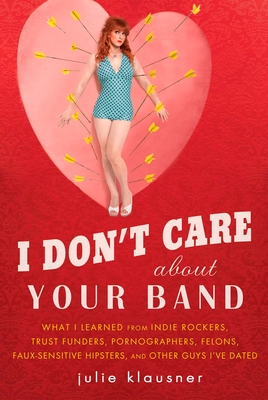
I Don't Care About Your Band

by DionysusPsyche

I Don't Care About Your Band: What I Learned From Indie Rockers, Trust Funders, Pornographers, Felons, Faux Sensitive Hipsters, and Other Guys I've Dated is pretty self-explanatory. Julie Klausner takes us on a ride through her life from her childhood dreams of stardom to her adulthood and dating history. While many women might disguise, cover up, and embellish how cool their attitude towards guys was from a young age, Klausner does not pretend to be shy, reticent, and a follower of “the boys have cooties” club. She wants to inform us almost as much as she wants to entertain us. Her sexuality, experiences, and emotional thought process are all for us to laugh and amuse ourselves with. Except for the occasional chagrin at her situations, our laughter is with her not at her.
Julie Klausner is a comedienne and writer for SNL's TV Funhouse and VH1's Best Week Ever. Purusing my local bookstore's comedy section, I knew nothing about her. For all I knew when I picked up her book, she could have been some bum on the street they dressed up for the picture. Upon glancing at the title, I laughed and said, “Yeah, I've felt that way about a guy before.”
It goes without saying, but I'll say it. This book will not teach you anything that will win you a spot on Jeopardy, unless the entire episode is dedicated to what you should or shouldn't learn from someone's love life. Since Rock 'n Roll Jeopardy is as close as it comes, if you're someone who reads books for information and educational purposes (and not merely to guffaw and delight in the schaudenfreud of someone else's love life), then it's probably not for you.
Klausner makes mistakes, and they don't get better as the story continues, they just get more interesting (until the end when Klausner seems to mentally sharpen to her experiences). Sitting through her childhood, I felt like if she threw out the earlier portions of story hour, I could enjoy the rest a little better. It didn't keep me from the full journey, but I wouldn't say it made me enjoy it more. It does make you wonder, based on her childhood and early reactions to boys, what will come of her teenage and college years. Did I say wonder? I meant dread.
It has become an annoying habit of all comediens to include an elementary or junior high “coming of age” chapter. The good news is that the previous chapter talks about Miss Piggy, and the chapter following the “coming of age” describes her gay best friend. Klausner also has an interesting way of writing about extremely personal situations with an almost out of body hilarity. Compared to some of the more outlandish, foul descriptions and language I've heard other comediens use, I was relieved by her wording and take. Reading something that intimate rarely made me shrink in horror but chuckle. She had more long distance online boyfriends than I cared to hear about, but it was fascinating to read about someone who kept meeting people over the internet despite the onesidedness she describes—probably in retrospect. At the beginning of each chapter, I consistently shook my head all the while smiling and said, sometimes aloud, “this can't be good!” I also could have added, and sometimes did, “in bed!”
Despite the clever phrase that a smart person learns from his mistakes and a genius learns from someone else's, this isn't always a lesson that is true for the world of dating. There is no greater proof than Klausner herself. At one point or another, everyone who is young doubts the wisdom of their elders or lacks information necessary that is withheld from one generation to the next concerning matters with the “birds and the bees.” I'm not talking Masters & Johnson's “How to” guide, I am speaking of more simple matters like, “If you have to get drunk to have sex with someone you find unattractive in mind, body, and spirit then you should refrain from drinking with this person, and never have intercourse with them.”
It took a while for Klausner's sense of humor to grow on me. She has some truly memorable lines and unique situations. When she starts describing her ex-boyfriends as “crazy,” “ugly,” or “judgemental” instead of rolling my eyes, I would widen them and get giddy and nervous all at once. At the beginning of it all, I found her annoying and chaotic, like a personality tornado. Fortunately, she becomes more collected and experienced as time goes on. Although I doubted her taste in men, when she called someone a very distinctive adjective, I grew excited for the chapter to unfold.
This book does show important life lessons, but Klausner does not always point them out as such. She makes mistakes that she learns from, and she makes mistakes that she most certainly doesn't learn from. She starts out picking boys like kids pick flowers—just grabbing the ones that are nearby and hoping they look nice in a vase. It is identifiable for those of us who are older and/or wiser. As the book progresses, her attempts at relationships, albeit often horrific and strange, are sought after with genuine desire to be loved and appreciated. To make things better, as her dates become less monstrous and more human, she actually becomes funnier.
While it is pitiful on more than one occasion, there is a certain relief that it didn't happen to you or it's worse than you at your worst. It is also comical to watch her fall into relationship after relationship all the while having a smidge of an idea of how to conduct herself and even less sense of how her counterpart should conduct himself. After Klausner walks away from the most damaging/destructive relationships she learns lessons about love and herself. She grows from her experiences, which is as rewarding for you as it is for her. The result is an enjoyable and amusing read.

By the end, Klausner become decidedly more mature and conscious of the little details in picking a mate which made the earlier more painful parts bearable. She holds no extreme feelings of anger or regret towards any of her exes, and that peaceful attitude was a much needed attribute of the book. More importantly, she learns to love and respect herself which is the message she passes on to the reader. Taking her past in stride and laughing about it at the same time. Her retelling of the past is not at all critical of others, so one can draw their own conclusions. Unlike books like “He's Just Not Into You” or “The Rules,” Klausner knows that everyone goes about love their own way at their own pace. It is what you make it. In conclusion, even though Julie Klausner's love life is messy, it's a fun mess.

Saturday, April 30, 2011

Confessions of a Superhero

Written by Joe the Revelator


In one of the strangest niches our society has created lies a sect of panhandlers who dress as their favorite superhero, stroll the Hollywood strip, and take pictures with tourists. Marilyn Monroe pretends to smooch with a pedestrian. Spiderman hops up on trash cans to shoot invisible web at people. And on the bad days, Elmo and Mr. Incredible get cuffed and jailed for getting pushy and breaking the rules.

They’re all waiting for their shot at the big screen. They have talent agents and coaches, they go out for casting calls. And when they’re not getting hassled by the cops for aggressive begging, they’re performing on the street, striking heroic poses.

Matt Ogen’s documentary follows four heroes who have seen better days. At a glance they look like Hulk, Batman, Superman, and Wonder Woman. But up close you can see where the spray-painted yellow bat symbol didn’t dry properly, or where Hulk’s mask is slit up the back, or how Superman’s narrow shoulders are slight under his cape. The costumes are all homemade and the actors wearing them are technically unemployed, working for ‘tips’, if the people flocking to them for a photo op are generous enough to pay out five bucks.


Look! Up in the sky! It’s a...

The camera doesn’t stay on the street though. It follows them and captures a slice of their life, their history and relationships. Ever wonder what kind of woman would date a man who wears a cape 16 hours a day? We’re given a good look at their homes, grit and all, and their secret identities might just make you cringe.

There’s something infinitely surreal about watching Batman, still hidden by his leather cowl, explaining to a psychologist that he has anger issues. He even pauses a moment to wipe away the tears which have collected under his mask. Or to listen to Superman lament about the worst day of his life, which surprisingly wasn’t during his battle with speed addiction, but the day Christopher Reeve died. In fact the only hero whose life is on an upswing is Hulk, who has improved his condition from homeless to living in a small apartment without furniture.

Superman, who seems to be the focus of the film, claims to want to star in movies. But this is contradicted somewhat by his odd leadership of the street performers and commitment to the lifestyle. He lectures the new Ghostrider about morals and takes steps to calm Batman’s outbursts toward the public. His apartment is cluttered and stacked with Superman memorabilia. He even makes a trek to Metropolis Indiana for the annual Christopher Reeve day, to compete in a superhero look-alike contest he doesn’t even place in. The other heroes openly admit Superman is the “crazy” one of the group, possibly believing himself to be the man of steel.


After the cape stops fluttering:

By the end of the documentary I couldn’t decide which emotion the director was trying to evoke; sympathy, pity, or humor. Maybe all of the above. I laughed like a madman watching Batman get put in the back of a squad car (which he subsequently kicked out the back window) for picking fights over a port-o-potty urinal. Wonder Woman’s history felt the saddest, the classic failed actress who packed her bags after high school and came to Hollywood on a dollar. And Hulk’s optimism was so natural and sedate it was infectious.

Would I recommend Confessions of a Superhero? When I see these people the only sure word that comes to mind is Byproduct, of stardom, of media, and of economy. Having said that, I would heartily recommend this documentary. And be prepared to feel weirded-out for the next few days.

Monday, April 18, 2011

Restrepo


Restrepo could easily be renamed Days in the Waging of the Afghanistan War. A documentary filmed by journalists for Vanity Fair (but distributed by National Geographic), it follows a platoon of soldiers tasked with holding and securing the Korengal Valley in Afghanistan.
.

Strategic Relevance

"Where the hell is Korengal Valley," you ask? Don't know. Its strategic importance isn't explained very well outside of, "We need to defend these people in this valley so that they will cooperate with us in opposing the Taliban." To this extent, it made me wonder as to the overall strategy of the Afghanistan war in general. While I'm sure that there is a strategy, the documentary does a fairly effective job of giving the impression that not even the soldiers know it; upon arrival in the valley they spend time wondering why they are even there. The valley itself is composed of extremely rugged terrain with loads of hills and mountains, making travel and movement very difficult. Despite this, through the documentary we see a year of the company's time in the area and their efforts to make the valley increasingly secure.

Restrepo focuses primarily on three events in the company's time in the valley, with entertaining interludes of watching the soldiers pass the time. These events are: arrival in the valley, creating a forward outpost named Restrepo after one of their fallen comrades, and the dangerous mission dubbed Operation Rock Avalanche. Of these, I found their time at Restrepo to be the most thought provoking with regard to how America is waging the war in Afghanistan.

Restrepo was an outpost built by the platoon on the top of a hill whose only purpose, according to the documentary, was to bring the enemy to the army to be taken down and also as a psychological hit to the Taliban, basically saying, "Hey, I took this rock from you and you can't take it back. Neener neener." This reminded me of the movie Lions for Lambs, within which this precise strategy is criticized for its inherent pointlessness. What is the point of building an arbitrary outpost just so you can get shot at within it? Aside from the psychological impact on the enemy, Restrepo did not convince me of the strategic wisdom of this move. To that point, this documentary was successful in making me curious as to how America is waging the war in Afghanistan and if our approach has changed for the better now.
.

The Human Factor

Another thing that makes Restrepo intense to watch is witnessing the lives of the soldiers within the company as they fight within the Korengal Valley, what was once regarded as "the deadliest place on earth". You see the leader of the platoon and his approach to keeping the company focused and together. You see the men and their reactions to what they are commanded to do. And, perhaps most potently of all, you see how this company of soldiers copes with the nasty situation they are in, how they entertain themselves and how they overcome the inevitable deaths of some of their closest friends.

You also get to see the company and the leader of the platoon deal with a number of the Afghans themselves. At a number of points throughout the documentary, the company goes door-to-door trying to gather information so that they can better defend the people within the valley as well as to try to winnow out those who might be secretly working for the Taliban. Of particular interest was the weekly meetings that the company holds with the village elders. My conclusion of this was that the army definitely needs some more diplomatic people inserted into the army units; the leader of the company is very blunt and often wince-inducing in how he treats and talks to the elders. It became very clear very fast that, if winning hearts and minds is the goal in Afghanistan, America needs to be sure that they are being polite to Afghanistan's local leaders while they are overcoming the understandable difficulties of working with them.
.

Conclusion

Restrepo may be one of the best documentaries I've ever seen. I did not feel that I was being force-fed an argument or point of view; instead I viewed objective events and was able to draw my own conclusion from them. One might argue that objective footage of anything isn't nearly as energizing as someone passionately defending one side of an issue, but I felt that this documentary was incredibly engrossing to watch while simultaneously not coming down for or against the war in Afghanistan. If I were forced to try and gauge what side the documentarists are on, I would wager they are against the war. But, coming out of it, I think that us being there and trying to help out is the right thing to do, we just need to make sure our strategies are workable and that we are kind to those who we want to work with. One thing is definitely clear, though, in that winning the war in Afghanistan will be a long haul. But I personally think that it is worth it.

Thus I highly recommend this documentary. One needn't worry about seeing people killed or anything like that; I thought that it was pretty tame with regard to injuries shown and all that. The big reason why is because the cameraman was trying not to get killed, and thank goodness for it. Consequently, this is a superb war documentary well worth watching that shows us a very close look at what exactly our troops have been up to in Afghanistan.

---

P.S. – On an unrelated note, happy 100th weblog post to me! Given that my posts tend to be around 1,000 words (usually more), I have now written over 100,000 words to this blog. For the record, that's the size of an average-length novel. Pretty impressive, if I do say so myself. :)

Wednesday, February 23, 2011

Letter to a Christian Nation


"In Letter to a Christian Nation, I have set out to demolish the intellectual and moral pretensions of Christianity in its most committed forms."

This early sentence in the short book by Sam Harris effectively summarizes both the argument that the author seeks to make along with the tone that that argument takes on. It is a book that features a very detailed logical argument against the morals and reasoning of religion (with a focus on Christianity in particular) based on reason, science, and historical basis.

Strengths in Argument

One thing that immediately becomes clear from reading this book is that the author's argument is approached in a manner designed to be as clear and as reasonable as possible so that anyone with the barest knowledge of religion can pick it up and devour it. It is also well researched and completely devoted to this goal; the author even uses a significant amount of text from the Bible itself in order to expose contradictions and hypocrisies. I have not read the Bible myself, but I still found myself able to keep up and understand through the author's very readable explanations and references.

Another strength, I found, was the author's analysis of current events and how the Christian reaction to these can often be inherently harmful and capable of impeding progress. Examples are many; the author touches upon points such as abortion, wars, stem-cell research, responses to natural disasters, and more. On top of that, the author delves deeply into history, seeking to illustrate how damaging religious belief has been to societies.

Most of this I already knew/agreed with, but I still found it immensely interesting to read about. There were some points that had not occurred to me, such as his rational argument for even 'religious moderates/liberals' causing danger to themselves and others. He makes the point that, "Religious moderation is the direct result of taking scripture less and less seriously," and expands upon that in a way that was revealing to me and, I felt, should have been obvious. One thing that I additionally found interesting was that, whenever I questioned the author's argument, there is an afterword at the end where he responds to common reader criticisms that ended up answering and addressing each of my own thoughts. This speaks to how powerful and detailed the logical argument is.

Failures in Vitriol

However, while this book was astonishingly effective in detailed logical argument, I would argue that it fails in maintaining a reasonable tone. Sometimes it feels as if the author goes out of his way to be offensive and, while this might sell you books, it also weakens the chance of being taken seriously. To that point, the book almost seems designed to scare off the very people it is trying to enlighten; the book is told as if talking directly to a Christian, but does so in a manner that would totally piss one off. For those who regard the Bible as holy writ, the author utterly demolishes and pokes fun at it in a way that would probably leave them outraged or crying on the floor. Of course, his arguments are totally rational and hard to argue with, but that doesn't mean he can't try to be civil about it.

Another example of vitriol comes near the end of the book where he unexpectedly goes off on Muslims. His impression of them comes off almost as near to hatred, which shocked me. Certainly, his thoughts on them are accurate when it comes to extremists, but I felt that he failed to acknowledge the great majority of Muslims who are quite peaceable who live in places other than sections of war-torn Middle East, places such as Indonesia, Southeast Asia, and North Africa. After spending the majority of the book giving fair, if slightly harsh, criticisms of the Christian faith, I was taken by surprise by what seemed to be a very narrow-minded view of Muslims. Thankfully, this is only a small portion of the book and not truly central to his main argument/thesis.

Conclusion

In the end, I would suggest that anyone who is either religious or curious about religion read this book. It is short at about 115 pages; I was able to finish it in an evening. While certainly biased towards atheism, the author provides an argument touching on many levels that prompts you to think about what you believe and assess it in a sensible manner. I would also be infinitely curious to hear what a religious person thinks of this book. I, myself, am agnostic, so I was already predisposed to agree and nod along with much of it. The interesting part would be hearing a religious friend read it and try to make a counterargument.

My only criticism is that I wish the author had approached his argument in a kinder manner. He can be nastily blunt sometimes and, as I mentioned earlier, I think that this lessens the likelihood of any Christian actually reading, much less finishing, the book. Also, his view on Muslims seems to be based on far less research than what he did for Christians; this is only excusable because it is only tangentially related to his argument. But this definitely should be kept in mind for any Muslims who choose to read it. Overall, good stuff that makes you think. Just go into it expecting it to challenge your beliefs/perceptions of Christianity.